BIZCHINA> Review & Analysis

|
BIZCHINA> Review & Analysis
|
|
Social security crucial to higher consumption
By Huang Jing (China Daily)
Updated: 2009-01-15 07:39 The unfolding global recession has already had a great impact on China, causing an economic downturn in recent months. What China's economy faces now is not just short-term difficulties but a fundamental challenge to its development model that originated from East Asia's economic success. Indeed, from the Japan-led "East Asian miracle" to Asia's rise driven by China's and India's rapid growth, virtually the whole of Asia (except the oil producers) has followed the same export-led development model in the last several decades, a model that has open and prosperous external markets on the one hand and steady inflows of foreign investments on the other as preconditions.
But China's effort to rescue this economic downturn has further exposed another problem: the structural imbalance of the Chinese economy, demonstrated by not only the heavy reliance on export-oriented manufacturing and processing industries, but also the excessive expansion of industrial capacity at the expense of consumption. Such a structural imbalance has made China's difficulties in the global recession more painful. Obviously, the Chinese leadership has keenly realized these challenges and is making a remarkable effort to overcome them. The stimulus plan to invest over $586 billion in the next few years is timely and decisive. But there is a risk that this plan could exacerbate, rather than improve, the situation. First of all, China's fast growth since the late 1990s has essentially been investment-driven, controlled by the government and fueled by the steady inflow of FDI, resulting in a long-existing "investment bubble". According to the National Statistics Bureau, the investment rate in China's GDP has kept increasing since the beginning of the century - from more than 38 percent in 2001 to nearly 50 percent in 2007 - despite the country's constant effort to cool it down. Given the looming crisis of industrial overcapacity, massive investment, especially in infrastructures, could sow the seed for future economic crisis if there's no good planning, careful coordination and effective execution of the stimulus plan.
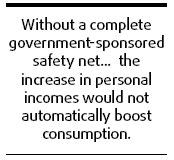
Moreover, the success of the massive investment to stimulate the economy will rely on good coordination between the central and local governments. In China, policymaking, and to a large extent policy implementation as well, has to be centralized in order to ensure policy effectiveness. But it is necessary to decentralize in order to promote economic development, especially in times of crisis, while maintaining a socialist market economy. Given the pressing situation and the unprecedented scale and complexity of the stimulus plan, it seems that the country has to bring localities' initiatives into full play in order to achieve the desired policy goals. As such, the government's capability and effectiveness of macro-management, fraud prevention, and policy coordination will all be put to test. But the massive stimulus plan is not just to keep the economy going amidst the global recession. Its essential aims are to develop a strong and balanced internal market (so as to amend the structurally unbalanced economy) and, more importantly, to maintain socio-political stability by creating jobs for millions of laborers who would be otherwise unemployed. In the long run, however, the remedies for China's economic problems are to increase the consumption level while developing a sufficient socio-economic welfare system. And the two aspects are essentially interrelated. Indeed, despite a steady increase in investment, China's consumption rate has kept falling in the last three decades, from around 55 percent of the total GDP in the 1980s to merely 35 percent last year. While this is certainly an unmistakable indication of an underdeveloped internal market, a more serious reason is the slow increase in personal incomes despite the fast economic growth. Yet it is highly arguable that there would be a rise in consumption should personal incomes increase. Compared with the extra-low consumption rate, the saving rate in China has remained high. This is not necessarily because the Chinese people are economically super-prudent, but because the insufficient socio-economic welfare system makes them feel insecure about healthcare, children's education, unexpected rainy days and eventual retirements. This problem is perhaps best demonstrated by the government spending on public goods. To this date, China is yet to develop national programs on healthcare, housing (subsidy) schemes, retirement, and social welfare. Amidst rapid expansion of the market economy, people's expenditure on life's necessities, especially on healthcare, education and housing, has increased dramatically. Without a complete government-sponsored safety net, it is but wishful thinking that an increase in personal incomes - if the stimulus plan achieves its desired goals - would automatically boost consumption. Given the government's recent decision on deficit spending to ensure the success of the stimulus plan, it is high time for the central government to address the long overdue problem of socio-economic welfare system in China. After all, when people have to count on their own savings as their safety net, consumption is more a luxury than a necessity. The author is a visiting senior research fellow, East Asian Institute, National University of Singapore (For more biz stories, please visit Industries)
|
|||||
主站蜘蛛池模板: 国产av区男人的天堂| 国产无码高清视频不卡| 一级毛片网| 中文字幕国产精品资源| 欧美成人午夜精品免费福利| 欧美精品va在线观看| 特黄特色三级在线观看| 大又大又粗又硬又爽少妇毛片| 日韩加勒比一本无码精品| 不卡一区二区三区视频播放 | 午夜男女爽爽影院在线| 四虎精品国产永久在线观看| 亚洲VA成无码人在线观看天堂| 亚洲午夜性猛春交XXXX| 国产精品人成视频免费999 | 国产成人精品久久一区二| 国产尤物精品自在拍视频首页| 久久精品国产亚洲av麻| 亚洲综合精品香蕉久久网| 92自拍偷拍精品视频| 国产69久久精品成人看| 色欲av久久一区二区三区久| 日韩中文字幕有码av| 狠狠色婷婷久久综合频道日韩| 亚洲天堂视频在线观看| 亚洲人成电影在线天堂色| 国产日韩一区二区在线看| 欧美国产成人精品二区芒果视频| 三人成全免费观看电视剧高清| 中文字幕精品1在线| 国产片一区二区三区视频| 99偷拍视频精品一区二区| 欧美亚洲一区二区三区在线| 男人又大又硬又粗视频| 国产精品久久久久久久久软件| 亚洲AV无码专区电影在线观看 | 亚洲精品天堂在线观看| 国产一区二区三区在线影院| 2021国产精品自产拍在线| 亚洲精品乱码久久久久久按摩高清| 亚洲 中文 欧美 日韩 在线|