BIZCHINA> Industries

|
BIZCHINA> Industries
|
|
Environment: Making money from trading emissions
By Sun Xiaohua (China Daily)
Updated: 2008-09-15 11:03 
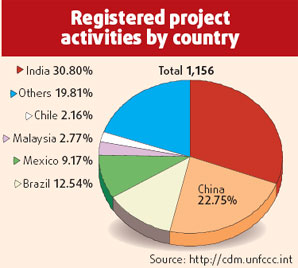
There's $30 billion floating in the air over China, but it won't be easy to grab it. It's China's carbon trading market. The world market for trading greenhouse gas emissions doubled last year to about $70 billion, according to World Bank figures. China accounts for 73 percent of the clean development mechanism (CDM) projects - a major carbon trading business. Until just a few years ago, the idea of making money from emissions trading would have sounded like madness to most businesspeople in China. But the CDM is changing all that. The deal between Myland Group, a chemical plant based in Jiangsu province, and the World Bank is one example. Every year during production, the plant emits HFC23, a strong, heat-trapping gas, equivalent to 8 million tons of CO2s. Before the manufacturer signed a contract with the World Bank to sell carbon credits, the chemicals group did not realize it was sitting on a goldmine. But the seven-year deal is expected to bring the group a windfall of more than 330 million euros at a price of 6 euros per ton of CO2s. China has 260 CDM projects registered with the UN, accounting for about 23 percent of the program's projects. The Chinese projects are expected to reduce about 114 million tons of CO2 emissions annually, accounting for more than 50 percent worldwide in terms of emissions reduction under the mechanism.
The Kyoto Protocol, an international treaty to limit greenhouse gas emissions and curb global warming, allows industrialized nations to meet limits on greenhouse gases by funding reduction projects in developing countries. These projects can earn saleable certified emission reduction (CER) credits, each equivalent to 1 ton of CO2s, which can be counted toward countries' Kyoto targets. Greenhouse gases - including CO2s, CH4s, N2Os, HFCs, PFCs and SF6s - have become intangible goods in international trade. The mechanism encourages sustainable development and emissions reduction, while giving industrialized countries flexibility in how they meet their emissions reduction or limitation targets. Take Japan for example. Under the Kyoto Protocol, Japan must cut its greenhouse gas emissions by 6 percent in 2010, based on the emissions level in 1990. "Japan needs to construct 20 standard nuclear power stations on its territory and to amend more than 100 laws and regulations in order to reach the target," Lu Xuedu, deputy director of the office of global environmental affairs at the Ministry of Science and Technology, says. "It's not easy for Japan. Participating in the CDM program is a cost-effective measure for the country to fulfill its international commitment." China is one of the world's biggest emitters, and CDM projects are bringing unexpected windfalls for most Chinese manufacturers. But local businesspeople are well aware of the challenges when it comes to the CDM. "As far as I know, many CDM developers are facing difficulties," Qin Chuan, who works at the Beijing office of a Norwegian consultancy, says. "It's not easy to carry out a CDM project and reap profits - obstacles can appear around every corner." Like many new consultancies, Qin's company plays a go-between role in the international business of carbon trading. It buys carbon credits in China and tries to sell them to rich countries that are bound to emission-reduction goals under the Kyoto Protocol. Most of the buyers are from EU countries and Japan. "I've been looking for a carbon credit seller for two years and I'm still searching," Qin says. "I'm in this position for many reasons." Big companies, like the top five power plants in China, have huge potential to reduce greenhouse gas emissions and are in a prime position to team up with international business partners. But Qin's company can't compete with global financial management and advisory giants like the World Bank or Merrill Lynch. Instead, Qin is shifting focus to smaller projects like wind and hydropower generation. He says local governments play a decisive role when it comes to choosing partners for small projects, and foreign companies are at a disadvantage in developing good relations with local governments. "But mine isn't the most frustrating story," Qin says. "I know some developers who have had to stop projects halfway through. They've watched as their early investment of hundreds of thousands of yuan for the necessary documents has evaporated into thin air, and they've lost the millions - or billions - of yuan they invested in infrastructure construction. Then there's the economic losses due to breach of contract." There are many reasons CDM projects are abandoned - some don't qualify for UN registration, some fail to produce the CER amounts, or simply the rules of the game change. (For more biz stories, please visit Industries)
|
主站蜘蛛池模板: 无码日韩做暖暖大全免费不卡| 日韩一区二区三在线观看| 一区二区三区午夜无码视频| 国模小黎自慰337p人体| 日韩一区二区三区高清视频| 亚洲国产成熟视频在线多多| 亚洲欧洲日产国码中文字幕| 一区二区三区精品偷拍| 久久久久久99av无码免费网站| 我国产码在线观看av哈哈哈网站 | 18禁极品一区二区三区| 嫩草伊人久久精品少妇av| 国产精品熟女一区二区三区| 久久av色欲av久久蜜桃网| 久久99久久99精品免观看| 黄色A级国产免费大片视频| 精品亚洲成av人在线观看 | 国产精品一区二区av片| 色成人亚洲| 午夜福利国产精品视频| 黑森林福利视频导航| 日韩人妻无码精品久久| 美日韩精品一区三区二区| 日韩精品一区二区亚洲专区| 色吊丝一区二区中文字幕| 邻居少妇张开腿让我爽了在线观看 | 日本午夜免费福利视频| 天天躁夜夜躁狠狠喷水| 欧美亚洲日本国产综合在线美利坚| 亚洲最大天堂无码精品区| 国产一卡2卡三卡4卡免费网站| 亚洲国产精品久久久久婷婷图片| 四虎成人高清永久免费看| 国产成年码AV片在线观看| 日本不卡一区二区三区| 国产麻豆剧果冻传媒一区| 色吊丝av中文字幕| 国产精品视频午夜福利| 日韩成人大屁股内射喷水 | 久久精品国产一区二区三| 中文字幕日韩人妻高清在线|