BIZCHINA> Newsmakers

|
BIZCHINA> Newsmakers
|
|
Related
Solar power looks into a brighter future
(China Daily)
Updated: 2008-06-03 14:39
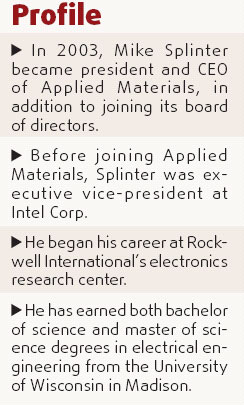
The world's largest maker of semiconductor production equipment, Applied Materials, is increasingly honing its focus on solar panels as semiconductor demand wanes. The company recently announced the largest deal to date in the industry, worth $1.9 billion, in which it would build the world's largest solar-panel manufacturing plant. After joining the firm five years ago, president and CEO Michael R. Splinter has pushed Applied Materials to become the semiconductor industry's No 1 firm for 17 consecutive years. Splinter discussed the company's growth strategy with China Daily reporter Zhang Qi. Q: What made Applied Materials decide to switch from focusing on semiconductors to solar power? A: Applied Materials has a long history of cooperation with China on challenging technological problems. We were the first company in our industry to establish operations in China back in 1984. Since then, we have been working together to support the growth of the semiconductor industry and the establishment of manufacturing capacity for flat panel displays. Our flat panel manufacturing systems have helped the industry decrease the cost of flat panel displays by 20 times over the last 10 years. This is what we must do with solar. We must lower the cost-per-watt of solar power to competitive levels and let market demand grow in proportion. At Applied Materials, this is the focus of our solar efforts, and I'm confident that, together with our customers and partners, we will make tremendous progress in establishing solar infrastructure. Q: What kind of technologies does Applied Materials use in sunfab thin-film manufacturing? A: There are different kinds of thin-film technologies. There is Cadmium telluride, which is primarily made by US company First Solar. Copper indium gallium selenide (CIGS) is not in production by anybody, but people are trying. The kind of thin-film technology that Applied Materials has is silicon glass and very thin layers of metal. With more than $1 billion invested every year in research and development, Applied Materials is a world leader in innovation. And technology we have introduced has already shown promise in boosting the efficiency of solar cells. Our technology will produce large 5.7-sq-m panels that are unique in the industry and significantly reduce the overall costs of solar power. These ultra-large substrates, sized at 2.2mX2.6m, are four times bigger than today's typical solar panels. These large panels are much cheaper to install and that's important, because today, half the cost of solar is in the installation of the panels, and we need to set a standard for panel size and installation, and get rid of the non-value-added costs. At the same time, we have launched a new approach to solar production that combines technology with high-productivity and large-scale manufacturing. Last month, we announced the largest contract in the history of Applied Materials for $1.9 billion to build a GW-scale solar panel factory - the largest in the world - and that will begin to change the economics of the industry. We believe that GW-scale plants and massive solar generation farms will help bring down the cost of solar dramatically and speed its adoption as an important renewable energy source. Q: Where does your confidence come from?
A: Confidence comes from your whole life experiences. But my confidence in solar technology comes from the great technology that Applied Materials has applied. We continue to be the leader in semiconductors and utilize our technology. If you (look at) our history, you can see we utilized the semiconductor technology to get into the flat panel technology, and we used our flat panel to get into the solar. So, these things are built on each other over a period of time. And we expect to continue to be able to do that, to bring our technology to new markets. Q: What are your expectations for your solar business in the Chinese market? A: Last year, the solar panel part was pretty much nothing. This year, it will be between 7 to 10 percent of our whole business (globally). We think the market for solar panels is very big, around $2.5 to $3 billion in business for us by 2010. I am quite excited about the renewable energy polices. If you do a single calculation, China has 700 GW in electrical storage capacity. The demand is increasing 10 percent a year, so by 2010, when 15 percent renewable energy (of the total energy supply) is required by China's 11th Five-Year Plan, there needs to be 100 GW. That's really a lot compared with what we have now. We are working with every major solar company in China. We have manufacturing, engineering and silicon product development for solar products in Xi'an, Shaanxi province. We just announced we are going to do a number of things for solar there. (For more biz stories, please visit Industries)
|
主站蜘蛛池模板: 成 人 色 网 站免费观看| 国产成人精品亚洲午夜| 夜夜偷天天爽夜夜爱| 曰本女人牲交全过程免费观看| 国产av剧情无码精品色午夜| 国产熟女一区二区三区蜜臀| 欧美成人精品手机在线| 午夜男女爽爽影院免费视频下载| 中文字幕久久精品人妻| 亚洲精品日本久久一区二区三区| 精品久久一线二线三线区| 亚洲熟女乱色一区二区三区| 国产中文字幕在线一区| 久久久一本精品99久久精品66直播 | 亚洲国产国语自产精品| 亚洲中文字幕在线无码一区二区| 国产熟女激情一区二区三区| 一本之道高清乱码少妇| 国产一区二区亚洲一区二区三区 | 丰满爆乳一区二区三区| 国产 浪潮av性色四虎| 色欲综合久久中文字幕网 | 纯肉高h啪动漫| chinese熟女老女人hd视频 | 日本高清熟妇老熟妇| 久久精品蜜芽亚洲国产av| 九九热在线观看视频精品| 少妇内射高潮福利炮| 精品久久久久久中文字幕2017| 国产成人精品亚洲午夜| 不卡国产一区二区三区| 无遮无挡爽爽免费视频| 亚洲人成电影网站色mp4| 极品教师在线观看免费完整版| av天堂精品久久久久| 日韩激情无码av一区二区| 国产精品亚洲二区在线看| 人人澡人人妻人人爽人人蜜桃| 日本中文字幕有码高清| 国产精品久久久久鬼色| 色噜噜亚洲男人的天堂|