BIZCHINA> Review & Analysis

|
BIZCHINA> Review & Analysis
|
|
Fitting China into your global footprint
(chinadaily.com.cn)
Updated: 2008-05-23 15:20 4. Factor in cost savings at the end To close the decision-making loop, you have to go back from competencies to products. After all, the decision to carry out a certain activity in China is not made at the level of competencies but for a tangible project, product or component. For example, you don't start developing a precision machining competency unless there is a product you plan to manufacture which requires that competency. Therefore, assess the "China fit" not only of competencies but also of products. You can do so by linking the products with the competencies embedded in them, i.e. these that are needed to develop and manufacture the product (one way to assess the dependency of a given product on a competency is to estimate the impact of the competency on the cost of the product). In other words, a product with a high "China fit" is one that makes use mainly of competencies with a high "China fit", i.e. for which China offers a strong competitive advantage and that are securely available within China. The overall "China fit" of a product is the weighted average of the "China fit" of its embedded competencies (see Exhibit 4). Exhibit 4: Example of the "China fit" of a product and its embedded competencies
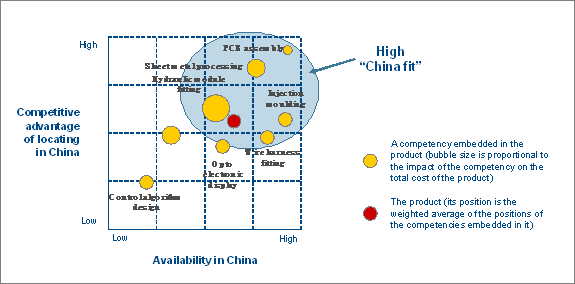 Finally, factor in the cost dimension. When comparing the "China fit" of different (future) products, product alternatives or R&D projects, compare the fit of each investment proposal with its cost savings potential. Transfer to China the proposals that come out best. Insights for the executive The "China fit" logic described above leads to a well-founded, powerful and easy-to-communicate overview of the products that could be developed and manufactured in China, and those that are better kept out. It also allows efficient comparison between alternative investment proposals. Once you have the overview, you are well equipped to focus further evaluation efforts on the alternatives that really make good sense in China. You avoid time-intensive and costly evaluation of alternatives with low potential. By linking products to the competencies embedded in them, you can define what competencies you have to develop, maintain or divest in China. From this you can easily derive your China growth strategy and the corresponding investment plan in both R&D and manufacturing. Deciding to transfer a product to China is no longer just a short-term offshoring decision, but a long-term investment in a sustainable competitive advantage. You can use the same approach for any other emerging market. The results are invaluable for the design of your global R&D and manufacturing footprint. Gert Bijnens is a Consultant in Arthur D. Little's Shanghai office, and a member of the Automotive and Manufacturing Practice. He focuses on growth strategy, innovation management and R&D in emerging markets. E-mail: bijnens.gert@adlittle.com Congjian Wu is a Manager in Arthur D. Little's Beijing office, and a member of the Automotive and Manufacturing Practice. He focuses on innovation and operations management. E-mail: wu.congjian@adlittle.com Nick Toone is a Senior Manager in Arthur D. Little's London office, and a member of the Automotive and Manufacturing Practice. He focuses on strategy and innovation in the manufacturing industry. E-mail: toone.nick@adlittle.com (For more biz stories, please visit Industries)
|
主站蜘蛛池模板: 日韩av无码免费播放| 三级黄色片一区二区三区| 中文在线8资源库| 我被公睡做舒服爽中文字幕| 亚洲国产韩国欧美在线| 蜜臀在线播放一区在线播放| 乱女乱妇熟女熟妇综合网| 亚洲国产精品黄在线观看| 国产成人精品中文字幕| 成人精品天堂一区二区三区| 欧美成人精品高清在线播放| 午夜成人亚洲理伦片在线观看| 久久无码中文字幕免费影院| 少妇高潮喷水惨叫久久久久电影 | 免费无码肉片在线观看| 亚洲中文字幕在线无码一区二区| 中日韩黄色基地一二三区| 午夜福利一区二区在线看| av在线播放国产一区| 亚洲国产精品乱码一区二区| 成人国产精品免费网站| 综合自拍亚洲综合图区欧美| 四虎精品国产AV二区| 亚洲gv天堂无码男同在线观看| 国产一区国产二区在线视频| 国产午夜福利视频合集| 1769国内精品视频在线播放| 亚洲熟妇自偷自拍另类| 69精品丰满人妻无码视频a片| 五月婷之久久综合丝袜美腿| 精品无码国产污污污免费| 亚洲欧美中文日韩V日本| AV最新高清无码专区| 亚洲欧美日韩综合二区三区| 视频日本一区二区三区| 五月婷婷久久中文字幕| 国产精品中文字幕观看| 俺来也俺去啦最新在线| 国产午夜视频免费观看| 国产精品98视频全部国产| 成人亚洲精品一区二区三区|
