Warming-connected extinction may 'about to happen'
Updated: 2007-10-24 17:01
WASHINGTON - Whenever the world's tropical seas warm several degrees, Earth has experienced mass extinctions over millions of years, according to a first-of-its-kind statistical study of fossil records.
And scientists fear it may be about to happen again — but in a matter of several decades, not tens of millions of years.
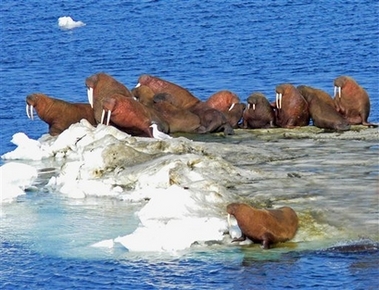 This May 18, 2006 file photo provided by the US Fish and Wildlife Service, shows walrus on an ice flow in the northern Bering Sea off of Alaska. The Arctic is under increasing stress from warming temperatures as shrubs colonize the tundra, changing wildlife habitat and local climate conditions, researchers said Wednesday Oct. 17, 2007. [Agencies] |
Four of the five major extinctions over 520 million years of Earth history have been linked to warmer tropical seas, something that indicates a warmer world overall, according to the new study published Wednesday.
"We found that over the fossil record as a whole, the higher the temperatures have been, the higher the extinctions have been," said University of York ecologist Peter Mayhew, the co-author of the peer-reviewed research published in the Proceedings of the Royal Society B, a British journal.
Earth is on track to hit that same level of extinction-connected warming in about 100 years, unless greenhouse gas emissions are curbed, according to top scientists.
A second study, to be presented at a scientific convention Sunday, links high carbon dioxide levels, the chief man-made gas responsible for global warming, to past extinctions.
In the British study, Mayhew and his colleagues looked at temperatures in 10 million-year chunks because fossil records aren't that precise in time measurements. They then compared those to the number of species, the number of species families, and overall biodiversity. They found more biodiversity with lower temperatures and more species dying with higher temperatures.
The researchers examined tropical sea temperatures — the only ones that can be determined from fossil records and go back hundreds of millions of years. They indicate a natural 60 million-year climate cycle that moves from a warmer "greenhouse" to a cooler "icehouse." The Earth is warming from its current colder period.
Every time the tropical sea temperatures were about 7 degrees warmer than they are now and stayed that way for millions of enough years, there was a die-off. How fast extinctions happen varies in length.
The study linked mass extinctions with higher temperatures, but did not try to establish a cause-and-effect. For example, the most recent mass extinction, the one 65 million years ago that included the die-off of dinosaurs, probably was caused by an asteroid collision as scientists theorize and Mayhew agrees.


|
|