New light on old money


|
More than 500 coins from olden-day China and about 100 statues from places along the ancient Silk Road are displayed at a Beijing museum. Photos Provided To China Daily |

Empires along the ancient Silk Road may have faded into obscurity over time, but a coin exhibition shows how trade thrived on the legendary Eurasian route. Wang Kaihao reports.
The exhibits are small and eroded, not only by sand, but by time. As the ancient empires along the Silk Road faded into obscurity, these surviving coins are remaining witnesses of the booming communication on that legendary Eurasian trade route.
The event, Coins Have Two Sides, West and East: Exhibition of Currencies on Ancient Silk Road was launched on Thursday at Network of International Cultural Exchange Gallery, which is affiliated to the Ministry of Culture.
At the show, more than 500 coins from ancient China and about 100 ancient statues from places along the land and sea routes, respectively, are displayed.
The exhibits range from copper coins with square holes from the Han Dynasty (206 BC-AD220) to gold coins from the Byzantine Empire besides items from today's Iran, Afghanistan, Syria and India.
The exhibition hall is like a microcosm of economic history in the ancient world.
The coins are on loan from Jin Jiadong, 67, who is based in Nanchang, capital of Jiangxi province.
Jin, who has been collecting coins for at least the past 30 years, owns more 10,000 items, which are displayed at a private museum in Nanchang.
"Some coins lack high economic value but contain very important historical information," says Jin.
"When you set out to systematically look for certain types of coins, you find many voids in your collection. That encouraged me to communicate more with overseas collectors," he says.
According to him, more than 200 exhibits are from ancient China's central kingdoms, and about 60 are from Xiyu (the western regions), a term used to describe the numerous regimes, which existed from the third century BC to the eighth century AD in today's Xinjiang Uygur autonomous region, and Central Asia.
Two coins, which were found in Hotan, Xinjiang, called "Hotan horse money", are his favorites and among the exhibits. They are from between the first and third century AD, and Jin says there are only about 200 such coins in existence.
"These coins are a good example of communication between East and West," he says.
On one side of the coin, there is an image of a sacred horse, which is rooted in Bactrian culture (from Afghanistan), plus a Kharosthi script (a distinct language once used in Pakistan and Afghanistan) and it was made using a Greek molding method.
On the other side of the coin, there are Chinese characters, and the weight of the copper coin is defined by zhu, a measurement unit from the Han Dynasty.
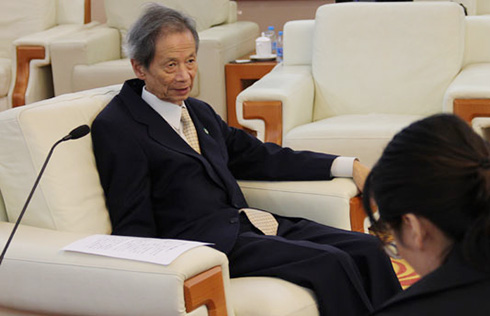
Pei Manyi, curator of the exhibition, says: "We often find three or four languages on one coin. This proves that the currency was used by several countries."
Pei adds that the coins also provide crucial evidence when studying myths, religions, craftsmanship and linguistics along the ancient Silk Road.
The exhibition is a part of a series of displays on the Silk Road at the gallery.
In March, an exhibition on the Mogao Caves, a crossroads on the Silk Road in Dunhuang, Gansu province, was staged there, at the start of its tour around the world.
The coin event is also scheduled to be taken to countries along the Silk Road, as part of China's Belt and Road Initiative.
He Ruzhen, who launched the program, says: "In ancient times, Chinese people used porcelain and tea to trade in goods along the Silk Road before using money. Today, we'd like to use these cultural linkages to stir emotional resonance among people in countries along the Belt and Road. More cultural exhibitions will help."
Contact the writer at wangkaihao@chinadaily.com.cn
If you go
Coins Have Two Sides, West and East: Exhibition of Currencies on Ancient Silk Road
10 am to 5 pm, through May 21, Mondays closed. Network of International Cultural Exchange Gallery, 83 Beiheyan Dajie (Avenue), Dongcheng district, Beijing.