Self-disciplined, hardworking, and curious about learning new skills — these are the words most often used to describe Eddie Peng, one of the most sought-after stars in the Chinese film industry.
Just before the interview with China Daily, Peng offered a quiet demonstration of that very curiosity.
Noticing my colleague's pocket-size camera mounted on a lightweight tripod, he leaned in and asked, "What kind of camera is this?"
Had the interview not been strictly limited to 20 minutes, the conversation could easily have drifted into a discussion of cinematographic technology.
With his naturally inquisitive temperament, it becomes easier to understand why Peng — best known for heroic roles in action-packed blockbusters — chose to join Busted Water Pipes, a lighthearted and hilarious comedy.
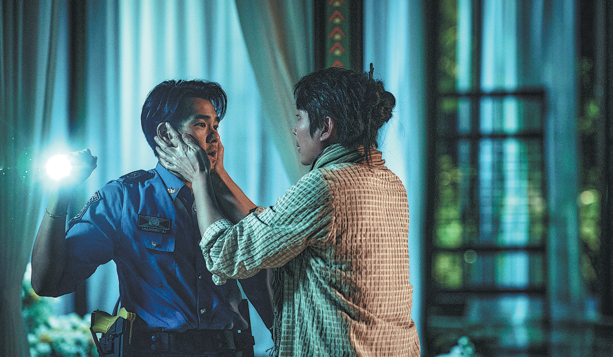
Many of Peng's most popular roles have been defined by bravery and determination, from an ambitious cyclist in the sports drama To the Fore (2015), to a courageous undercover police officer in Operation Mekong (2016), and a fearless rescue chief in the disaster blockbuster The Rescue (2020).
In his latest film, the A-list actor takes a sharp turn in a new direction, portraying an unconventional police officer named Yu Dahai, while picking up two entirely new skills: caring for a young child and digging an underground tunnel.
Set in an unnamed Southeast Asian country, the film begins with Yu and his fellow officers mistakenly raiding an elderly couple's apartment due to faulty intelligence. Forced to take the blame for his superior and placate public anger, Yu is demoted and transferred from the capital to a small town called Hoping.
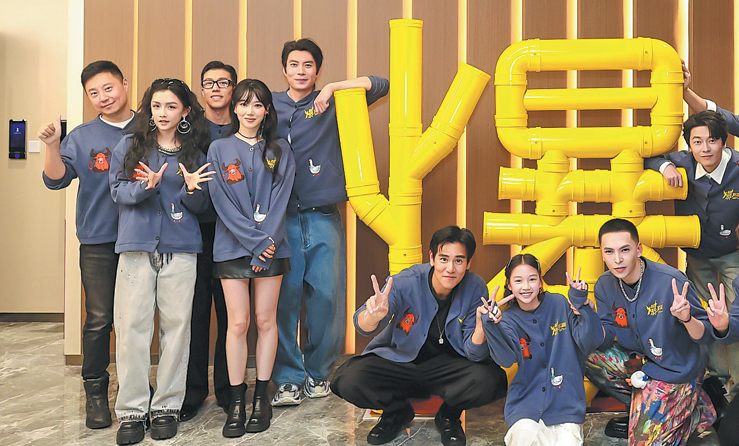
Thanks to the protagonist's diligent spirit, he manages to maintain a zero-crime record in the town for seven years. Ironically, this leads the authorities to decide to shut down the local police station and lay off all four officers, including Yu. In a desperate bid to save their jobs, Yu and his team hatch a reckless plan to stage an arson in a disused warehouse.
But an astonishing twist follows: a group of tomb raiders also targets the same warehouse for storing explosives, which triggers a massive blast. Even more incredibly, the police station itself is revealed to be the very location the criminals have been searching for over the years. Buried beneath it lies the missing treasure of a pirate once thought to exist only in legend. As the situation unfolds, a team of fully armed gangsters — investigating the disappearance of a man linked to one of the tomb raiders — converges on the scene, leading to a chaotic showdown in the underground labyrinth.
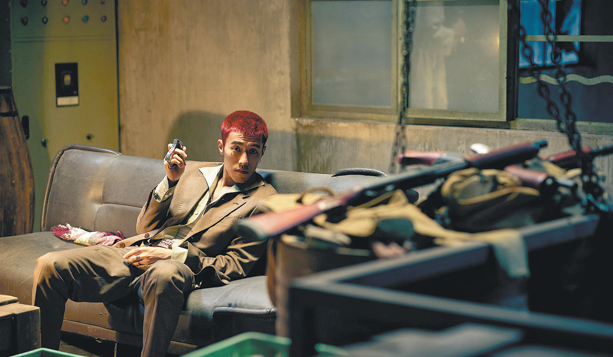
"I was drawn to the character as soon as the director shared the concept," Peng recalls, adding that he learned of the project through a friend and quickly decided to join in late 2023.
Through rounds of discussions on key plot points and dialogue, the image of his character, Yu, as an "overachiever" gradually took shape. Peng hopes audiences will connect with the role, explaining that Yu "represents a state of being very familiar to all of us — you work tirelessly, yet the outcome may be entirely different from what you imagined".
In Peng's view, while the film is cloaked in comedy, its core touches on a collective anxiety within Asian culture.
"From childhood, we are taught to work hard, to strive for first place — as if, with enough effort, we can get into a top school and land a good job. But once we enter society, we realize the world doesn't work that way," he says, pausing.
"The system tells you to keep learning, to keep improving yourself, and then one day, it might suddenly decide: 'You don't need to be that good anymore — you can step back'. It's that kind of confusion — I hope audiences see their own reflection in the film," explains Peng.

The film was shot in Xishuangbanna Dai autonomous prefecture, Southwest China's Yunnan province, where the tropical climate and lush vegetation provided the perfect setting for the Southeast Asia-based story.
To maintain a sense of authenticity within the absurd comedic narrative, the crew invented a written language, visible everywhere from storefront signs to official paperwork. Additionally, they enlisted a Malaysian consultant to help some actors deliver their lines in Chinese with a Southeast Asian accent.
More interestingly, as any filmmaker knows, children and animals are often the most challenging to work with on set. Peng's character is a single father raising a young daughter, played by two child actors at different ages, and he found himself struggling to act alongside the younger girl in the role, who often cried and tried to leave the set.
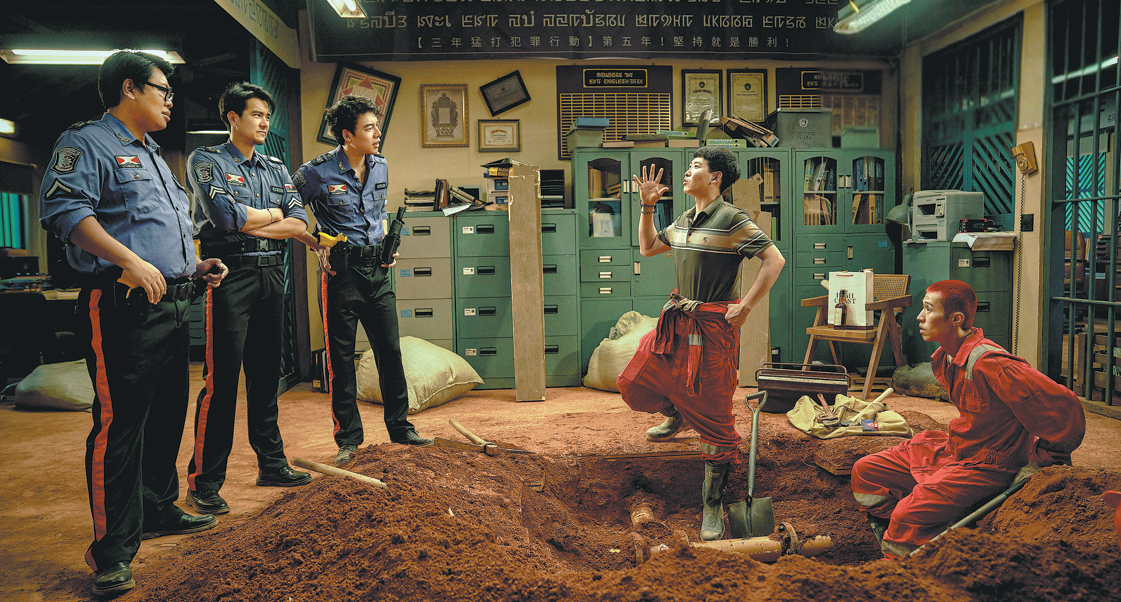
Working with animals proved to be equally memorable. In the film, one of the major characters — a fugitive played by actor Ai Lun who disguises himself as a spiritual mentor — keeps a pet goose. Peng recalls that he had an impressive experience spending time with the bird, adding that he believes most animals possess a kind of "spirituality".
For director Zhou Difei, a United Kingdom–educated filmmaker who previously worked on the blockbusters Crazy Alien and The Wandering Earth 2, this film marks his tribute to cinema's golden era. The movie is structured in four chapters, each lasting 20 to 30 minutes — a duration corresponding to the length of a traditional film reel.
Since its domestic release last Friday, the film has gained popularity online, evidenced by its related content amassing over 100 million views on Sina Weibo, 850 million clicks on Douyin, and 50 million views on Xiaohongshu (Red-Note) — all major social media platforms in China.
Contact the writer at xufan@chinadaily.com.cn