LA port chief highlights US-China supply chain and green shipping ties







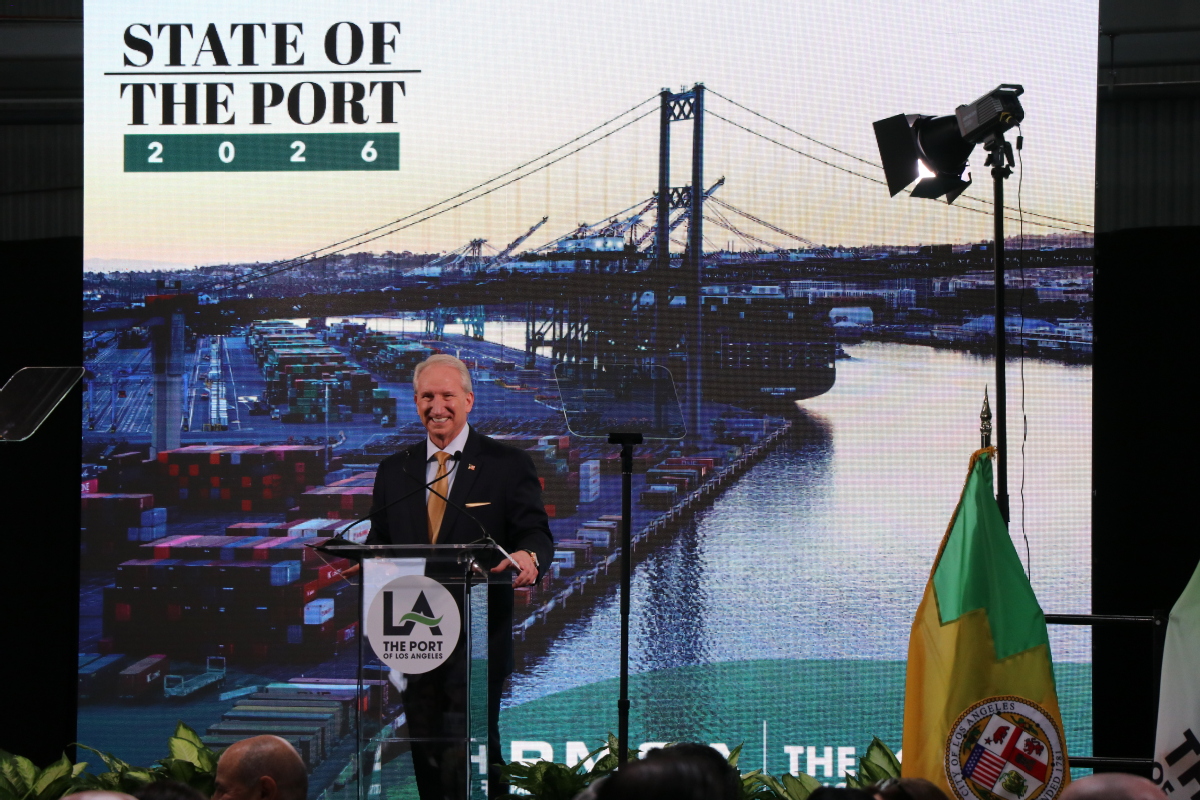
The Port of Los Angeles is accelerating its push for greener shipping, smarter infrastructure and closer cooperation with China as the busiest port in the United States prepares for another year of rising cargo demand, according to Executive Director Gene Seroka.
"China still represents approximately 40 percent of our business, more than two and a half times our next largest trading partner," Seroka told China Daily. "There is no faster way to get cargo from China to the US than through LA. These partnerships have run deep for many decades, and we intend to continue them."
He added that he traveled to China "three or four times last year" to reinforce ties with government agencies, State-owned enterprises and private companies, stressing that stable, efficient cargo movement is vital for both economies.
"American farmers, manufacturers, retailers and consumers all depend on how well we move that cargo," Seroka said on Thursday before about 900 industry and community representatives gathered at the port as he laid out an ambitious strategy centered on "Building Bigger and Building Smarter," combining infrastructure expansion, digital innovation and environmental leadership with renewed efforts to strengthen global partnerships, especially along the trans-Pacific trade routes that connect California with China.
The port handled 10.2 million TEUs in 2025, its third-highest annual volume on record. It has been ranked the No. 1 container port in the US for 26 consecutive years, and in 2024 it facilitated $333 billion in trade, underscoring its central role in the US-Asia supply chain.
"Cargo remains the lifeblood of the US economy," Seroka said.
He highlighted major progress in the Los Angeles-Long Beach-Shanghai Green Shipping Corridor, one of the world's most closely watched cross-Pacific decarbonization partnerships. The initiative, launched in 2022, aims to deploy low- and zero-carbon shipping technologies and establish reliable clean-fuel infrastructure between the world's two busiest port regions.
He announced that the corridor has successfully completed all Phase 1 objectives, which included expanding the use of shoreside electricity for berthed vessels, advancing the introduction of cleaner vessel technologies on the trans-Pacific route and laying the groundwork for future bunkering of lower-carbon marine fuels. These achievements, Seroka noted, reflect the strong daily coordination between the Port of Los Angeles, the Port of Long Beach, the Shanghai Municipal Transportation Commission and the Shanghai International Port Group.
"Our partners in Shanghai have been wonderful to work with every day," Seroka told China Daily. "The Shanghai-Long Beach-Los Angeles green shipping corridor is gaining momentum, and our partnership will only get stronger."
The LA-Long Beach-Shanghai corridor links the world's busiest container port (Shanghai) with North America's busiest port complex, covering a trade lane responsible for more than $300 billion in two-way goods movement annually, according to US Census Bureau trade data.
Looking ahead, Seroka highlighted several transformative projects under the port's "Build Bigger" strategy, including a proposed Pier 500 Marine Terminal designed for next-generation, zero-emission operations. He emphasized that environmental progress remains central to the port's mission, noting that Los Angeles now posts the lowest emissions per TEU of any major port worldwide.
Local officials reiterated the importance of stable US-China economic ties for California's logistics and manufacturing sectors.
"As the local council person for the city of Los Angeles working with the Port of Los Angeles, I'm gratified that we know how to move goods," LA City Councilmember Tim McOsker told China Daily. "Regardless of what happens on the national or international stage, I hope we can continue working cooperatively to move goods quickly, safely and efficiently."
Los Angeles Mayor Karen Bass also praised the role of the port in keeping supply chains steady during a period of economic uncertainty.
Industry and transportation data show that the San Pedro Bay port complex — home to the ports of Los Angeles and Long Beach — handles about 40 percent of all US containerized imports, making it the nation's primary gateway for trans-Pacific trade. Much of this cargo originates from major Chinese ports such as Shanghai, Ningbo-Zhoushan and Yantian, which rank among the world's busiest export hubs and serve as key load points for trans-Pacific shipping services.
As global supply chains evolve and companies diversify their sourcing strategies, analysts say cooperation between the US and China in areas such as decarbonization, digital logistics systems and green shipping corridors will grow increasingly critical to maintaining efficiency and resilience across the Pacific.
"Our work is far from finished," Seroka added. "But with the partnerships we've built — locally and globally — we're ready for the opportunities of tomorrow."