


Gold and silver trace the pulse of Chinese civilization







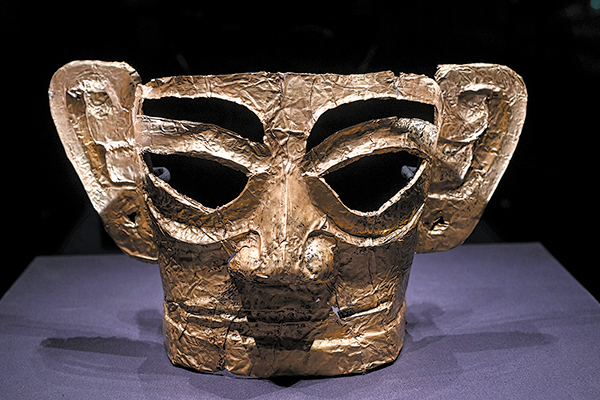
The originality of Chinese civilization was not confined to its central regions, as evidenced by a golden mask excavated at the Sanxingdui Ruins in Southwest China's Sichuan province in 2021.
Dating back more than 3,000 years, the mask is crafted from 85 percent gold and weighs 97 grams. Though found crumpled into a compact mass, the artifact revealed its full form following meticulous conservation.
The mask's exaggerated facial features, elongated eyes and sharply contoured features are hallmarks of Sanxingdui's visual culture. Scholars who led the excavation believe such gold masks were originally placed over bronze sculptures of human heads or attached to separate bronze masks, serving as important ritual objects symbolizing supreme authority.
A silver hook from the horse and chariot pit of Qinshihuang's Mausoleum stands as a testament to the grand efforts of China's first emperor to create a unified empire. Curved in a semicircular shape and decorated with cicada patterns in shallow relief, the hook is a component of the bronze chariot's yoke.
According to Zhou Ping, deputy director of Emperor Qinshihuang's Mausoleum Site Museum, this artifact symbolizes unity, reflecting the "unification of standards" that Emperor Qinshihuang implemented after unifying China. A key reform involved the standardization of roads and vehicles.
Inclusivity — the ability to absorb and engage with cultures beyond its own borders — is vividly reflected in a gold ornament depicting a figure with exotic features.
Excavated from a noble's tomb at the capital site of Yan, one of the seven major powers during the Warring States Period (475-221 BC), the figure wears a felt cap and has arched eyebrows, a high nose, and two short mustaches curling upward — characteristics commonly associated with people from the Eurasian steppe.
"The recovery of dozens of gold ornaments with strong Eurasian-steppe stylistic features presents a striking picture of close interaction between Yan-state elites and northern nomadic groups. These finds offer tangible evidence of China's openness to the wider world long before the modern era," says Dong Yafei, who directs the preservation of cultural relics at the Yan site in North China's Hebei province.
Peaceful exchange underpins a lobed silver box from the Western Han Dynasty (206 BC-24 AD). The box, which was discovered in East China's Anhui province, comprises a silver body that exhibits distinctive ancient Persian stylistic features, as well as an iron ring foot that was later added to its base. Similar silver boxes have also been discovered in other regions in the country.
Zeng Lei, director of the Qingzhou Museum in East China's Shandong province, says the body of the silver box likely reached China via the Maritime Silk Road, before being adapted by Chinese craftsmen. Such objects serve as proof that cultural dialogue between Eastern and Western civilizations was achieved through peaceful exchange.
In recent days, Liu and his peers have been busy cataloging and retrieving these cultural artifacts to return them to their homes across the country. Looking back on the exhibition, which took a year and a half to plan, Liu says that he feels proud as he and his colleagues had offered the public a meaningful encounter with history and civilization.
"In doing so, the exhibition illustrated the defining features of the Chinese civilization, one that is ancient yet innovative, diverse yet integrated, and sustained by a longstanding pursuit of harmony," he says.