
4,500-year-old 'yangmei' tree branches found in Ningbo
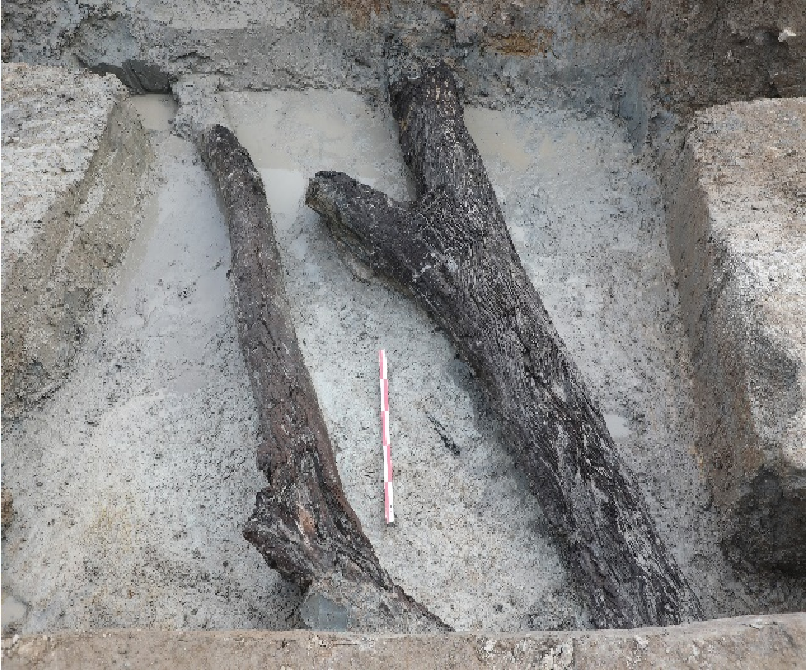
The two branches that were found at the Shi'ao site in Zhejiang. [Photo provided to China Daily]
It only makes an appearance for a brief few weeks in the early summer of humid southern China. So those who miss that small window must wait another year before they can taste the deliciously refreshing, sweet, and tart Chinese bayberry, or yangmei, as the fruit is known locally.
Recent archaeological discoveries have revealed that the thirst-quenching fruit was popular among the ancient people of China as well, in fact, for much longer than initially believed. So, how long have Chinese bayberries been a sweet choice for the people?
Pieces of Chinese bayberries have been unearthed from the tombs of high-ranking people who lived during the Second Century BC in Hunan and Guangdong provinces, proving that bayberries were part of people's diet during the Western Han Dynasty (206 BC-AD 24).
Archaeologists now believe that the fruit has been around for much longer.
As over half of the fruit produced in China comes from Zhejiang province, recent discoveries at the Shi'ao site in Yuyao, a city in the province, prove why it is known as the "hometown of yangmei".
Using a series of high-tech methods, researchers from the Chinese Academy of Social Sciences and the Zhejiang Provincial Institute of Cultural Relics and Archaeology confirmed that two branches unearthed at the site were from a Chinese bayberry (academically known as Myrica rubra) tree and were about 4,500 years old.
"This makes them the earliest known and most definitely identified tree remains of their kind to date," Wang Shuzhi, a researcher at the CASS' Institute of Archaeology, announced at a conference of the academy in Beijing on Wednesday.
The two branches, measuring 2 and 2.2 meters in length, respectively, were found on the southwest side of the Shi'ao site. Carbon dating of samples taken from the wood and studies of the tree rings showed that they were from 2520 BC, the time when the Liangzhu culture flourished.
The Liangzhu culture — from about 5,300 to 4,300 years ago — was a crucial rice-cultivating and jade-worshipping civilization in the Yangtze River Delta. The Archaeological Ruins of Liangzhu City in Hangzhou, the provincial capital of Zhejiang, was inscribed on the UNESCO World Heritage List in 2019. The culture is seen as a key indicator of the origins of Chinese civilization.
To prove that the unearthed pair of branches from the Shi'ao site were indeed yangmei ancestors, even after anatomical analysis of the excavated wood had revealed that it belonged to the bayberry family, researchers used other methods such as gas chromatography and mass spectrometry and found that the ancient tree remains were "almost identical" to living Chinese bayberry trees in the region: Out of the total of 13 major chemical compounds discovered in the ancient wood, 12 can be found in today's living trees as well.
"This research is thus a breakthrough in using a scientific approach to solve archaeological puzzles," said Wang, the researcher.
She added that the chemical changes caused by artificial cultivation provide important reminders about the need for conserving biodiversity.
The Shi'ao site previously yielded other surprises for researchers. In 2020, remnants of paddy fields spread over 8,000 square meters were discovered. Dating back 4,500 to 6,700 years, the remnants are still the earliest-known evidence of rice-cultivating paddies.
"Yangmei trees and ancient rice paddies suggest a wetland ecological landscape, which shows how the indigenous people of the region during the Liangzhu culture period engaged in a diversified economic system," said Zhao Zhijun, an archaeology professor at Shandong University. "This provides key references for a comprehensive understanding of the food composition and economic activities of the ancient people," he added.