


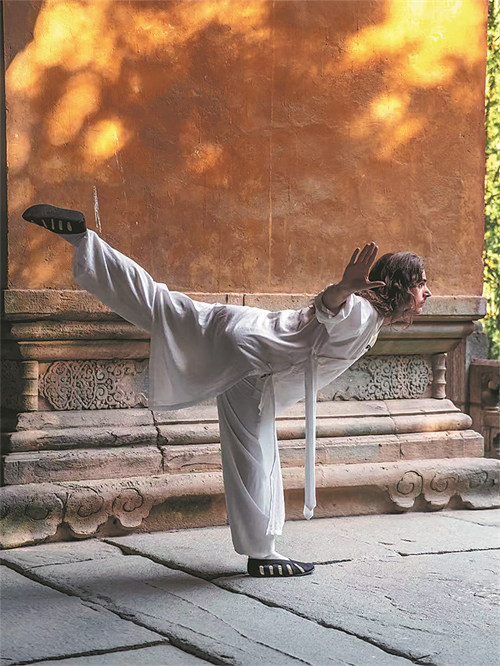
"You have to imagine your feet are rooted in the ground like a tree," said Thomas Vriens, a 24-year-old Dutch musician studying Taoist culture on Wudang Mountain in Shiyan, Hubei province.
"You draw the energy, or qi, from the earth up through your legs and guide it to the dantian, the energy center in your lower abdomen," he continued. "As it begins to circulate, you feel warmth in your palms. That's when you know your meridians are opening."
The exercise Vriens described is zhanzhuang, or standing meditation — a foundational qigong practice that emphasizes breath, stillness, and awareness. For Vriens, one of the youngest Western students of Taoism in Wudang, it has become a daily ritual.
"At the beginning, it's simply about learning to stand still, which is difficult for many people," he said. "At first, your knees hurt because in everyday life you rarely keep them slightly bent. But once you get past the soreness, it becomes about the mind — understanding your thoughts and learning to control them."
Vriens' path to Wudang began far from silence, sparked instead by a teenage passion for heavy metal.
"I started playing guitar when I was 13 or 14," he recalled. "I was into more extreme music at first, but through that scene I met people who were interested in spirituality and philosophy. That's when I started asking those questions too."
He said Western religions, such as Christianity, never quite resonated with him. "The Bible tells you very clearly what's right and what's wrong, and that doesn't speak to me as much," he explained. He was looking for something more open-ended — something that encouraged reflection rather than handing down fixed answers.
The turning point came when a teacher he admired gave him a copy of the Tao Te Ching, one of the central texts of Taoist philosophy. "I had no idea what Taoism was," he said. "But the moment I opened it, I felt different."
His curiosity soon extended beyond books, leading him to search online for traditional instruments tied to Taoist culture, including the dongxiao flute and the guqin zither.
In 2023, that quest ultimately led him to Wudang, the spiritual home of Taoism. He returned in 2025, and with each visit, he gained a deeper understanding of both Taoism and tai chi.
According to Vriens, life in Wudang follows a disciplined but meaningful rhythm. "Mornings begin with qigong practice and a silent breakfast that encourages mindfulness," he said. "Afternoons are devoted to reading Taoist texts like the Tao Te Ching and Zhuangzi, while evenings focus on practicing tai chi."
Although tai chi may look effortless, Vriens quickly discovered how demanding it is. "You need coordination, balance, flexibility — everything must come together. And when it does, it becomes something beautiful," he said.
As students grew more familiar with the rules and movements, they also began to grasp the deeper layers of Taoist philosophy. At the core of tai chi is the Taoist principle of shouzhong, or keeping the center. In yunshou (literally "cloud hands"), for example, practitioners are taught to move naturally without raising too high or sinking too low, always initiating from the waist.
"Before every session, we stood still with our feet together and eyes closed, just breathing for a moment,"Vriens said. "It was a way to reconnect with wuji — the emptiness that comes before yin and yang take shape. From that silence, movement begins, and at the end we always return to stillness."
"You move freely, follow the natural order of things, and keep balance — it's a philosophy for martial arts, but also for life," he added.
That perspective has also shaped his music. Much of his songwriting now draws on Taoist imagery and ideas."After learning about Taoism, I stopped comparing myself with others," he said. "Everyone has their own sound, their own dao. I'm finding mine."
As he prepares to return to the Netherlands, Vriens is determined to carry forward both passions. He plans to record his new music professionally in a studio and, at the same time, offer tai chi classes online.
"Taoism teaches us not to be trapped by what others expect, but to follow our own nature," he said. "That's something I'll carry with me always — in my practice, in my music, and in my life."








