



Trade tensions threaten green goals, scholars warn







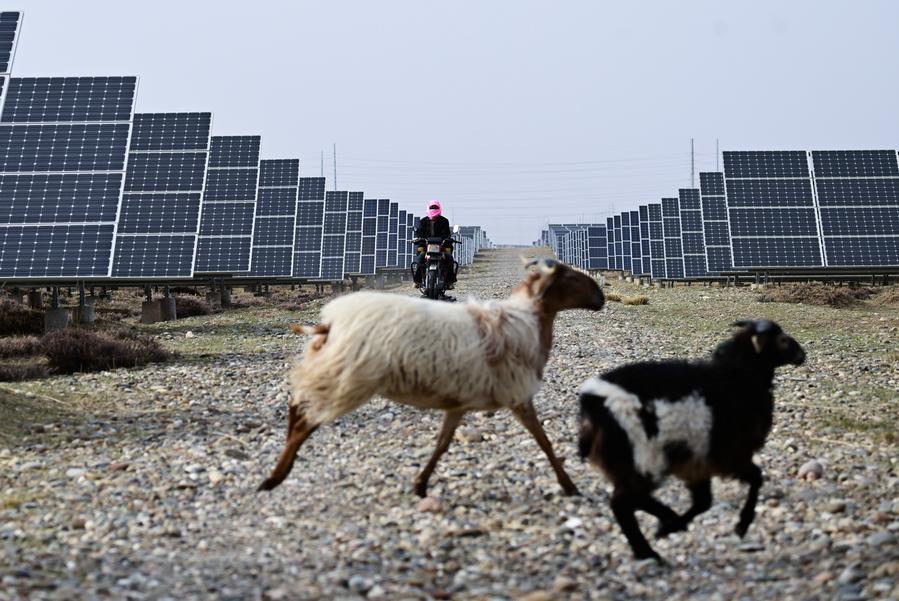
As nations combat climate change, a surge in trade disputes is creating a dangerous rift between climate ambitions and international trade, potentially slowing a global green transition and raising costs, experts caution.
It comes as the market for environmental goods continues to boom. In 2024, exports in this sector hit $2 trillion, making up 14 percent of globally manufactured goods, according to a report by the UN Trade and Development.
Between 2013 and 2022, trade in solar energy products soared by 56 percent and wind generation goods grew by 39 percent, outpacing the 23 percent growth of overall industrial goods, the report found.
This rapid expansion, however, has clashed with tensions between trade and climate policies. Disputes increasingly center on carbon offsets, green subsidies, and regulations, with major economies implementing unilateral measures viewed by experts as protectionism disguised as climate action.
In the United States, the Inflation Reduction Act, with its substantial subsidies for domestic clean energy production, has sparked formal disputes at the World Trade Organization from the European Union and others alleging unfair competition.
Similarly, the EU's Carbon Border Adjustment Mechanism has long faced resistance from developing nations. The Indian-based Centre for Science and Environment, for example, warns that the policy risks shifting decarbonization costs onto emerging economies.
Another focal point of tension is the West's targeting of China's green industries, particularly electric vehicles and renewable energy technologies, over accusations of "unfair subsidies". The EU began imposing tariffs on Chinese EVs in late 2024.
Scholars argue these accusations often misrepresent China's industrial policy.
"If you study the so-called subsidies to Chinese green industries cited by many Western countries, they are not traditional trade subsidies. They often represent government-funded R&D as part of a coherent industrial policy," said Sun Yixian, an associate professor of international development at the University of Bath. "Many Western countries are now learning from this model, which has created a virtuous cycle supporting green industrial development.
"The subsidy narrative is largely used by these countries to exert pressure in trade disputes with China and to justify some of their protectionist policies," he said.
Zhongxiang Zhang, founding dean of the Ma Yinchu School of Economics at Tianjin University, described the EU's anti-subsidy tariffs as a "preemptive move" to counter China's competitive advantage rather than a remedy for proven damage. He pointed out that China's rise in the EV sector has broken the long-standing technological dominance of developed nations.
Developed countries are struggling to transition from internal combustion engines and compete with Chinese EV makers, according to Zhang. As a result, he said, they have adopted such measures to buy time.
Trade tensions became one of the key topics at last year's COP30 in response to the growing threat it poses to combating climate change.
The conference's key outcome, the Global Mutirao decision, explicitly called for dialogue on trade and climate. It reaffirmed the need for international cooperation in promoting an open economic system supporting climate action and that climate measures, including unilateral ones, should not constitute arbitrary discrimination or trade restrictions disguised as regulations.
A significant institutional step was the launch of the Integrated Forum on Climate Change and Trade by Brazil. This platform aims to foster trust and bridge climate and trade, operating independently of both the WTO and UN Framework Convention on Climate Change, or UNFCCC.
"This is the first time the issue of unilateral measures has entered a formal dialogue mechanism under the UNFCCC framework, opening a new channel for discussing climate and trade issues," said Zhang Jian, vice-president of the Institute of Climate Change and Sustainable Development at Tsinghua University.
While its current scope and legal force are limited, Zhang argued that this progress lays crucial groundwork for future institutional arrangements.
"The scaled deployment of green technologies relies on an open, stable, and predictable international cooperation environment," Zhang said. "Over-reliance on unilateral measures can easily trigger trade frictions, raise transition costs and weaken investor confidence, ultimately affecting the efficiency of global emissions reduction efforts."
Dong Yifan, an associate research fellow at the Institute of Country and Regional Studies at the Beijing Language and Culture University, added that unilateral measures can slow each countries' respective green transition and erode global trust, particularly in the Global South.
"The current pace of transition is insufficient to tackle climate change. This is fundamentally a problem of cost and political will that requires the whole world to work together to make the pie bigger," he said.
"For green trade, we should refocus the discussion on the fundamental goal of reducing carbon emissions," urged Dong. "We need to resolve misunderstandings through international cooperation and consultation. Establishing robust mechanisms based on a rules-based framework would benefit both developed and developing countries."
Sun from the University of Bath pointed out that trade can be a double-edged sword for the green transition. "While it can accelerate implementation, as seen with falling global renewable prices driven by Chinese innovation, it also creates winners and perceived losers. For the US and EU, China's rapid development in clean energy has triggered competitive anxieties," he observed.
Therefore, the key to driving global transformation lies not in raising barriers, but in finding mutually beneficial solutions, he said.










