Remedy for morbid symptoms







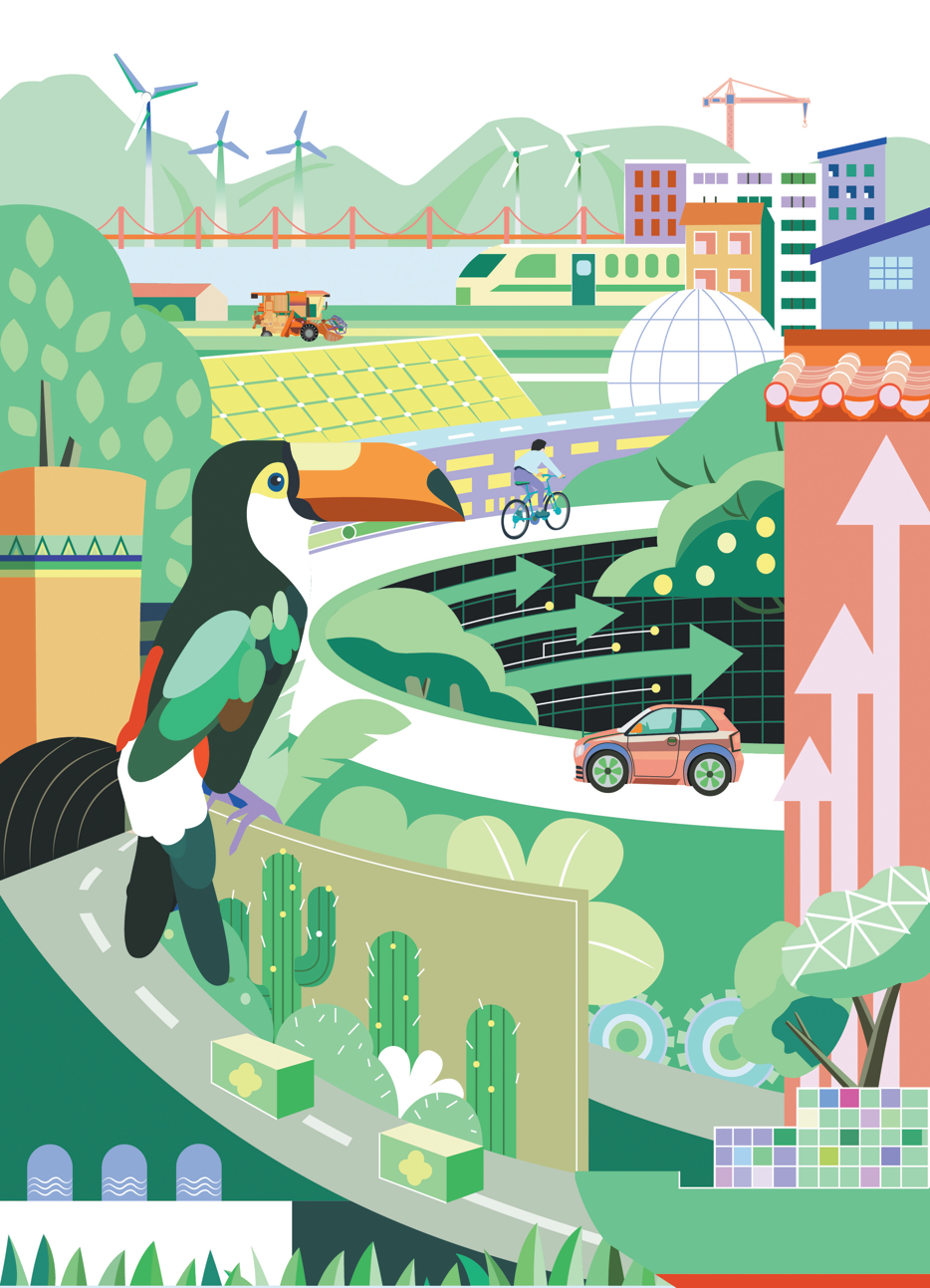
China's cooperation with Latin America and the Caribbean and the way forward for South-South relations
"Changes unseen in a century are accelerating in the world, and a significant shift is taking place in the balance of power." These are the opening words in China's Policy Paper on Latin America and the Caribbean released on Dec 10. Pandemics, wars, climate change, natural disasters of various kinds, mass migrations, droughts and famines have hit the world with unprecedented ferocity in the third decade of the new century. This is not due to happenstance, but rather to the transition from one type of world order to another. As Italian philosopher Antonio Gramsci put it, crisis is "the fact that the old is dying and the new cannot be born; in this interregnum a great variety of morbid symptoms appear".
In this context, marked by multiple challenges, China's presence in the region has been a significant stabilizing factor. This is precisely the subject of this new China Policy Paper on Latin America and the Caribbean, the third in a series. The first was issued in 2008 and the second in 2016, coinciding with President Xi Jinping's visit to South America to participate in the APEC Economic Leaders' Meeting in Lima, Peru, and subsequent state visit to Chile. The latest document places Latin America within the broader setting of the Global South, which has come into its own in the past few years.
For the first 180 years of its independent history, Latin America depended solely on two international partners: the United States, on the one hand, and a few selected European countries on the other. In the new century, after China joined the World Trade Organization in 2001, this changed. Suddenly, there was a third diplomatic, trade, investment and financial partner. And the effect was instantaneous. Riding on the wave of what has been called the "China boom" of 2003-13 and the commodities super-cycle, Latin American economies did extremely well during this decade, growing at their highest rates in 30 years. This allowed the region to weather the 2008-09 global financial crisis especially well (as opposed to what happened in many other such crises, no Latin American bank went belly up in those years), as countries, thanks to their exploding trade with China, had paid down much of their foreign debt, and had replenished their foreign exchange reserves.
The main driver of these expanded relations has been China-LAC trade, which has gone from $12 billion in 2000, to $518 billion in 2024, a 40-fold increase. For South America as a whole, China is now the main trading partner, having displaced the US and the European Union. In the case of Brazil, bilateral trade with China has reached $180 billion; in the case of Chile $61 billion. Up to 37 percent of Chile's exports go to China, and about 29 percent of Brazil's. Chinese investment started to rise especially after 2010 and reached an estimated cumulative total of $187 billion by 2022. Though originally mostly targeted at extractive activities in mining and fossil fuels, Chinese investment has now also moved into the infrastructure and energy sectors. Here, China's worldwide role in the energy transition toward a green economy plays a key role, one that is complemented by South America's abundant copper and lithium reserves, critical elements for this transition.
As US and European companies move out of the region for a variety of reasons, Chinese ones are moving in. The recent launch of a BYD factory of electric vehicles in the state of Bahia in Brazil (inaugurated by President Luiz Inácio Lula da Silva) in what used to be a Ford Motor Company industrial park, and of another by Great Wall Motors in the state of S?o Paulo, in what used to be a Mercedes-Benz factory, is emblematic of this process. This is underscored in an important new book by political scientist Francisco Urdinez, Economic Displacement: China and the End of US Primacy in Latin America, that documents how US trade and investment in South America have been on a downward slope.
The new China Policy Paper on Latin America and the Caribbean aims to raise China-LAC links from the strictly economic level — admittedly central to a region in dire straits — to other areas such as global governance, peace and security, civilizational dynamics and people-to-people exchanges. For too long, modernization has been equated with Westernization. As the West as a geopolitical entity breaks up, and a white nationalist Christian movement aims to monopolize the very notion of "the West" — making it increasingly irrelevant for the peoples of the Global South — the notion of multiple modernities comes to the fore. In such a setting, what China has to offer in terms of the opportunities of a globalized and interdependent world, one that builds bridges, not walls, stands out.
The author is the co-author of a new book The Non-Aligned World: Striking Out in an Era of Great Power Competition, a former ambassador of Chile to China and a non-resident fellow at the Quincy Institute for Responsible Statecraft, a Washington DC-based think tank. The author contributed this article to China Watch, a think tank powered by China Daily.
The views do not necessarily reflect those of China Daily.
Contact the editor at editor@chinawatch.cn.