2025 in review: A year of shifting horizons
Emerging conservative forces redraw the world's political map







Emerging parties
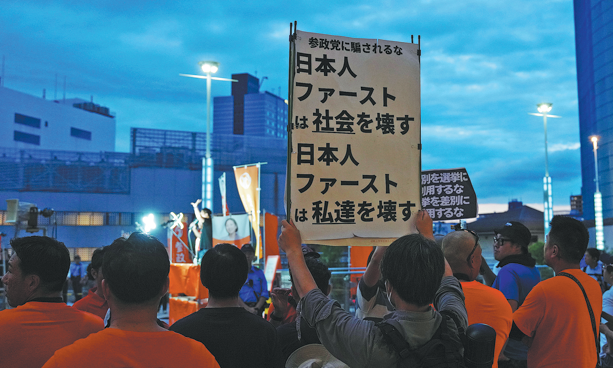
This shift is not unique to Japan. Rather, it is part of a global restructuring of political power.
Zhang Jinling, a senior research fellow at the Chinese Academy of Social Sciences' Institute of European Studies, told China Daily that the shift is clearly reflected in the microcosm of party politics.
"The rise of once-fringe far-right parties has done more than win seats," he said. "It has forced other parties to respond to their demands, serving a crucial 'agenda-setting' function."
For decades after the end of the Cold War, far-right parties largely operated on the fringes. That pattern has now been shattered.
In 2025, far-right or conservative parties rose through the ballot box to become a critical force. This transformation has been particularly dramatic in Europe in recent years, analysts said.
More right-wing parties are emerging and gaining power across the continent.
In the United Kingdom's local elections in May last year, the Reform UK party, founded just seven years ago, won more than 670 seats out of about 1,600, challenging the country's largely two-party system.
Similarly, Portugal's Chega ("Enough") party, established in 2019, achieved a historic result in elections the same month.
The far-right Alternative for Germany party, or AfD, achieved an unprecedented 20.8 percent of parliamentary votes in February last year, making it the second-largest party in the German Bundestag, the lower house of parliament.
When AfD was founded in 2013, it garnered less than 5 percent of the votes, missing the threshold to enter parliament.
Wang Mingjin, a professor at Beijing Foreign Studies University, said last year's German election stands as the year's landmark event.
He said that the AfD not only achieved its best result but also signaled a "major restructuring" in the German political landscape.
Economic instability
The rapid ascent of "outsider" parties to the mainstream is rooted in deep-seated global contradictions. Analysts say widespread economic anxiety, intensifying security concerns, and fracturing identities have combined to create fertile ground for this rightward shift.
Intersecting crises deepened the global predicament in 2025. US-led tariff wars exacerbated regional and global supply chains and economic instability, while the Russia-Ukraine conflict continued to create uncertainty in international markets, severely harming industrial development and livelihoods.
Under this shared pressure, distinct structural dilemmas — such as Europe's refugee crisis, Japan's aging population, and Latin America's security issues — have shaped the contours of the "right turn", analysts said.
Yan Shaohua, deputy director of Fudan University's Center for China-Europe Relations, believes all political problems are ultimately economic.
Europe's economic woes have been intensified by the US tariffs, the Russia-Ukraine conflict, and deindustrialization, Yan said. With stagnant incomes and shrinking social welfare, European voters are focusing more on self-interest.
Europe's political landscape risks further fragmentation, warned Zhang at the Institute of European Studies.
To maintain governance, traditional mainstream parties may be forced to form fragile coalition governments or compromise on key issues with far-right demands, exacerbating policy uncertainty, he added.
Wang said that losing cheap Russian energy has forced a pivot toward defense spending, signaling a "militarization" of the economy that, alongside massive loans for Ukraine aid, has further stoked public dissatisfaction.
He added that while immigration is frequently sensationalized, it serves primarily as a populist "scapegoat" for poor governance rather than being the primary driver of right-wing support.
Social anxiety
Across the Pacific, Japan faced political turmoil in 2025, driven by severe livelihood issues. With the price of a standard 5-kilogram bag of rice approaching up to 4,400 yen ($30), double the price two years ago, panic-buying became common.
Zhou Yongsheng, a professor at China Foreign Affairs University's Institute of International Relations, told media that this shift was due to both external and internal pressures.
Externally, US tariffs — which rose to about 15 percent, according to various estimates — have dealt a heavy blow to the automotive export industry, Zhou said.
Domestically, strategic missteps in technology, such as betting on hydrogen over lithium batteries, have also weakened the country's competitiveness. Furthermore, with nearly 30 percent of the population over 65, labor shortages and soaring social security costs have severely constrained the consumer market, Zhou added.
While Japanese Prime Minister Takaichi has managed to secure political support through right-wing rhetoric and aggressive tactics, Zhou argued that her administration will be counterproductive.
By adopting a provocative stance toward Asian neighbors and instigating disputes, Japan is making enemies on all sides, offering no benefit to the struggling Japanese society, he said.
Backlash in the Americas
South America has also struggled with high inflation and sluggish growth, with regional expansion projected at just 2.4 percent in 2025, according to the Economic Commission for Latin America and the Caribbean.
Experts said this rightward tilt is largely a reaction to the failure of previous policies.
Cristobal Rovira Kaltwasser, a professor at the Pontifical Catholic University of Chile, said that the decline in the left's "golden age" created a vacuum where the "new extreme right" could position itself as the only force willing to take measures to address crime and public safety.
The extreme right in Latin America is hemmed in by the enduring problem of inequality, which has been exacerbated by the neoliberal economic model since the 1980s, Rovira said.
The far-right refocuses the question of inequality, blaming self-dealing elites, while also emphasizing "traditional values", Rovira said.
Test of governance
While election victories rely on mobilization and packaged promises, governing a nation requires confronting and addressing deep-seated challenges, such as economic insecurity and identity. For right-wing parties, the true test of governance has only just begun, Rovira said.
Experts predict that some right-wing governments will gradually become moderate and pragmatic after taking office.
"Whether it is right-wing, far-right, left-wing, or centrist governance, all face the same political, economic, and social realities. Once in power, right-wing governments also need to respond to public demands and address practical economic and security challenges within this context," said Yan of Fudan University.
He said that despite this conservative tide, opportunities for breakthrough exist.
The key, he said, lies in strengthening communication and cooperation with states and political forces that maintain a pragmatic stance, building pragmatic partnerships to navigate the fragmented landscape.
Cao Yuqian and Zhuang Jiayi contributed to this story.