Data drives digital border security
Outstanding immigration officers fuel advances in keeping checkpoints secure








In the digital era, computing power is the capacity of policing and algorithms are the tactics, according to Yi Guiping, an immigration officer at the Huangpu border checkpoint in Guangzhou, Guangdong province, with over 40 years of experience.
Yi monitors nautical charts and ship trajectories to identify suspicious vessels in the Pearl River.
Border security no longer relies solely on patrols and checkpoints. To realize data-driven law enforcement and smart border control, the National Immigration Administration has rolled out a series of measures covering customs inspection, government services and border security. These initiatives have not only improved customs clearance and administrative efficiency but also fortified the security barrier at national borders and ports.
Behind policies such as "zero-wait" berthing for international shipping vessels, "zero-delay" clearance for departures, and expedited clearance services for travelers lies strong data empowerment and support, as well as officers like Yi.
Maritime guardian
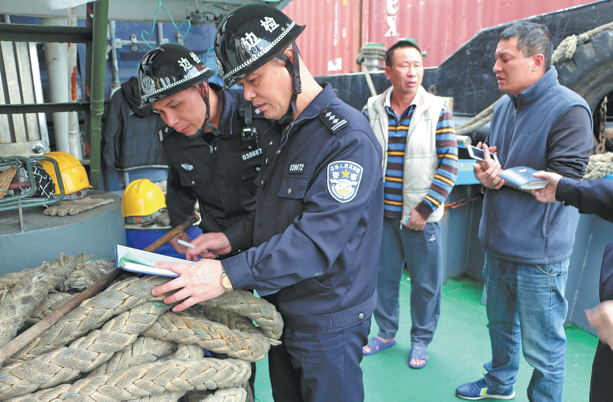
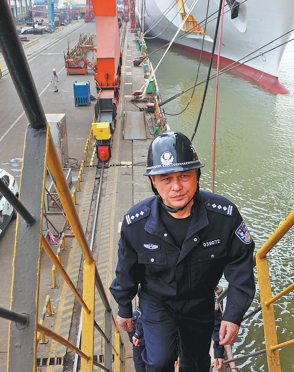
At the Huangpu border checkpoint, Yi oversees exit and entry inspection for ships and crew within the 83-nautical-mile waters adjacent to the Pearl River.
The waters host routes linking 61 countries and regions, with a high volume of international vessels. While the public admires the Pearl River's grandeur and operators seize opportunities in this "golden waterway", Yi sees a battlefield behind the prosperity.
Aided by data analysis, his team has achieved remarkable results in cracking down on maritime smuggling, human trafficking and cross-border crimes.
They have inspected 215 vessels for port violations, provided clues leading to the China Coast Guard's seizure of 20 smuggling ships with 138 people on board and contraband worth 140 million yuan ($20.02 million).They have also identified four drug-related ships, arresting 49 suspects and seizing 2.6 metric tons of drugs.
Yi's pursuit of precision stems from his father, a meticulous automobile mechanic in his hometown of Guiyang county, Hunan province. "Every part matters to the driver's safety," his father would often say. "Repair cars meticulously; it's the same as being a person; slip up at any step, and you risk falling."
As a child, Yi admired his father and dreamed of becoming a mechanic, but also harbored fantasies of being a brave soldier like those in his favorite film, Railway Guerrillas. At 17, after graduating from high school, Yi followed most of his classmates into the technical school of the local iron mine — a tuition-free program with guaranteed employment, the best option for a worker's child back then.
However, a radio announcement recruiting for the People's Armed Police changed his life. Eager to serve in the military rather than become a technician, Yi shared his decision with his parents, who argued through the night before agreeing.
Yi withdrew from the technical school and enrolled in the PAP. "I had no backup plan, but I never regretted it," he said. After successfully enlisting, he was deployed to Guangzhou in November 1983.
"Joining the military took me out of the mountains and gave me a life different from my parents," he said.
After two attempts, Yi was admitted to the PAP's Guangzhou command college in July 1986, assigned to the border defense cadet company. "I didn't fully understand border defense, but I was determined to master it," he said.
Transferred to the Huangpu border checkpoint's law enforcement and research team in 2007, Yi faced the long-standing challenge that illegal ship activities often occurred far at sea, making detection difficult.
To achieve whole-time and full-area supervision and precise crackdowns, he spent years visiting maritime customs and ports, as well as dozens of docks and shipyards, learning and taking notes. Sensing the big data wave, he integrated the Automatic Identification System with exit-entry data to develop 11 verification techniques for illegal ships.
Yi's dedication is unparalleled — he has monitored single suspicious vessels for hundreds, even thousands of hours. Among the many illegal ships he has uncovered, the longest continuous monitoring of one vessel exceeded 200 days.
He also tracks new drug trends, analyzes risks across routes and maintains a database of high-risk drug-related ships. "Starting with individuals to trace ships is common when investigating drug cases, but Yi's model boosts investigation efficiency and accuracy," a local anti-narcotics officer said.
In February last year, after learning of Guangdong-Hong Kong fishing boats being seized for drug smuggling, Yi adjusted his research direction and collaborated with public security and coast guard units to crack the major case, seizing 530 kg of drugs, 300 cannabis oil cartridges and arresting 17 suspects.
"One person's strength is limited,"Yi often says. "Only when effective methods are promoted and new forces grow can our national border defense be solid."
He has written over 170 reports and research articles, shared by over 100 port border checkpoints nationwide.
Port intelligence explorer
Lin Cong, 43, an immigration police officer with 20 years of service at Huanggang border checkpoint in Shenzhen, Guangdong, is another big data trailblazer.
Joining the Shenzhen general station of exit and entry border inspection after university, he has turned routine passenger inspections into a master class in observation. Using gaps between duties, he studied document verification and compiled key points, counterfeit traits and personnel characteristics in his notebook — mastering passports and entry-exit patterns from hundreds of countries.
Lin has delved into big data intelligence analysis since joining the force in July 2005. In March 2015, he participated in the investigation of a 430-million-yuan case, working round-the-clock for seven days to uncover a gang of over 100 suspects fraudulently obtaining exit-entry documents.
After successfully solving this major case, Lin did not stop his pursuit. Over the next year, he used big data to assist in arresting dozens of fugitives and recovering over 1 billion yuan in economic losses — further fueling his passion for big data analysis.
Huanggang Port in southern Shenzhen is Asia's largest 24-hour land port and has inspected nearly 1 billion passengers and 200 million vehicles since its establishment in 1988. As China's economy and international exchanges thrive, border security challenges have grown rapidly.
Lin addresses this by immersing himself in inspection sites, analyzing data patterns to boost efficiency and crackdown intensity. Using his expertise, Lin built a land port risk screening and early warning system integrating multi-port data screening, tactical application and platform matching. This marked the "first step" in systematic big data screening for China's immigration management, exposing illegal entry tactics.
Starting from the end of 2017, Lin and his team have conducted retrospective analysis of thousands of past cases one by one, summarizing patterns and conducting repeated verifications. This has enabled the proactive pre-positioning of high-risk individuals matching model parameters to on-site inspection personnel, driving a leapfrog transformation in border checkpoint enforcement models — from "waiting passively for suspects" to "taking proactive action".
"We've broken data barriers, formed joint forces and brought modeling into the digital era," Lin said.
"It's nothing if I alone set a good example. I need to let my colleagues across the national immigration management system know that big data is effective and easy to use. Big data empowering immigration management has become an inevitable trend of the times."
For his outstanding contributions, Lin has been awarded one First-Class Individual Merit, one Second-Class Individual Merit and four Third-Class Individual Merits. He was named a "Model Individual" in the Ministry of Public Security's national police training campaign and conferred the title of "Second-Class Model Hero of the National Public Security System" in June 2021.
The NIA said that in the coming years it will strengthen the digital intelligence, equipment, system and organizational advantages of immigration governance, and further improve the system for fostering new-quality combat capabilities.