Corporate fundamentals, new economy lay ground for A-share bull market








China is assuming a more prominent role on the global stage, driven by its growing national strength and industrial vigor. Through the advancement of the Belt and Road Initiative, as well as the implementation of the Global Development Initiative, the Global Security Initiative and the Global Civilization Initiative, China is offering an increasing range of public goods, particularly in infrastructure and trade facilitation. This engagement, rather than being a one-way provision, follows a cooperative model built on consultation, joint contribution and shared benefits, creating a mutually reinforcing dynamic in which China supports global development and gains from global engagement in return. Strengthened economic resilience, rising industrial competitiveness and more robust financial risk-management capabilities have further bolstered China's confidence in advancing high-standard opening-up.
This growing confidence is expected to gradually feed into global investor sentiment, paving the way for a re-rating of China's capital markets. At present, the equity risk premium in the US stock market, often measured by the S&P 500, frequently sits below 2 percent, supporting elevated price-to-earnings valuations. By contrast, the equity risk premium of the CSI 300 Index, which tracks 300 large-cap stocks listed on the Shanghai and Shenzhen exchanges, has remained above 5 percent for an extended period, suggesting ample room for an improvement in market sentiment. Narrowing the gap with the United States, however, will require more substantial improvements in China's capital market fundamentals.
First, China's capital market needs to continue strengthening its resilience by containing volatility and improving its Sharpe ratio — a popular measure of reward per unit of risk. In April 2025, amid a surge in global uncertainty, Central Huijin Investment, a Chinese State-owned investment firm, stepped in to play a role similar to that of a market stabilization fund, helping to anchor market expectations and stabilize sentiment. This mechanism is gradually evolving into a healthy, self-reinforcing cycle. As market resilience continues to strengthen and the Sharpe ratio trends higher, China's capital market is expected to attract growing attention from global investors in 2026.
Second, the foundation of resilience in China's capital markets lies in long-term strategic planning, as well as in the solid shareholder returns delivered through consistently high dividend payouts. Since the launch of the value re-rating of State-owned enterprises in 2022, increasing dividend distributions has become one of the core instruments for attracting medium and long-term capital. Looking ahead to next year, against the broader backdrop of anti-involution policies — and as capital expenditure requirements ease across many traditional industries — operating cash flows are likely to improve, creating favorable conditions for enterprises to sustain robust dividend policies.
Third, further narrowing the equity risk premium in the mainland's A-share and Hong Kong markets will require Chinese enterprises to convert the country's growing national and cultural influence into durable pricing power, while fostering business ecosystems that offer fair returns instead of falling into reckless competition. Some investors contend that US equities merit a lower risk premium because their return on equity exceeds that of A-shares. We believe, however, that Chinese enterprises are well positioned to convert their supply-chain strengths into genuine pricing power. In 2024, China accounted for 32 percent of global manufacturing value added on a US dollar basis, establishing irreplaceable competitive advantages in key industries.
China's national and cultural influence has been gaining momentum, with successes such as Labubu and Black Myth: Wukong reflecting a broader and more sustained trend. A global repricing of Chinese products along supply chains would, in turn, accelerate market-oriented reforms in domestic factor markets and help restore healthier profitability across entire industry chains. Indeed, sustainable gains in consumption and domestic demand require factor prices to reflect economic fundamentals and industries to earn reasonable returns. Even with moderate nominal GDP growth, this rebalancing could materially improve corporate earnings and ROE, leading to a lasting compression in China's equity risk premium.
Fourth, China's capital markets need to strengthen their ability to value future industries. As the country advances toward building a modern industrial system during the 15th Five-Year Plan period (2026-30), emerging and future-oriented sectors will each play distinct roles. Yet the market still lacks a clear, robust framework for pricing these industries. Developing valuation methodologies that accurately reflect the characteristics and growth profiles of future sectors will be essential to creating a more inclusive and forward-looking capital market. As this capability improves, equity risk premiums can be expected to decline accordingly.
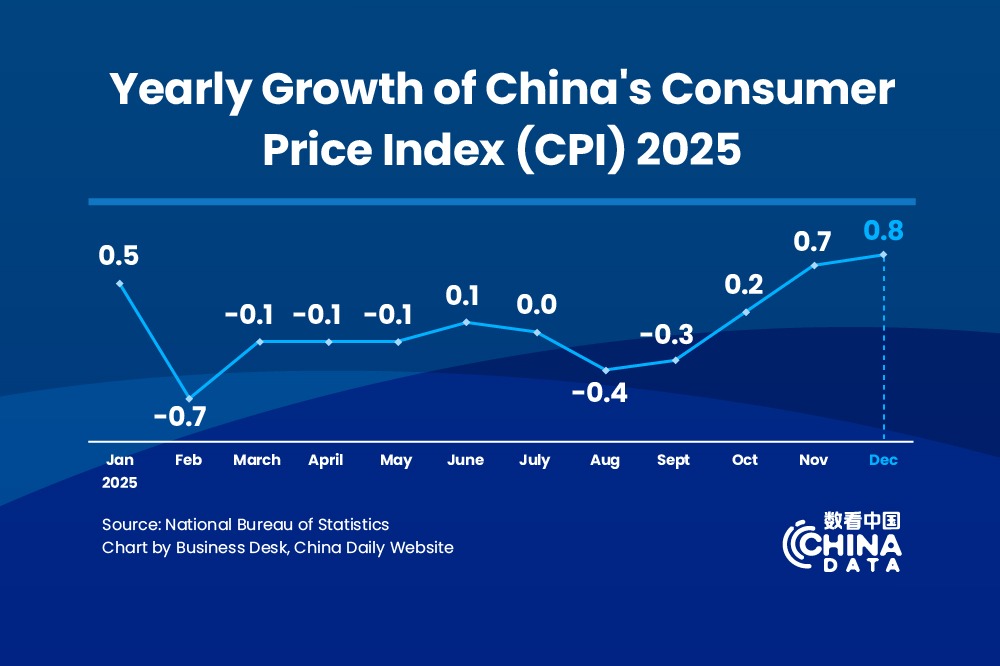
Going forward, the producer price index is set to be a key indicator. As fixed-asset investment growth among A-share listed companies is likely to bottom out around mid-2026 and supply-side expansion continues to slow, steady demand should be enough to support a natural rebound in producer prices. Together with price normalization driven by efforts to curb unbridled competition, the PPI could move back toward zero between mid and late 2026.
Externally, political pressures surrounding the US midterm elections could tilt the Federal Reserve toward a more dovish stance in 2026, while the prospect of additional fiscal stimulus measures cannot be ruled out. Such a combination of accommodative fiscal and monetary policies across major economies would, at least in the near term, support a more constructive outlook for global fundamentals.
If these conditions materialize and the PPI continues to recover, 2026 could mark two milestones not seen since 2021. It would represent the first meaningful earnings rebound in five years for A-share companies outside the financial and petrochemical sectors, as well as the first return to double-digit growth in net profit attributable to shareholders over the same period. As corporate fundamentals move into a cyclical upswing, momentum builds in new-economy sectors and China's global influence continues to rise, these forces could together lay the groundwork for a broad-based A-share bull market.
Against this backdrop, global investor confidence would strengthen, setting the stage for a renewed surge in foreign inflows. Marginal buyers could shift from domestic life insurers and high-net-worth individuals in 2025 to international investors in 2026.Such a transition would likely revive large-cap growth and quality factors, while narrowing the performance gap between value and growth. A range of traditional Chinese manufacturers, often overlooked but occupying critical positions in global supply chains with genuine pricing power, could also see their valuations reassessed. At the same time, the large-cap growth segment in the A-share and Hong Kong markets features leading internet, technology, and advanced manufacturing companies, underpinning a constructive outlook for tech-related equities in 2026.
The writer is director of the Research Institute at Shenwan Hongyuan Securities. The article was originally published in Tsinghua Financial Review.
The views do not necessarily reflect those of China Daily.