



In 2025, success came through integration, not traditional labels







For decades, moments when Chinese culture caught global attention have followed a familiar arc: a breakthrough work appeared, foreign media marveled at the spectacle of its cultural symbolism, and the spotlight quickly moved on. These waves — a case in point would be the blockbuster kung fu films — were episodic and explanatory. What sets 2025 apart is that Chinese culture was no longer introduced to the world; it is circulating within it.
The success of Ne Zha 2 illustrates this shift with unusual clarity. Its global impact in 2025 did not rest on cultural labeling or curiosity. Instead, it operated like a mainstream blockbuster: audiences encountered it through trailers, box-office rankings, social media discourse and peer recommendation — exactly the channels that propel Hollywood films. The film did not ask viewers to appreciate it because of its Chinese cultural markers. This is a crucial departure from earlier moments when Chinese works arrived abroad carrying footnotes.
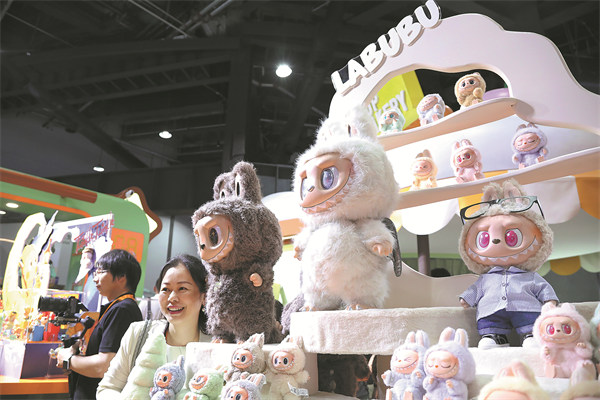
A similar logic applies to Labubu, the "blind box" designer-toy character pioneered by its parent company, Pop Mart. Although it is not new as an idea, 2025 was the year Labubu became a global cultural icon. It spread across Southeast Asia, Europe and North America through resale markets, fashion styling, social-media aesthetics and lifestyle communities — spaces where meaning is produced horizontally, by users, not vertically, by institutions. Labubu was not consumed as "Chinese culture" but as a visual attitude, a mood, a collectible identity. That distinction marks the point at which Chinese cultural products cease to require contextual explanation to be legible.
In contrast, earlier "China boom" moments were mostly centered on representation — China was something to be explained and decoded. At exhibitions of Chinese art and antiques, the global public encountered Chinese culture as observers, not participants.
The new wave of 2025 ensures that films, games, toys and short-form dramas enter global circulation through the same algorithms, fandom mechanics and consumption rhythms as their Western or Japanese counterparts. Ne Zha 2 succeeded not because audiences learned who Ne Zha was, but because the film allowed them to feel the character's rebellion and humor immediately. Labubu succeeded not because people understood its origin story, but because it could be worn, displayed, photographed and traded. For once, a Chinese cultural product is not admired from a distance, but carried — dangling from the backpack of a cool young woman, fully embedded in everyday life. 2025 marks a move from symbolic prestige to lived presence. Past booms often produced symbols — award wins, critical praise and "firsts".The present produces habits. Chinese IPs are watched weekly, collected obsessively, cosplayed, memed, and debated. They generate ongoing engagement rather than momentary acclaim.
In 2025, global audiences discovered Chinese cultural products through each other. A viral clip, a resale post, a fan edit travels faster than any official endorsement. Authority has shifted from institutions to networks. This decentralization favors cultures that can generate strong visual languages and emotionally immediate narratives — areas where contemporary Chinese creators have become increasingly confident.
The sustained global attention around Black Myth: Wukong, for instance, shows how Chinese mythology can function as a shared imaginative resource rather than an exotic reference. Meanwhile, the international expansion of Chinese short-form dramas demonstrates that even hyperlocal storytelling can score when delivered through the right formats. None of these require audiences to pause and "learn about China" first.
In this sense, 2025 is not a peak but a threshold. It marks the point at which Chinese culture stops arriving as a guest and starts operating as a resident within global cultural life. The success of Ne Zha 2 and Labubu does not lie only in numbers, but in how those numbers were achieved: through circulation, participation and normalization.





