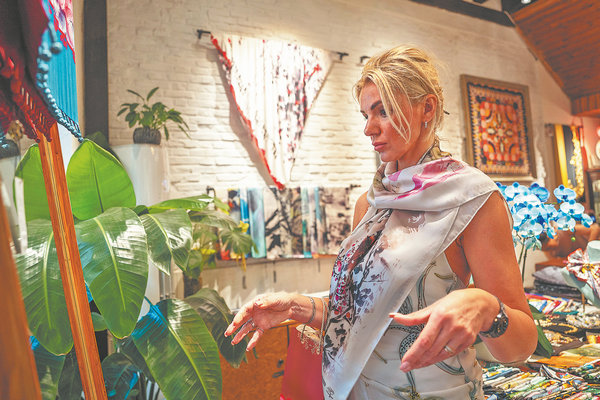
NANJING — Dressed in an elegant qipao and holding a delicate fan, German traveler Lea Hoffmann strolled through a centuries-old water town in Suzhou in East China's Jiangsu province.
Her journey was not merely about ticking off another tourist spot. "I want to truly step into this place and feel the classical charm within traditional Chinese culture," she said.
Hoffmann exemplifies a growing trend among international visitors who are opting for personalized, in-depth cultural experiences over whirlwind tours.
From learning intangible cultural heritage textile weaving in Yunnan province to trying their hand at pottery wheel throwing in the ancient porcelain capital of Jingdezhen, Jiangxi province, or practicing Suzhou embroidery stitching in Jiangsu province, foreign tourists are increasingly seeking authentic connections when visiting China.
"The reasons for international tourists to visit China are diversifying as shows, sports events, exhibitions, and gourmet food can all be the draw," said Hu Di, head of an international travel agency in Suzhou.
Hu noted a rise in independent travelers forming small groups, planning extended itineraries that cover more destinations, and staying longer, with demand shifting from iconic landmarks to themed, in-depth, and customized experiences.
In the culturally rich northern province of Shaanxi, for example, various projects featuring Chang'an, the ancient name for Xi'an, which served as the capital for many Chinese dynasties, offer immersive experiences in hanfu (traditional costume) photography, interactive performances and intangible cultural heritage cuisine.
The vibrant tourism offerings have become social media sensations abroad, allowing visitors to virtually time-travel to the ancient capital of the Tang Dynasty (618-907). "The costumes and scenes in the videos are breathtaking. I want to experience that atmosphere firsthand," Hoffmann said.
This tourism trend is supported by China's expanding visa-free policies and measures that make travel easier for foreign visitors, including tax refunds and enhanced electronic payment options.
Official data show a significant surge in inbound tourism. Visa-free entries constituted over 7 million, or 72.2 percent, of all foreign arrivals in the third quarter, marking a 48.3 percent annual increase.
As cultural experience tours gain popularity, foreign tourists are venturing beyond major cities to explore China's diverse regions.
This winter, destinations like Harbin, Heilongjiang province, are trending. Data from China's online travel service giant Trip.com Group show inbound bookings for winter scenic spots nearly doubled year-on-year, with provinces like Hebei seeing increases of more than 130 percent.
To cater to rising demand, cities are leveraging visa-free transit policies to design boutique inbound travel routes. Beijing offers hutong and Central Axis cycling tours, while Yunnan features eco-wellness and outdoor adventure itineraries. The Guangxi Zhuang autonomous region integrates tropical fruit picking into tours, and the "Panda Express" train loops through Sichuan and Guizhou provinces and Chongqing.
Upgraded services for inbound tourists are also being implemented. The coverage of foreign bank card payment terminals is expanding, and mobile payment solutions for international visitors are improving.
Shopping areas such as Beijing's Silk Street mall offer foreign-language services, currency exchange, and expedited tailoring. Zhejiang province launched a global smart travel service platform with AI-powered itinerary planning, and Nanjing, Jiangsu, introduced a tour card bundling connectivity, payments and access.
The inbound tourism boom presents a vibrant, diverse China to the world while injecting new momentum into domestic demand. James Liang, executive chair of Trip.com Group, highlighted the sector's potential.
Liang noted that bringing China's inbound tourism revenue to 1 to 2 percent of GDP, on par with international levels, could unlock a market increment of 1 to 2 trillion yuan ($142.7 billion to 285.4 billion).