



Trump says US will take temporary control of Venezuela







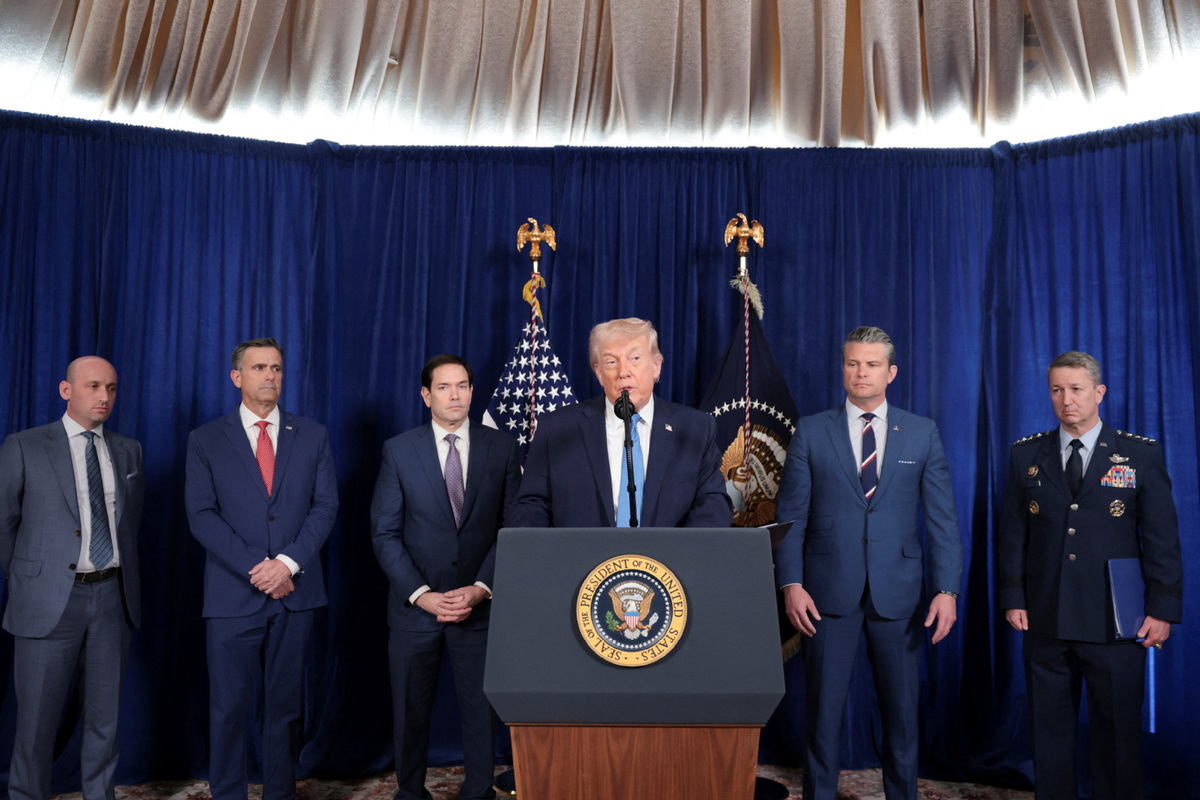
The United States will take interim control of Venezuela after capturing President Nicolas Maduro and does not rule out deploying US troops on the ground, US President Donald Trump said on Saturday, as UN Secretary-General Antonio Guterres warned the US strikes set "a dangerous precedent".
"We're going to run the country until such time as we can do a safe, proper and judicious transition," Trump said during a news conference ?at his Mar-a-Lago resort in Florida, hours after a US overnight attack on the South American country.
A US occupation "won't cost us a anything" because the United States would be reimbursed from the "money coming out of the ground", Trump said, referring to Venezuela's oil reserves.
Trump said American energy companies would rebuild Venezuela's broken infrastructure under US supervision.
The president also said that the military operation against Maduro was not necessarily over, warning that the US stood ready to escalate if required.
"We are ready to stage a second and much larger attack if we need to do so," Trump said, although he added that the initial operation was so successful that "we probably don't have to do a second."
He also said that US troops could remain on the ground in Venezuela during the interim period.
"We're not afraid of boots on the ground if we have to have [them]," he said, pointing out that American forces had already operated inside the country. "We had boots on the ground last night at a very high level," he added.
Guterres is "deeply alarmed" by US military action in Venezuela that sets "a dangerous precedent", his spokesperson said on Saturday.
"These developments constitute a dangerous precedent," Guterres' spokesperson Stephane Dujarric said in a statement. "The ?secretary-general continues to emphasize the importance of full respect — by all — of international law, including the UN Charter. He's deeply ?concerned that the rules of international law have not been respected."
Moments after Trump announced the ?US would ?run the South American country until a "safe" transition was ?completed, Spain said it will not "recognize an intervention that violates international law and pushes the region toward a horizon of uncertainty and belligerence," Prime ?Minister Pedro Sanchez wrote on X.
Venezuela and Colombia have asked the 15-member Security Council to meet, diplomats said, though the meeting had not yet been scheduled, Reuters reported.
In a letter to the Security Council on Saturday, Venezuela's UN Ambassador Samuel Moncada described the operation as a "deadly and treacherous US military attack" against "a country that is at peace," warning it "has serious implications for regional and international peace and security."
He said the US had violated the founding UN Charter, citing its provision that "All members shall refrain in their international relations from the threat or use of force against the territorial integrity or political independence of any state."
In a separate letter to the Security Council's January president, Venezuela's Permanent Mission to the United Nations condemned what it called "brutal, unjustified and unilateral" US armed attacks.
The mission said that US forces bombed "civilian and military sites" in Caracas and other locations and called the operation "a flagrant act of aggression" that violated the UN Charter.
Countries that criticized US strike mainly focused on the UN Charter's prohibition on the use of force and urged de-escalation.
China said it was "deeply shocked and strongly condemns the use of force by the US against a sovereign country and the use of force against the president of a country."
"Such?hegemonic acts of the US seriously violate international law and Venezuela's sovereignty, and threaten peace and security in Latin America and the Caribbean region. China firmly opposes it," a Ministry of Foreign Affairs spokesperson said.
The spokesperson urged Washington to abide by international law, and the purposes and principles of the UN Charter, and stop violating other countries' sovereignty and security.
Russia strongly urged the US leadership to release Maduro and his wife, the Russian foreign ministry said on Saturday.
In a statement, the ministry called on Washington to reconsider its position regarding the couple.
The statement also stressed the need to create conditions for resolving any existing issues between the United States and Venezuela through dialogue.
France's Foreign Minister Jean-Noel Barrot said, "The military operation that led to the capture of Nicolas Maduro violates the principle of not resorting to force, that underpins international law".
He added that "no lasting political solution can be imposed from the outside" and "only sovereign people themselves can decide their future".
A leading international-law expert at Chatham House said that the US rationale collided with the UN Charter's baseline prohibition on the use of force.
"International law prohibits the use of force as a means of national policy," Marc Weller, program director of Chatham House's International Law Programme, said in a post on the London-based policy institute's website on Saturday.
Short of a UN Chapter VII mandate, force is generally lawful only "in response to an armed attack" or possibly to rescue a population facing "imminent threat of extermination," he said.
"Clearly, none of these requirements are fulfilled" by the US operation against Venezuela, he said, adding that US interests in stopping drugs, or portraying the Maduro government as a criminal enterprise "offers no legal justification".
Agencies contributed to this report.










