Where curious minds engineer a brighter future
Students gain invaluable hands-on knowledge and experience while working on scientific projects during their education







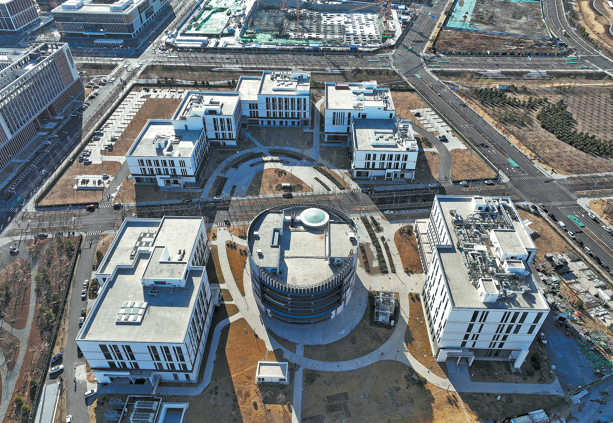
For most people, the magnifying-glass-shaped structure at Huairou Science City in Beijing is a high-end but inaccessible facility designed to deliver the "world's brightest X-rays".However, for 25-year-old Liang Chongyang, the High Energy Photon Source is quite familiar, as he has worked there for nearly two years.
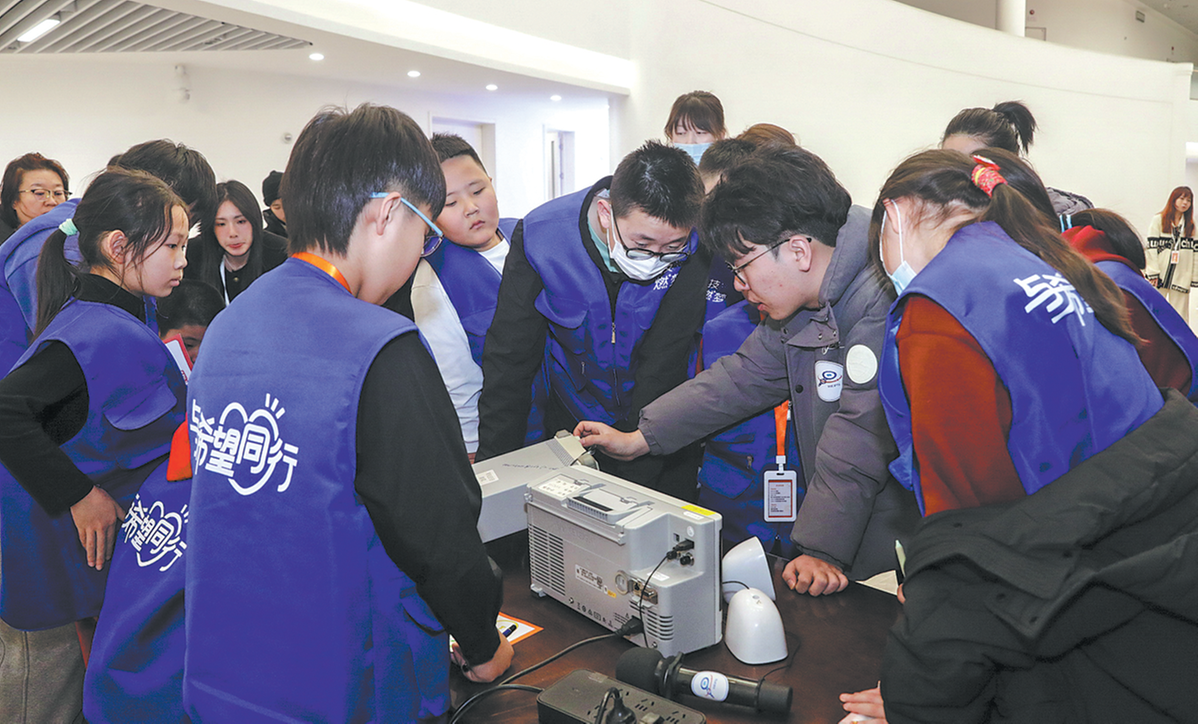
Liang, a 2025 graduate of the University of Chinese Academy of Sciences, is among the tens of thousands of students from the university who participate in major national scientific and technological research projects during their studies. Through such involvement, students can deepen their professional knowledge, stay updated on the latest scientific developments and hone skills that benefit their future careers.
Construction of the High Energy Photon Source, the first high-energy synchrotron radiation light source facility in China, started in June 2019 and was completed in 2025. It was one of the key projects listed in the 13th Five-Year Plan (2016-20) and was designed to address the demand for high-energy, high-brightness and high-coherence X-rays for facilitating research in basic and engineering sciences.
The facility, Liang said, resembles an ultra-powerful X-ray machine that uses high-brightness synchrotron light to reveal material structures at nanoscale resolution. It helps address research bottlenecks of microscopic material structure in fields such as energy, environment, materials and life sciences. "My first impression of the High Energy Photon Source was spectacular. It is a fine combination of the macro and the micro," Liang recalled. "After participating in its construction and understanding how it works, I can appreciate the beauty of the physics that powers it."
He highlighted its vast area of 65 hectares — enough to accommodate 90 football fields — and its capability for minute observational scale.
Majoring in nuclear technology and applications, Liang received academic training at the Institute of High Energy Physics of the Chinese Academy of Sciences. "Before entering the school, I learned about opportunities to join key research and development projects," he said. Guided by his mentor He Jun, a researcher at the Institute of High Energy Physics, his seniors conducted preliminary simulations and data analysis to optimize the design of the facility's electron position detector, while he worked in the assembly of detector components during the construction.
"I used to catch the 7:30 am shuttle bus from my dormitory at Yuquan road to the facility and return around 5:00 pm," Liang recalled. At times, when there was too much work, he would sleep at the facility itself.
Liang's work involves electron position detector calibration. It's a process for establishing the accurate correspondence between the detector's output signals and the actual beam positions, thereby eliminating systematic errors. It takes around four hours to work on one detector, and they are given a daily target of two to three detectors. The installation of detectors is carried out in stages, including installing the detector units, connecting the cables, and conducting final inspections and tests, Liang added.
"Unlike the first-year curriculum, which followed the undergraduate structure focused on course examinations and score-oriented learning, the second year shifted to research-centric training. While mentors provided initial guidance, the emphasis was on self-directed exploration," he said.
The interdisciplinary challenges in research pushed Liang to study foundational theories and consult with experts across various fields. By speaking to experts in electron position detectors, he enhanced his knowledge of mechanical and electronic engineering, understood the mechanisms of the equipment and learned about X-ray detector electronics for achieving high-precision capture of low-frequency signals.
"Without set answers or immediate feedback, the research process often swung between frustration and a sense of achievement. But overall, it was very beneficial for me," he said.
After graduating in September, Liang joined Honor Beijing, a Chinese smart device brand, where he works as a product planner. His research experience not only deepened his academic knowledge but also gave him a profound sense of achievement when he learned about the facility's successful performance acceptance organized by the Chinese Academy of Sciences in October.
More importantly, it cultivated in him a comprehensive skillset. By adjusting and installing hundreds of detectors, Liang developed a more holistic mindset. He learned to prioritize performance stability for mass production and has integrated this consideration into his design approach. His experience collaborating with experts from diverse disciplines also honed his teamwork abilities.
Furthermore, Liang emphasized that this experience significantly influenced his career choice. "During the project's early stages, I felt frustrated because breakthroughs required long-term commitment. I don't favor delayed gratification. I thrive on innovation, which is why I chose to do this job," he said.
Like Liang, many other engineering students have gained from working at major scientific facilities during their studies in UCAS.
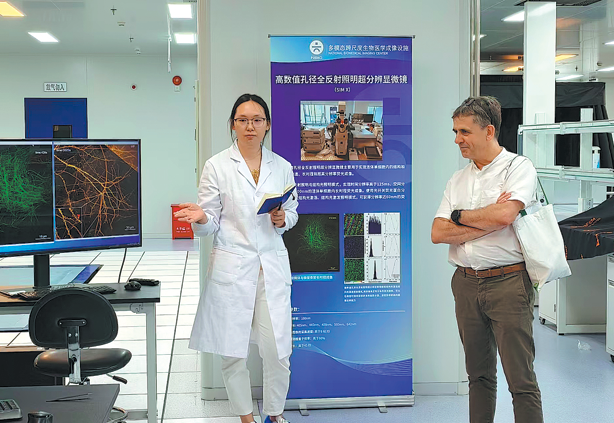
For Xie Shengzhi, who worked at the National Multimode Trans-Scale Biomedical Imaging Center before graduation from UCAS in 2025, her experience with the scientific facility strengthened her resolve to continue working in this research field.
The facility integrates diverse imaging modalities into a seamless biomedical imaging cluster, spanning scales from molecules to humans across nine orders of magnitude. It is designed to support research in life sciences and aid the diagnosis and treatment of major diseases.
During her final year of PhD studies at the Institute of Biophysics of the Chinese Academy of Sciences, Xie was responsible for the acceptance stage of five microscopes for the multimode living cell imaging platform, one of the four key platforms of the facility.
"The acceptance process includes not only a technical performance evaluation to ensure that all technical specifications meet design requirements but also an expert-led archival review, covering a complete set of technical documentation and management records," Xie said, adding that this has enabled her to gain a holistic and deep understanding of the construction, working principles and operational processes of this cutting-edge facility.
She emphasized that, given the strategic significance of large-scale scientific research facilities, participating students must undergo rigorous selection and require mentor guidance.
Xie's mentor, Li Dong, a researcher at the Institute of Biophysics, had instructed her in the development of a structured illumination super-resolution microscope — the prototype of one of the facility's core structures — during her graduate studies.
She also systematically studied optical imaging principles, such as confocal imaging and structured illumination, laying a solid theoretical and technical foundation.
Despite the theoretical framework of structured illumination being validated through published papers and the hardware system passing multiple rounds of testing, Xie insisted on conducting validation experiments using fluorescent microspheres — a cost-effective substitute for live samples — before each inter-departmental acceptance inspection, ensuring data reliability through fitting calculations.
"Upon the successful national acceptance of the facility this March, I felt both delighted and relieved of the significant responsibility," she said.
She said it's a great honor for her to participate in major scientific projects as a student and emphasized that it can significantly shorten her adaptation period in future scientific research while enabling the targeted cultivation of talents aligned with national strategic priorities.
"Moving forward, I will leverage my practical experience and theoretical expertise to conduct systematic performance maintenance, ensuring its long-term stable operation," she added.