Conquering ocean depths with relentless innovation







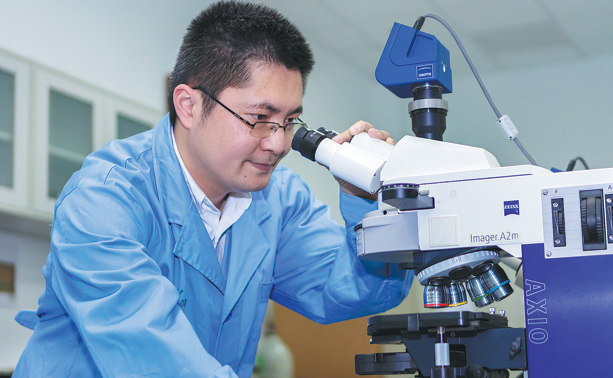
In 2020, the abyssal darkness of the Mariana Trench in the western Pacific Ocean was illuminated when China's manned submersible Fendouzhe descended below the 10,000-meter mark. Fendouzhe later completed dozens of dives below 10,000 meters, turning one of the most forbidding realms on Earth into a laboratory of possibility. Behind these milestones were years of relentless efforts of the development team, including Deputy Chief Designer Yan Kaiqi.
Yan and his team have managed to address the key bottleneck of withstanding ultra-high pressure in the deep sea. As one descends in the sea, pressure increases by one atmosphere every 10 meters, reaching 1,000 atmospheres at 10,000 meters. Yan says that force is roughly comparable to 2,500 adult African elephants pressing on the human body. This immense pressure, along with ultra-low temperatures and mysterious conditions of the deep sea, make exploring these depths even more challenging than landing on the Moon, according to Yan.
Trained in materials chemistry at Nankai University, Yan found inspiration in the university's motto — dedication to public interests, all-round capability and aspiration for progress. It emphasized the importance of innovation, which he embraced.
That spirit drew him to the Technical Institute of Physics and Chemistry of the Chinese Academy of Sciences, where he found that the research for tackling key technical challenges in deep-sea exploration and novel materials aligned with his ambition to meet national demands. He decided to continue his studies there so that he could compete with top international teams and contribute to China's development.
When Yan joined the institute in 2009, his mentor Professor Zhang Jingjie gave him a list of research topics. At that time, Yan didn't know that many of these topics were intended to lay the theoretical groundwork for building deep-sea submersibles.
Based on his research interests, he chose to focus on the mechanical structure of hollow glass microspheres. These are very small thin-walled structures that have low density and extraordinary resistance to high pressure. They resemble ping-pong balls, with a hollow core and a delicate shell. But they are only as large as the diameter of a hair, making their structure extremely unstable.
The challenge was compounded by the limited interest in the highly specialized field. "The biggest challenge in my research was the scarcity of relevant research and reading material," Yan said. But that also nudged Yan to come up with original thinking. His innovative ideas and solid expertise in material behavior mechanisms were recognized by experts at the institute. They made an exception and allowed him to join the project in 2011, thus shifting him from fundamental research to practical applications.
The transition was not easy. Fundamental research often achieves breakthroughs within a short period, but applied research requires sustained efforts. However, while discoveries in fundamental research reach readiness levels in 5 to 10 years, applied research can demonstrate technical feasibility sooner, Yan added.
Yan completed his PhD studies at the institute and continued to work there after graduation. He dedicated himself to the project, and persisted despite repeated failures. The breakthrough came when the team discovered that integrating hollow glass microspheres into polymer matrices can create solid buoyancy materials capable of withstanding extreme pressure. That material makes up more than half of Fendouzhe. "The technology is now recognized as one of the six core technologies for deep-sea submersibles," Yan said.
Although China started later than other countries, it has rapidly closed the gap, Yan noted. Today, its method of producing and applying the material ranks among the world's best.
For Yan and his team, the journey is far from over. "Our research till now was primarily focused on developing Fendouzhe, so our understanding of many material properties is still incomplete," he said. "We are now investigating how these materials evolve during long-term deep-sea service, which will help in the development of deep-sea equipment designed for future extended-duration missions," he added.