The US in 2025: a year of deep divisions
Record-long shutdown, immigration breakdown and partisan paralysis leave country battered and exhausted







Midgley said polarization has affected the Congress' ability to pass basic legislation more than ideology alone. "Congress' inability to pass important legislation has less to do with polarization than with the outsized role played by megadonors tied to individual issues or business interests," he said.
Legislators advocate for donor positions and are less willing to compromise, even within their own parties, he added.
The public blame for the resulting shutdown was distributed almost equally along party lines.
A Reuters/Ipsos tracking poll conducted in October showed US citizens blaming Republicans 50 percent to Democrats 43 percent.
Among independents, 41 percent said "both parties share the blame equally", according to an earlier PBS/NPR/Marist poll.
A November Gallup survey showed that 80 percent of US citizens endorse that political leaders should compromise with the other party to get things done.
Sourabh Gupta, a senior fellow at the Institute for China-America Studies, said the 43-day shutdown has revealed deep distrust between parties.
"There has been such a breakdown in trust and polarization over the last 20 to 25 years that has made governance harder," he told China Daily.
The addition of a polarizing president has only worsened it, he said.
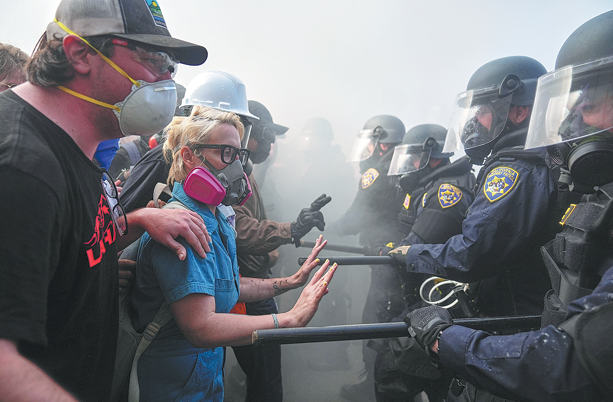
Surging protests
Polarization also fueled a surge in protests, as research from Syracuse University's Institute for Democracy, Journalism and Citizenship showed that local news, which is less partisan than national outlets, continues to struggle to bridge gaps between red and blue counties.
Gupta pointed to recent gun incidents as further signs of societal strain amid deepening polarization.
"These sorts of erratic instances are just going to get more and more," he said, warning that political violence is rising as politicians fan the flames.
In November, the Brookings Institution's analysis of No Kings participants revealed 26 percent left-leaning support for political violence (up 9 percent year-over-year) versus 17 percent right-leaning (down 12 percent), highlighting emotional divides amid the ongoing Affordable Care Act debates.
The record-setting 43-day shutdown caused damage. The shutdown began on Oct 1, when fiscal year 2025 funding expired without new appropriations.
It ended on the evening of Nov 12, when Trump signed a clean continuing resolution that extended funding at 2025 levels until Jan 30.
The Congressional Budget Office issued a formal estimate during the closure. In October, the office's figures showed a permanent loss of $11 billion.
The December Bureau of Labor Statistics report showed a 0.2 percentage point increase in the unemployment rate to 4.6 percent, attributing part of the rise to shutdown distortions.
An update also noted that permanent distortions in labor data may impact 2026 fiscal forecasts.
Human costs were equally stark. Approximately 670,000 civilian federal employees were furloughed without pay for the full 43 days.
Another 730,000 "exempt" federal employees, who were required to work during the shutdown, received no income while working for the six weeks.
Active-duty military personnel continued to work but faced the real prospect of missing their Nov 15 paycheck if the shutdown had lasted two more days.
In December, unemployment in Washington, DC, remained above the national average of 4.6 percent, according to data from the Office of Revenue Analysis.
Short-lived initiative
The short and controversial life of the Department of Government Efficiency epitomizes the political chaos that defined the country in 2025.
It was created by an executive order on Jan 20 — inauguration day, granting extraordinary authority to recommend agency mergers, mass terminations, and regulatory repeals. Its stated target was to reduce federal spending by $1 trillion over 10 years.
Over its 10-month existence, DOGE oversaw "savings" totaling $214 billion, primarily from the Department of Education, Department of Health and Human Services, and the Environmental Protection Agency, while its own operations have reportedly generated at least $21.7 billion in waste across the federal government.
Independent analysis by Yale University and the University of Pennsylvania estimated that reductions in Medicaid, food assistance and public health programs contributed to 51,000 excess deaths that would not have occurred under previous funding levels.
In late November, agencies terminated an additional $289 million in contracts following DOGE guidance, but critics noted the savings fell short of targets amid opaque accounting.
As of Dec 12, reports from the Office of Personnel Management indicate that DOGE-inspired cuts have institutionalized $500 million in annual efficiency gains.
On Nov 23, 11 days after the shutdown ended, the White House announced that DOGE was being dissolved.
OPM Director Scott Kupor told reporters that afternoon: "The entity no longer exists. Remaining functions have been returned to their originating agencies."
The federal hiring freeze imposed in January was lifted the same week.
By Dec 1, White House officials clarified that DOGE's principles persist through embedded staff in agencies, with $140 million in recent savings from 15 terminated contracts. The short-lived experiment thus ended, leaving the question: Did the pursuit of efficiency ultimately prove efficient?
So, what ends and what remains as 2026 approaches?
The immediate crises of 2025 have formally ended. Federal offices are open again. DOGE has been disbanded. The largest waves of protests have subsided with the arrival of winter weather.
Moretti, Gupta and Midgley all see little reason for optimism in 2026. Moretti expects "chaotic" politics ahead of the midterm elections. Gupta predicts worsening polarization and economic strain on affordability. Midgley warns that profound damage to government machinery and international relations will take years to repair.
yifanxu@chinadailyusa.com