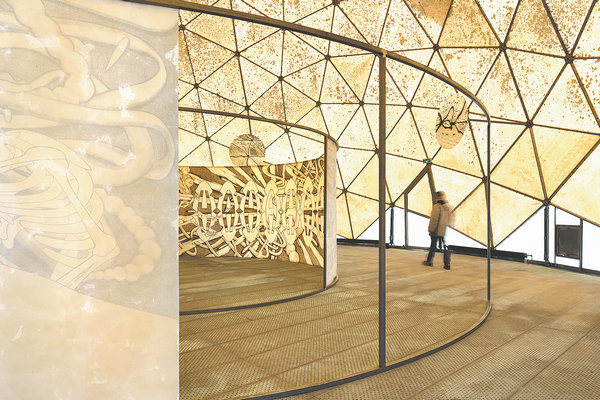
This year has seen the French artist working in Beijing while Chinese artist Dai Xiyun completed a three-month residency at the Palais de Tokyo in Paris. Artists are encouraged to take a deep dive into the foreign environment, gather inspiration, and build durable artistic bonds across borders.
Reflecting on the value of such bilateral exchange, Guillaume Desanges, president of the Palais de Tokyo, says, "Chinese artists coming to the Palais de Tokyo bring us a new vision of the topics we are exploring. In today's globalized world, we all face similar questions, but do not have the same answers. That is what's truly interesting: to encounter different perspectives and different answers, depending on the country and culture one comes from."
Desanges also mentions an interesting observation: When selecting French artists for the residency in China, the institution received an overwhelming number of applications. "I think it's an exciting experience for the artists," he says.
"China and France are geographically and culturally distant, yet we have shared a long historical connection. What stands out today, however, is the palpable sense of curiosity, especially now, as China undergoes rapid transformation, where tradition, modernity and contemporary culture blend in compelling ways, much like they do in France."
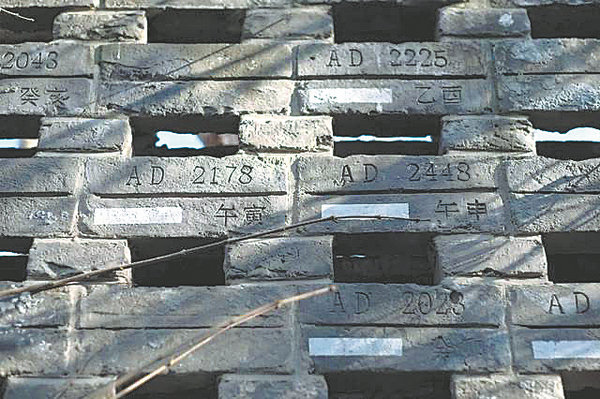
In turn, Jonathan Choi Koon-shum, founder of the Jonathan K.S. Choi Foundation, which runs the Choi Centre Cloud House, the driving force behind the art project, says that art is a universal language that doesn't require translation. Through art, "we can truly achieve people-to-people bonds and nurture international friendship via creation and exchange".
Over the past two decades, Choi, who also serves as chairman of the Hong Kong-based conglomerate Sunwah Group, has established more than 10 Choi Centres across the globe, including locations in France, Britain, Vietnam, and Japan, as well as in many domestic cities such as Shenyang, Liaoning province; Kunming, Yunnan province; Shanghai and Chongqing. Each cultural center varies in focus, with some promoting tea culture and others emphasizing traditional Chinese medicine.
According to Choi, this enduring dedication to building cultural bridges stems from a personal legacy: "My wife is a cultural practitioner skilled in music and the arts, so this is something of a family tradition."
Two decades ago, when he established the first Choi Centre in Vietnam to promote Chinese culture, he still recalls facing considerable difficulties and skepticism. Today, however, as interest in Chinese culture continues to grow, many places invite him to open cultural centers.
"Each cultural center has a different focus. We showcase the forms that resonate locally," says Choi.
"I have observed that while investment and trade are important, it is cultural connections that bring people together. That is why I have consistently promoted arts, culture, and traditional Chinese medicine, all of which hold wide international appeal," he adds.
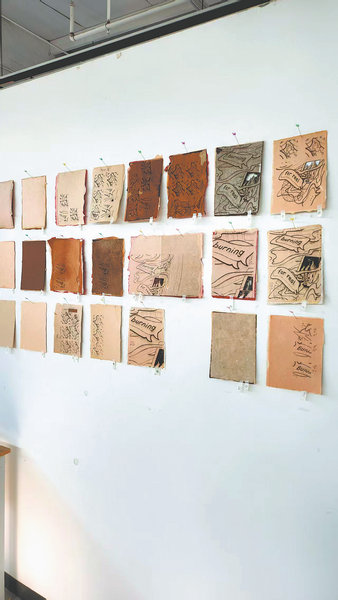
In Beijing, the Choi Centre Cloud House reimagines a traditional siheyuan courtyard as a modern arts venue, blending contemporary exhibitions with the serenity of a classical Chinese garden and traditional architecture. Choi also introduced Chinese tea culture into the center's programming this year, hoping artists-in-residence like Kohnke can immerse themselves in an authentic conventional setting and draw further inspiration. He warmly invites Kohnke to experience other Choi Centres across the nation.
"Our ultimate goal is to enhance mutual understanding and foster international friendship through cultural exchange. It has been an immensely fulfilling journey, and we will continue to innovate and expand our global initiatives," says Choi.