That mission came into sharp focus in Quzhou, a city deeply scarred by Japan's biological warfare during the war. Between 1940 and 1944, Japanese forces carried out three aerial attacks, releasing bacteria including plague, cholera and anthrax in the region. According to Chinese records, more than 300,000 people were affected, and over 50,000 died. Many survivors suffered from lifelong illnesses, known locally as "rotten leg disease".
In 2012, at a museum commemorating victims of Japan's biological attacks in Quzhou, Han photographed Yang Dafang, then head of a local victims' association, as he denounced the atrocities. The image, later titled Accusation, captures Yang mid-gesture — bent with age, arms raised, mouth open — confronting a crime committed decades earlier.
That same day, Han followed Yang to visit survivor Hong Fufu, who was a biological warfare victim as a teenager and was never able to walk again. In a dim, earthen-floored room, Hong sat motionless on a wooden stool, his legs swollen, ulcerated, and blackened. Stunned by what he saw, Han raised his camera, capturing a close-up of the legs.
"The war ended, but for the victims, the pain never did," Han says. "If this history isn't recorded, it will fade away."
That conviction grew into a project spanning more than a decade. Han documented survivors until their deaths, photographing empty stools, abandoned canes and silent homes. The images, he says, are not only portraits, but evidence.
Before he died in 2017, Yang told Han that he lived, so others would remember the victims of biological warfare. Han promised the elderly man that he would continue telling their stories.
He has since taken tens of thousands of photographs and donated them to public archives in Quzhou and Yiwu, a nearby city in Zhejiang. His work has appeared in exhibitions at home and abroad.
In 2018, Accusation was short-listed at the 125th Toronto International Salon of Photography, a recognition that Han believed mattered less for prestige than for international acknowledgment of a little-known chapter of the war.
In 2014, Han turned his lens on another wartime narrative: the Doolittle Raid and the Chinese civilians who rescued American airmen after their planes crashed in 1942. Of the 75 US crew members who were downed, most survived with help from locals. Chinese communities paid a devastating price in Japanese reprisals, as many locals suspected of sheltering the Americans were tortured or slaughtered by Japanese forces.
"For Americans, it's a heroic mission,"Han says. "But the cost for the Chinese is rarely remembered."
Working with Zheng Weiyong, a bank employee with a long-standing interest in uncovering the history of the Doolittle Raid, Han visited the crash sites, interviewed elderly villagers, and documented commemorations.
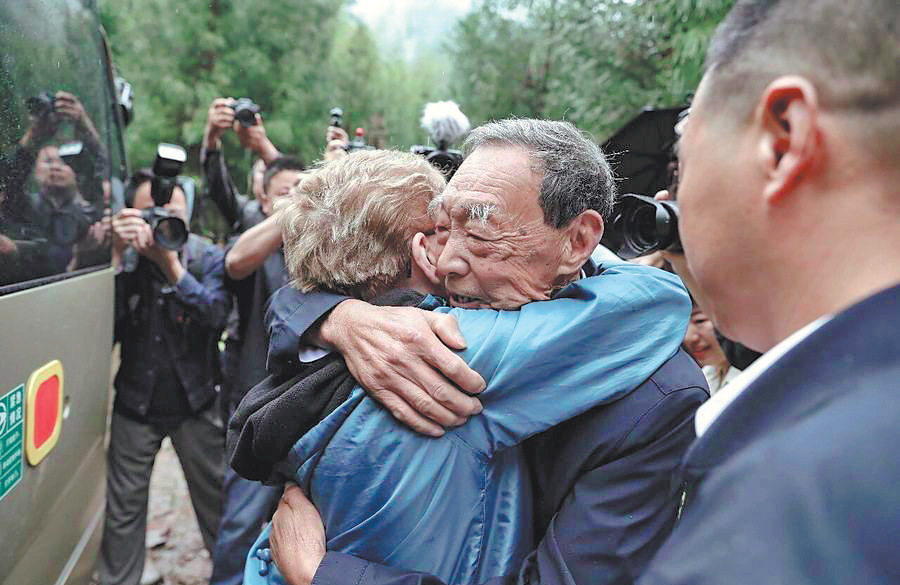
His photographs capture moments of remembrance, such as American descendants visiting villages, collecting soil from landing sites, and embracing Chinese families whose parents once cared for foreign airmen. These images, now used in people-to-people exchanges between China and the United States, tell "a friendship forged in war".
Han sees photography as a form of historical testimony. At exhibitions, he often quizzes visitors about that history. Most give vague answers to which he responds by pointing to the images.
"These images are evidence," he says.
Looking ahead, Han plans to document stories along the WWII Hump Route, the Himalayan air corridor used to supply China during the war, where hundreds of aircraft were lost.
"Each crash site hides the untold stories of Chinese villagers rescuing American crews," he says. "This history is fragmented. I want to piece it together, using my knowledge of flight to unearth these overlooked details."
As the world marks 80 years since the end of the World Anti-Fascist War, Han continues his work, convinced that photographs can preserve what time erodes, capturing both suffering and sacrifice, as well as the bonds that connect people across borders.