



Another sign of Japan's right-wingers' dangerous ambition to break free of all postwar constraints: China Daily editorial







The remarks by a senior Japanese government official reportedly suggesting Japan should acquire nuclear weapons constitute not only a grave challenge to Japan's nonnuclear principles, but also to the global nuclear nonproliferation regime and to the postwar international order.
This latest controversy has once again exposed a dangerous undercurrent in the country's security discourse, one that warrants serious vigilance from China and the international community.
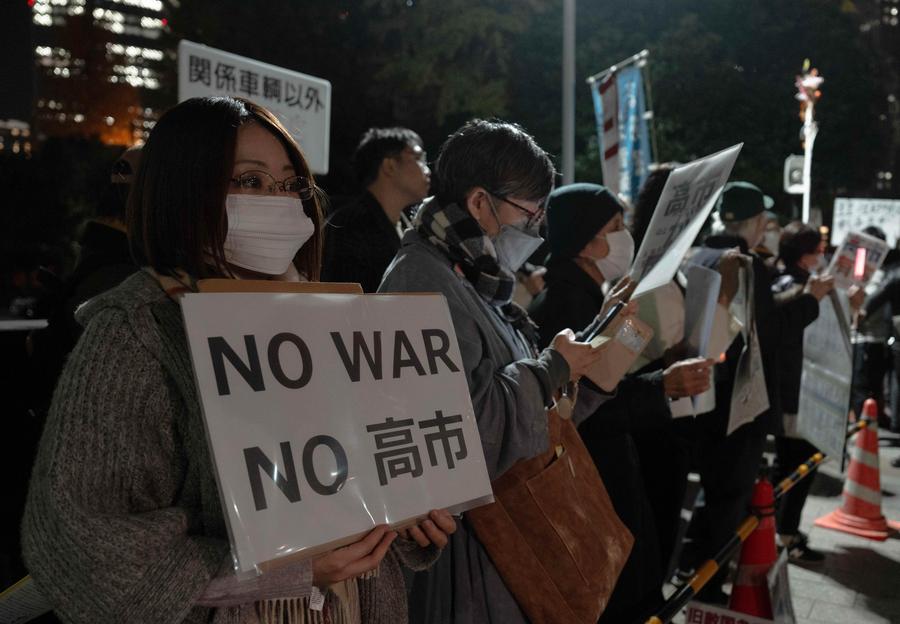
Even if a "personal view", as the Japanese government later tried to frame it, such statements are not slips of the tongue. They reflect a broader and increasingly visible trend in Japan's political circles to test the boundaries of public support for breaking the country's long-standing three nonnuclear principles. The Japanese public remains deeply cautious about any attempts to overthrow the three nonnuclear principles, but the government appears intent on convincing it otherwise.
Chief Cabinet Secretary Minoru Kihara reiterated that Japan's policy of not possessing, producing or permitting the entry of nuclear weapons remains unchanged. Yet his refusal to directly address the remarks, coupled with Prime Minister Sanae Takaichi's earlier ambiguity over whether the "three nonnuclear principles" will remain intact in the country's future defense strategy, only fuels concern.
If Japan were to abandon its vow never to arm itself with nuclear weapons, the global bulwark against the proliferation of nuclear weapons would be critically weakened.
And that, as Chinese Foreign Ministry spokesman Guo Jiakun rightly noted, demands grave attention from the international community.
Confronted with this potential shift in policy, the international community must respond with a clear and firm voice to uphold the nonproliferation regime. Russia has already expressed its opposition to discussions in Japan about the possible acquisition of nuclear weapons.
Japan's nuclear debate cannot be viewed in isolation. In recent years, Tokyo has steadily loosened the constraints imposed after World War II, revamping its security and defense policies, lifting the ban on exercising the right to collective self-defense and deepening military cooperation under the banner of so-called "extended deterrence". Even so, the country's three nonnuclear principles — not possessing, producing or permitting the introduction of nuclear weapons into Japanese territory — were regarded as sacrosanct. When vice-defense minister Shingo Nishimura, for instance, voiced similar ideas in 1999, he was promptly dismissed.
Floating the idea of possessing nuclear weapons reveals a growing ambition within Japan's right-wing forces, represented by the Takaichi government, to cast off the constraints of the postwar order and accelerate a march toward remilitarization.
The irony is stark. Japan often portrays itself internationally as a moral advocate for a world free of nuclear weapons, emphasizing its status as the only country to have suffered from the use of nuclear weapons. Yet this selective narrative obscures a deeper problem. As Guo pointed out, Japan has never fully reflected on the wars of aggression it waged, nor has it squarely confronted the historical responsibilities that come with that dark period of its past.
The Takaichi government's invoking of "worsening security environments" does not justify nuclear ambitions. The Treaty on the Non-Proliferation of Nuclear Weapons recognizes only five nuclear-weapon states, and Japan is not among them. Any attempt to move closer to nuclear armament — whether through indigenous development or hosting foreign nuclear weapons — would erode regional trust and stability.
This year marks the 80th anniversary of victory in the Chinese People's War of Resistance Against Japanese Aggression (1931-45) and the World Anti-Fascist War. It is a moment that should prompt sober reflection in Japan, not renewed militaristic ambition. Respecting international law and adhering to its nonnuclear commitments are not burdens imposed from outside, but responsibilities rooted in history and morality.





