



Revitalizing a historic link







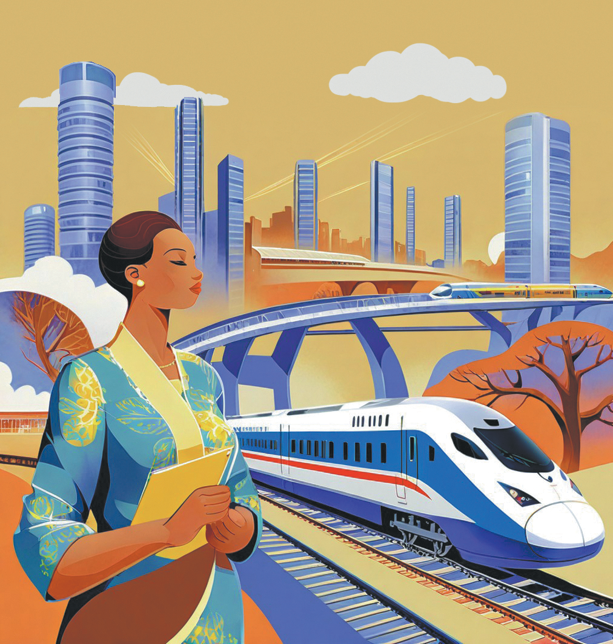
The Tanzania-Zambia Railway offers a practical model for enhanced connectivity and capacity building
This year, the G20 Summit was held in Africa, the first time it has been held on the continent. Ahead of the summit, the revitalization project of the Tanzania-Zambia Railway, or Tazara Railway, was officially launched in Lusaka, the capital of Zambia. As a major infrastructure project with long-term Chinese involvement, the modernization of the Tazara Railway tangibly demonstrates the G20's advocated principles of "solidarity, equality and sustainability", offering a practical model for South-South cooperation.
In the 1960s, newly independent Tanzania and Zambia faced severe economic blockades. Landlocked Zambia saw its vital copper exports controlled by the apartheid regime in southern Africa, creating an urgent need for independent and secure access to seaports. Although Tanzania possessed ports, it lacked transport corridors linking them to the hinterland. After failing to secure support from the World Bank, Western countries and the Soviet Union, the two nations turned to China, which was itself then exploring its own development path.
Construction of the Tazara Railway began in 1970. China provided an interest-free loan of 988 million yuan and dispatched a total of 56,000 engineering and technical personnel over six years to complete the 1,860-kilometer cross-border railway. Stretching from the port of Dar es Salaam in Tanzania in the east to Kapiri Mposhi in Zambia in the west, the railway initially handled an annual freight volume of about 1 million metric tons, carrying over 80 percent of Zambia's copper ore exports. It also spurred the emergence of numerous new towns along its route, promoted the flow of goods and population aggregation and laid the groundwork for initial regional economic integration.
The Tazara Railway has gradually become a key cornerstone for building political trust between China and other Global South countries. According to Afrobarometer survey, within a 400-km radius along the railway, 38 percent of local residents attribute their positive perception of China to infrastructure projects. The analysis also reveals a distinct "influence gradient": identification with China as a "development model" and positive assessments of its economic influence and aid value decline significantly with increasing distance from the railway. This underscores the railway's enduring geopolitical and social impact as a "corridor of friendship".
After half a century, however, the railway's infrastructure has severely aged, and its capacity has shrunk to roughly 200,000 tons per year. Against the backdrop of the accelerated development of the African Continental Free Trade Area and the broader wave of regional economic integration, modernizing the railway has become an urgent priority. On Nov 20, China, Tanzania and Zambia issued a statement on jointly building a TAZARA Railway Prosperity Belt, which identifies modernization of the railway as the core objective. The Tazara Railway revitalization project is thus defined as a comprehensive regional development plan spanning six dimensions: freedom, development, friendship and partnership, people's welfare, green development, and regional harmony.
The Tazara Railway was born during a critical period of national liberation in Africa, symbolizing the commitment of China, Tanzania and Zambia to independent sovereignty and the right to development. Amid profound shifts in the international landscape, the three parties, guided by the principles of mutual respect, equal consultation and shared development, have innovatively adopted a build-operate-transfer model of market-based cooperation to advance the prosperity belt. This marks a shift in China-Africa cooperation from traditional assistance to a more sustainable paradigm of shared development and mutual benefit, offering long-term support for the modernization of southern Africa.
In terms of development, the economic benefits of the revitalization project will unfold in two successive phases: construction and operation. During construction, the initial investment of over $1.1 billion is expected to create nearly 20,000 jobs. On-site training during this phase will also build a localized talent pool for future operations. Once operational, the railway's annual freight capacity is projected to rise to 2.4 million tons, cutting transport time by two-thirds. This will significantly reduce the logistics costs for agriculture and mining, promote an upgrade from raw material exports to higher-value-added products and help translate China's zero-tariff policy for African goods into stronger export competitiveness for local manufacturing. Moreover, through integrated land-sea logistics and the connection of the railway with Tanzania's Central Line, the project aims to build a transport network serving a population of 120 million people, lower intra-regional trade costs and boost the AfCFTA.
With regard to friendship and partnership, the three parties will use the prosperity belt initiative as a platform to establish a regular mechanism for sharing governance experience, holding in-depth discussions on key issues such as development planning, industry cultivation and livelihood improvement. In culture and tourism, they will jointly explore historical and cultural heritage along the route, develop curated travel collections and organize cross-cultural events to showcase the convergence of diverse civilizations. Exchanges between technical teams and youth programs will further strengthen people-to-people bonds, broaden the social foundation for cooperation, and foster mutual understanding and affinity at the grassroots level.
On the dimension of people's welfare, the three parties adhere to a people-centered approach, setting the improvement of public welfare as the fundamental goal of the project. For human capital development, skill training aligned with railway operations and related industries will be provided to local youth, women and other groups, enhancing employability and fostering a localized professional workforce. To improve living standards, cooperation in education, healthcare and other fields will upgrade public service facilities and enhance the quality of life for communities along the belt.
Green development principles will be integrated throughout the prosperity belt. Monitoring and protection mechanisms will be established, utilizing environmentally-friendly technologies, materials and energy-saving measures to safeguard ecological security. Industrial cooperation will center on green industries, e-commerce, digital payments, technology and artificial intelligence, with digital trade platforms established to drive green transformation through innovation. Cooperation on standards will also be advanced to establish a green industry standards system, enabling high-quality sustainable growth through technological and institutional innovation.
Regarding harmony and security, the revitalization of the Tazara Railway will be dovetailed with regional security cooperation. Improved communication and coordination mechanisms will help mitigate risks in infrastructure, trade, energy and other sectors. Policy coordination and resource sharing will elevate security governance, ensuring the smooth implementation and operation of the project. The resulting economic growth and social progress will, in turn, enhance regional economic resilience and social cohesion, creating a virtuous cycle in which development and security reinforce each other.
From its historical role as the "Uhuru Railway" (uhuru means freedom in Swahili) to today's vision of a "prosperity belt", the Tazara Railway revitalization project is not merely an infrastructure upgrade but a concrete practice of advancing common modernization through institutional innovation and multidimensional cooperation. It illustrates a practical pathway for Global South countries to pursue modernization through enhanced connectivity and capacity building.
Xiao Hao is a professor and the executive deputy dean of the Institute of African Studies at Hunan University. Tang Chenxi is an assistant professor at the Institute of African Studies at Hunan University. The authors contributed this article to China Watch, a think tank powered by China Daily.
The views do not necessarily reflect those of China Daily.
Contact the editor at editor@chinawatch.cn.





