Salt of the earth
1,100-year-old field transforms from ancient production site to green, agritourism hub







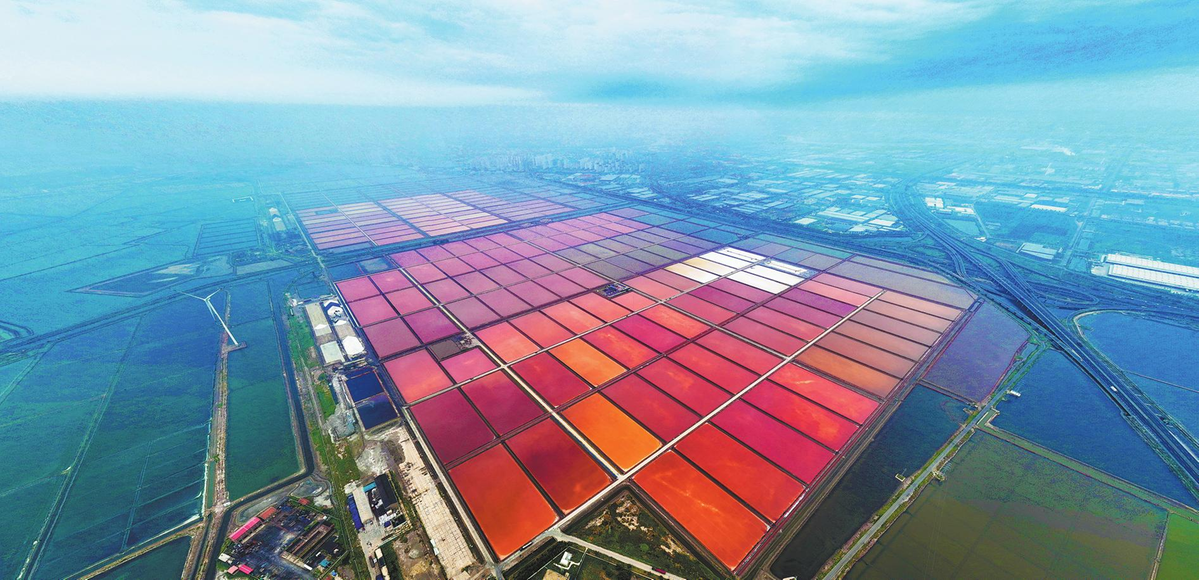
In the vast, sun-drenched coastal expanse of Tianjin's Binhai New Area in early autumn, the landscape shimmers. Here, where the waters of the Bohai Sea meet the land, lies the Tianjin Changlu Hangu Salt Field, a place that has been continuously harvesting salt for over a millennium.
Marking its 1,100th anniversary this year, the Hangu Salt Field is no longer defined by the arduous labor of ancient salt masters. It is now a leading-edge industrial park, a national cultural heritage site, and the host of the world's largest "salt-light complementary" power station — a stunning testament to China's push for green, high-quality development. The story of this field is the story of China itself: an ancient industry reimagined for the 21st century.
Established in 925, the Hangu Salt Field is one of the largest sea salt production bases in the Changlu salt-producing area, with an annual production capacity of 1 million metric tons.
From the ancient method of boiling seawater for salt to today's intelligent production and integration of cultural tourism, this salt field is pioneering a new path of high-quality development for traditional industries.
Technological innovation
"The first step in salt production is the intake of tidewater. That is, using pumping systems and the natural force of rising tides to channel seawater into the salt pans, where natural evaporation turns it into brine, the raw material for salt production," said Dong Shaosen, head of a crystallization zone at the Changlu Hangu Salt Field.
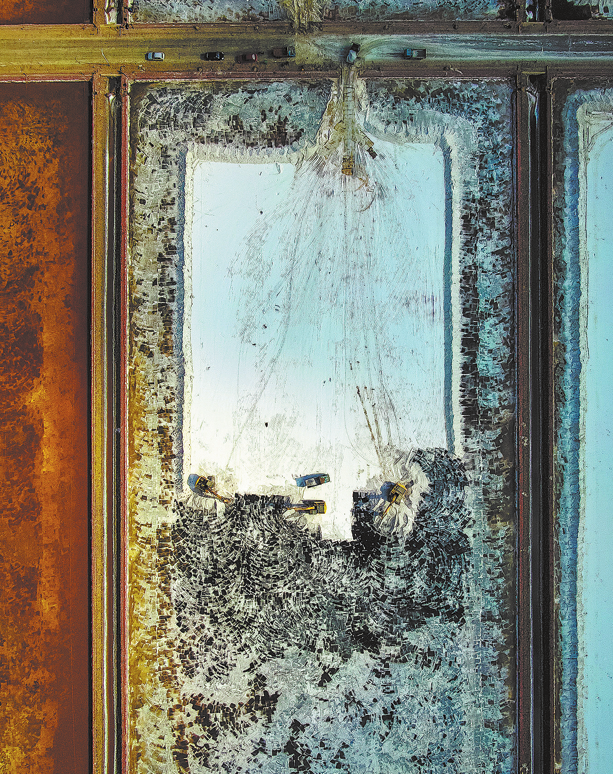
The salt pans are constructed following the terrain, which is higher in the west and lower in the east. The brine flows eastward along the slope through multiple evaporation ponds, exposed to wind and sun for over 300 days. During this process, its concentration gradually increases until it finally reaches the crystallization point.
Compared to the laborious traditional method of scraping soil to leach brine and boiling it in pans to form salt, modern salt production has achieved a leap forward in both efficiency and quality. One of the core innovations is plastic sheeting technology — a floating plastic cover system used to ensure ideal conditions at all times.
"When rainfall exceeding 5 millimeters is forecast, the plastic sheets are mechanically deployed along tracks to swiftly cover the entire crystallization pond, protecting the brine from dilution," said Dong.
"In the past, rainwater would directly fall into the ponds, and production was entirely at the mercy of the weather. Now, with plastic sheeting technology and modern salt harvesting systems, our production capacity and stability have significantly improved, enabling year-round crystallization," he said.
In 2020, the salt field established a high-end edible salt production base with an annual capacity of 300,000 tons. Centered on a dedicated manufacturing execution system, the base has achieved automation and digital management across the entire production process. This enables stricter quality control and meets market demand for high-quality edible salt.
Heritage of a millennium
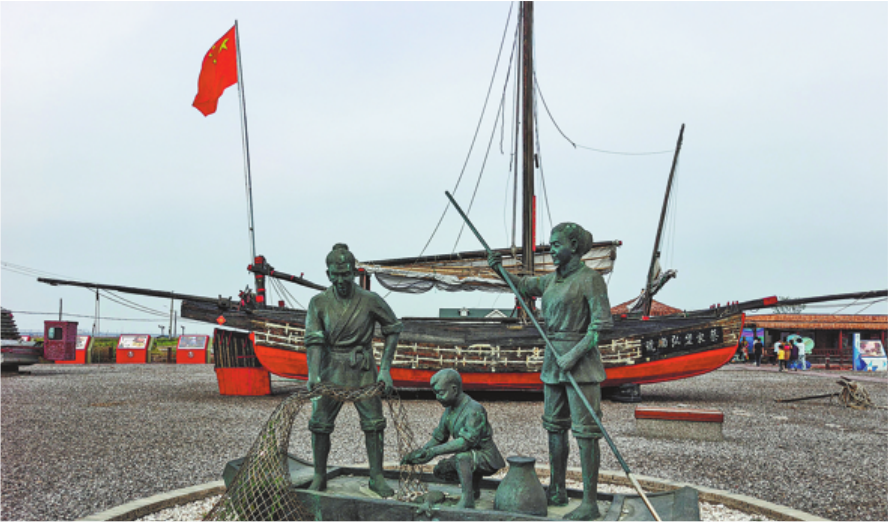
The history of the Hangu Salt Field is a living fossil of China's sea salt development. Its salt-making history can be traced back to the Five Dynasties Period (907-959), when Zhao Dejun, military governor of Youzhou prefecture, established a workshop here to boil salt.
In the early Qing Dynasty (1644-1911), production technology shifted from the method of boiling to evaporation, significantly improving production efficiency and scale.
"We are guarding not just millennium-old salt fields, but also a cultural gene that has been passed down," said Yan Haibin, head of the publicity department at the Hangu Salt Field.
Compared to well salt, rock salt and lake salt, sea salt holds unique value. China's salt product structure consists of 87 percent well and rock salt, 10 percent sea salt and 3 percent lake salt.
"Unlike well and rock salt derived from underground brine, sea salt naturally retains various trace elements from seawater such as potassium, magnesium and calcium without anti-caking agents," Yan said. "This is why it has a fresher, saltier flavor and is more favored by health-conscious consumers."
The Pharmacopoeia of the People's Republic of China 2020 Edition includes "Daqing Salt", clearly documenting its efficacy in "clearing heat, cooling blood and improving eyesight". Records of "using salt as medicine" can also be found in classical Chinese medical texts. For instance, The Divine Farmer's Materia Medica classifies salt as a substance of middle grade that requires dialectical use, noting its salty and cold nature, and its impact mainly on the stomach, kidney, large intestine and small intestine meridians.
In order to upgrade consumption, the salt field is actively developing new products like low-sodium salt and other functional salts to meet consumers' increasing demand for health.
Renewable energy
In 2022, the Hangu Salt Field collaborated with Goldwind Science & Technology Co to build a 12.9-megawatt decentralized wind power project. This is the first decentralized wind power project in China's salt industry, and currently the largest such project in Tianjin.
The large wind turbines distributed around the ancient salt fields generate electricity directly for production needs, capable of meeting one-third of the fields' annual electricity demand.
"Last year's annual power generation reached 33 million kilowatt-hours, reducing carbon dioxide emissions by 23,990 tons annually and saving the enterprise over 3.3 million yuan ($460,000) in electricity costs," said Liu Qing, the project leader.
Last year, recognized for its outstanding performance in green manufacturing and management, the Hangu Salt Field received the honorary title of "National Green Factory".
Industrial integration
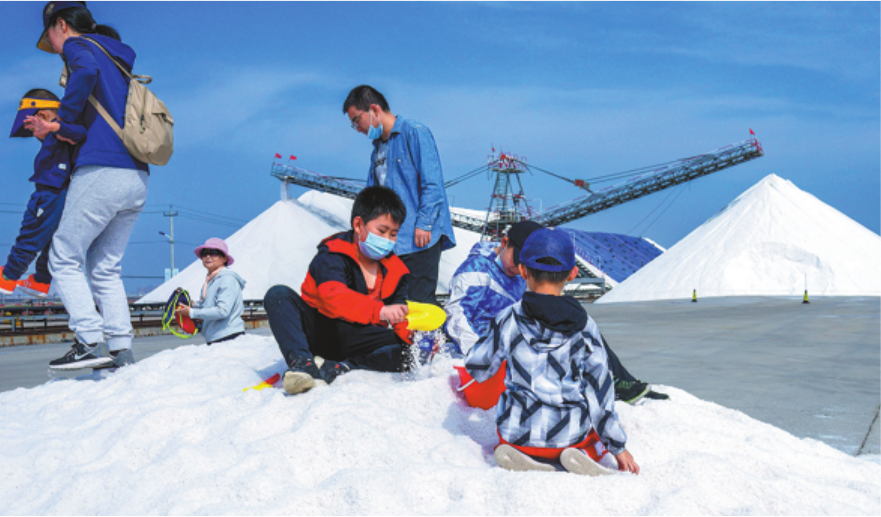
The Hangu Salt Field has evolved from just being a production base into a 4A-level national tourist attraction, attracting some one million visitors in the past five years.
The vibrant colors of the salt ponds stem from a clever combination of nature and science. The brine of different concentrations hosts different halophiles and algae, which cause the water to exhibit rich colors like yellow, red and brown, forming a unique artificial ecological wetland landscape.
A key component of the area's cultural-tourism integration has been the Zhiyan School, which has been renovated from old industrial buildings. "The school, as a national marine science education base, boasts modern technologies like naked-eye 9D to immerse visitors in the history of the salt industry," said Li Shuangwei, deputy general manager of Hanyan Cultural Tourism Development Co. "The most popular activity is salt sculpture, where children can grind handmade salt with stone mills. It's great fun."
On the horizon
Zhang Shiyong, deputy Party secretary and chairman of the trade union of the Hangu Salt Field, said that the development path is clear. "The primary sector, focusing on our sea salt production, is the foundation; the secondary sector, developing high-value-added industries like salt chemical and biological industries, is the engine; the tertiary sector, establishing the aquaculture and cultural tourism brand, is the wings."
He added: "The company will continue to stick to the core salt business while exploring pathways for the transformation of the traditional salt industry. We will accelerate the integration of the primary, secondary and tertiary industries, promote the shift of the traditional salt production zone into an ecotourism destination and a modern industrial base, and further uncover new narratives for Tianjin's time-honored brands."
Wu Meng and Liu Wenchaocontributed to this story.