On a cold winter afternoon, as the archaeological work at a well-preserved ancient city site in Longyao county, Xingtai, in North China's Hebei province was drawing to a close, a clump of earth with an unusual texture caught the eye of archaeologists.
With a history of over 2,600 years, the historical site of Bairen City, or the Ruins of Bai People's Town, is one of the most well-preserved ancient cities in China.
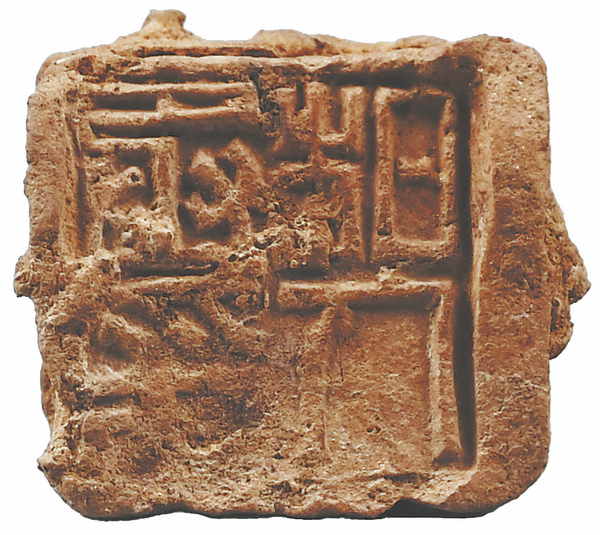
Brushing away the dirt, they saw the faint but unmistakable imprint of ancient Chinese characters begin to emerge.
"It says 'Bai Ren'!" Cao Yu and Li Keying exclaimed, their voices a mixture of excitement and awe. The two are students in the Department of Archaeology and Museum Studies at the School of History, Renmin University of China.
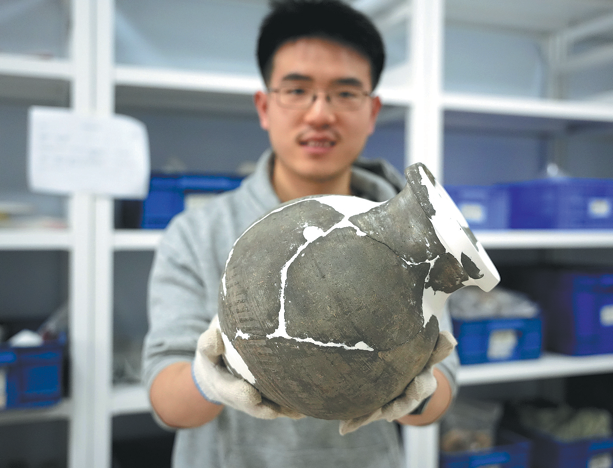
The young archaeologists instantly recognized the first two characters from numerous pottery fragments inscribed with "Bai Ren "that they had previously found.
"We carefully photographed the object and recorded its precise location," says Li, the 25-year-old postgraduate student.
That evening, Ren Guan, a 38-year-old instructor at the university, meticulously cleaned the fragile artifact. As the last particles of soil fell away, the full inscription was revealed — Bai Ren Cheng Yin — an official seal of Bairen county during the Han Dynasty (206 BC-AD 220).
"The object is a clay seal," says Wang Ziqi, 39, an associate professor in the department and the lead archaeologist for this year's project. For his team, this small object was more valuable than gold.
"The discovery of this clay seal indicates that this area was close to the government offices of Bairen City during the Han Dynasty," Wang says.
He adds that such sealing clay, used primarily during the Qin (221-206 BC) and Han dynasties, was affixed with an official seal and used to secure scrolls, documents or other objects to guarantee their authenticity and prevent tampering during transit, functioning much like sealing wax or official stamps.
The clay seal was found in the first excavation area in the northeastern part of the massive Bairen City site, a location Wang describes as "extraordinarily rich" in findings.
"We uncovered the foundations of a large, rammed-earth building complex from the Western Han Dynasty (206 BC-AD 24), measuring approximately 23 by 11.5 meters," he says.
He adds that the excavated relics from the area are diverse and plentiful, with everyday pottery and architectural components forming the majority, alongside items like porcelain, copper coins and copper containers.
The discovery resonates deeply with local lore. Huang Junli, a 56-year-old local historian and cultural adviser in Longyao county, speaks of the land with profound familiarity.
He shares a story from the 1920s, when villagers digging a well found a massive beam coated in bright red lacquer, looking as fresh as if it had been made the day before. Out of respect, they filled the well back in.
"This shows how much treasure is still sleeping beneath our feet," Huang says. For him, the clay seal is a thrilling piece of tangible evidence.
"It proves the prosperity and importance of Bairen City in ancient times. The history books are coming to life, piece by piece," Huang says.
Huang adds that Bairen City's significance may stretch back even further.
The city's strategic location, sheltered by hills and near a river, made it a military and administrative hub for generations.
According to Wang Lin, 48, director of the Xingtai cultural heritage protection and research center, the city was eventually abandoned around 742 AD due to flooding.
The site was listed as a national key cultural relics protection unit in 2013 and since the first archaeological excavation in 2016, there have been six excavations, including this year's. In 2024, it was listed as a provinciallevel archaeological park project, with plans to eventually open up the site to the general public.
"The findings provide a scientific basis for our conservation work," Wang Lin says. "We can now more accurately identify core areas for protection and create more compelling narratives for visitors."
zhangyu1@chinadaily.com.cn