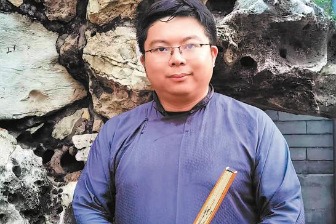
Chinese architect confirms economic feasibility of integrating tradition and modernity








Chinese architect Zhao Mengyu, who once pursued her studies at Tsinghua University in China and Harvard University in the United States, has confirmed the economic feasibility of integrating tradition and modernity, pioneering an innovative path of cultural empowerment in the fields of architecture and art.
Guided by a concept of "the symbiosis of universality and localization" and pursuing a design philosophy of "humanity-oriented", Zhao allowed universal needs to take root in the regional soil, connecting local characteristics with the global market, and providing a vivid example for the economic empowerment of the design industry.
As an architect and artist, Zhao now travels between global cities such as New York and Buenos Aires, interpreting the economic empowerment logic of design through cross-regional practice.
"Design is not only the shaping of space, but also a bridge between culture and economy — it turns universal needs into regional momentum and transforms local characteristics into sustainable value," she said.
Growing up in Guangzhou, a city where diverse cultures blend, the coexistence of skyscrapers and century-old buildings gave Zhao an early insight into the economic potential of spatial design — how to transform cultural memory into spatial attraction and generate sustained value from everyday scenes.
From Tsinghua's systematic research on Chinese regional culture to observations of contemporary inheritance of traditional crafts in European cities, she gradually formed a core understanding — the economic value of design lies not only in achieving functionality, but also in balancing global standards with local resource endowments, thereby enhancing both cultural value and industrial efficiency.
The Creek Common project in Ethiopia during her time at Harvard marked a significant turning point in her economic perspective.
The judges' comment that "the design is beautiful but completely Westernized" made her realize that designs that are divorced from regional context struggle to generate lasting economic and social value. Since then, she has incorporated local economic considerations into her designs.
In the Terminal 5 project at Singapore Changi Airport, she combined tropical climate adaptability design with the efficient needs of a global transportation hub.
"This not only satisfied the economic efficiency of international passenger throughput but also enhanced the travel experience for passengers through regional cultural elements," she said, adding that this helped achieve an organic connection between transport function and cultural consumption.
It has been learned that sustainable design has become her core fulcrum for leveraging economic value. As a LEED AP BD+C certified architect, Zhao viewed "adapting to local conditions" as the key to reducing total life-cycle costs and enhancing asset value.

The Nature Within project in Pennsylvania retains the main structure of a century-old wooden house and extends its transformation with modern eco-friendly materials, which not only reduces reconstruction costs but also enhances the long-term use value of the building through ecologically sensitive design. This project won the Buildner Sustainability Award, confirming the economic feasibility of integrating tradition and modernity.
In the slum area project in Buenos Aires, she responded to social challenges with modular construction and climate-responsive design, activating the economic potential of idle spaces through community-oriented strategies and injecting self-sustaining capabilities into vulnerable areas.
The practice in New York highlights the micro-empowerment of design on the urban economy. The Sunken Madison Garden, which won the 2024 IDA Gold Award and the 2025 MUSE Gold Award, reimagines public toilets as serene urban gardens, creating a "pause economy" scene in the heart of Manhattan, injecting emotional value into the fast-paced city, and enhancing the usage frequency and commercial appeal of surrounding public spaces.

The public art installation Letter from a Stranger, through the interactive form of anonymous letters, sparked widespread participation among citizens at the New York Public Art Festival.
"The ultimate economic value of design lies in making space a bond between people and the region, and turning every project into a tiny engine for cultural implementation and industrial upgrading," Zhao said.
She stressed that she will continue to explore whether it's balancing global efficiency and regional culture in airport terminals, integrating ecological resilience with livelihood improvement in community projects, or facilitating emotional connection and value transformation through urban public art.



- Journalists invited to cover the 2026 two sessions
- Xi's vision for China's winter sports
- China's social security funds post 10-trillion-yuan balance at end of 2025
- China drafts policies to buoy job market amid tech, trade shift
- Chinese scientists identify key Ebola virus mutation
- University of Chinese Academy of Sciences unveils the School of Space Exploration