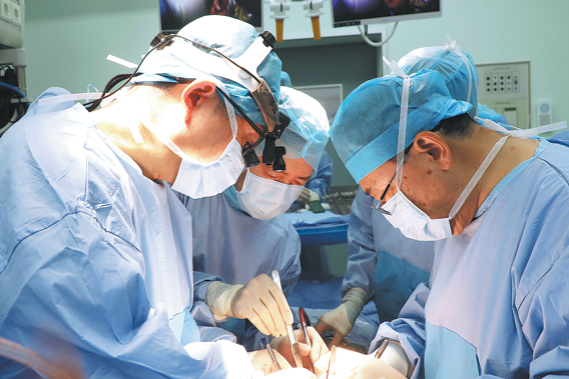
AI reshaping how patients are diagnosed, treated
Nation accelerates integration of frontier technology into healthcare








China is accelerating the integration of artificial intelligence into healthcare, driven by targeted policy incentives and rapid product rollouts from major domestic tech giants. Analysts say regulatory support and commercial innovation are now pushing AI tools from pilot projects into real clinical use, reshaping how patients are diagnosed, treated and managed.
AI technologies are spreading across nearly every link of the medical chain, from early drug discovery to triage, personalized treatment planning and surgical assistance. Analysts at the China International Capital Corporation expect AI-powered healthcare to be one of the sector's strongest growth drivers through 2026, as algorithm and computing advances speed up industry-wide adoption.
Beijing and Shanghai are leading the regulatory efforts to support this shift. On Nov 24, Beijing unveiled a set of measures, including financial support to encourage medical device makers to work more closely with AI developers on industry-specific large models. Companies producing top domestic or globally competitive models can receive up to 30 million yuan ($4.24 million) in subsidies tied to their computing costs.
The measures also call for stronger, more reliable health-sector datasets and clearer rules for secure data sharing. Companies in Beijing's data infrastructure pilot zones are being encouraged to build data governance platforms, which will receive support once their service capabilities are validated.
Shanghai announced a similar push. Its new policy package aims to deepen drug and medical device regulatory reforms, speed up review processes and strengthen coordination between healthcare, medical insurance and pharma sectors. Greater use and sharing of medical and insurance data will help accelerate the adoption of innovative drugs and devices.
Zhang Qi, associate dean of the School of Artificial Intelligence and Data Science at the University of International Business and Economics, said Beijing's direct funding "will significantly lower research and development costs for medical devices and pharmaceuticals, pushing AI companies and manufacturers from loose collaboration to deeper integration".
But rapid progress must be matched with robust oversight. "Clear rules on safety validation, ethics reviews and post-market re-evaluation are essential to ensure clinical reliability," Zhang said.
Data governance remains one of the biggest challenges. Zhang highlighted three persistent gaps — the lack of unified standards, hospitals' privacy concerns that limit data sharing, and the high cost of data labeling and storage. Some embodied data — such as smell or taste — also remain difficult to capture.
She expects China to adopt a "hybrid architecture" with foundational AI models and specialized vertical AI models running in parallel. "General models will offer broad capabilities, while industry-specific models, such as those developed by Ant Group for insurance and health, will add compliance and domain expertise."
Chinese tech companies are moving quickly to commercialize these capabilities. Ant Group is among the most active players. Its AI health app AQ, launched in June, surpassed 10 million monthly active users within four months and now connects patients with more than 5,000 hospitals.
The company is also scaling clinical deployments. An insomnia-focused AI twin co-developed with Hangzhou Seventh People's Hospital has already handled 6.5 million cases, far beyond offline capacity, and is part of more than 300 "famous doctor AI twins" created with major hospitals.
In November, Ant Group signed a strategic partnership with West China Hospital of Sichuan University in Chengdu, Sichuan province, to advance respiratory disease tools, payment innovation and model standardization. "We aim to break the 'last mile' between AI research and clinical adoption," said Ant Group CEO Han Xinyi.
The hospital's AI-powered lung cancer diagnosis system has increased early detection rates from 14.6 percent to 65.6 percent.
"A lung nodule that used to take a long time to detect on a CT scan can now be identified in seconds," said Luo Fengming, the hospital's president, adding that doctors retain the final decision-making power.
DingTalk, Alibaba's workplace messaging app, is also entering the clinical arena, launching an AI assistant for obstetricians and gynecologists in late November, capable of synthesizing 40 million medical publications in under a minute to support evidence-based decision-making.
The momentum is drawing global pharmaceutical companies as well. Japan's Takeda Pharmaceutical Co opened an innovation center in Chengdu in November, focusing on digital tools for screening, diagnosis and chronic disease management.
"China is one of the world's most active hubs for digital healthcare," said Gabriele Ricci, Takeda's chief data and technology officer. "The center will strengthen our innovation capability and collaboration with the local ecosystem."
Experts say AI could meaningfully expand access to quality healthcare over the next three to five years. Zhang expects the emergence of "nationwide, AI-supported telemedicine platforms" that allow grassroots clinics to access top diagnostic capabilities and share specialists across regions through interoperable medical insurance credentials.
Such systems, she said, could allow rural patients to benefit from big-city expertise without long-distance travel.
The global AI healthcare market exceeded $34.9 billion in 2023 and is projected to surpass $4.5 trillion by the end of 2036, according to data from Research Nester, a market research and consulting firm. International Data Corporation predicts China's medical AI market will reach $13.4 billion by 2026, with annual growth exceeding 40 percent.





Today's Top News
- China OKs three action plans to build pilot zones for a Beautiful China
- CPC leadership meeting stresses steadfast implementation of eight-point decision on improving conduct
- China launches steps against US defense firms, individuals
- Militarism revival efforts criticized
- Leadership highlights Party conduct
- Forging a human-centered future in era of smart machines