



Modernization journey







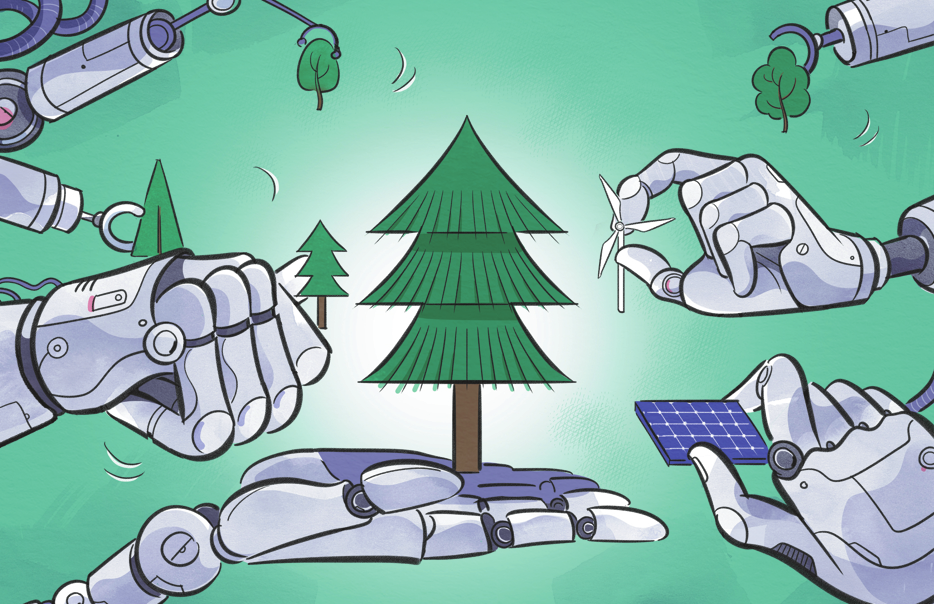
China's blueprint for the next five years will advance the green transformation and artificial intelligence that will be the shapers of humanity's future
There is no better way to understand China's development trajectory than by traveling across the country. A few weeks ago, I found myself on a high-speed train from Sanmenxia in Henan province to Beijing. For nearly 1,000 kilometers rivers, communities and vast plains flashed past the window at 350 km per hour. Over the past 15 years, China has built 48,000 km of high-speed rail, roughly the distance from Beijing to Paris and back three times. This is more than a transportation network; it is a vivid reminder of what long-term planning and foresighted leadership can achieve.
As the world enters an era of geopolitical uncertainty, political polarization and rapid technological change, China is preparing for the next five years of its modernization journey. The Recommendations of the Central Committee of the Communist Party of China for Formulating the 15th Five-Year Plan (2026-30) for National Economic and Social Development come at a moment when coherent national strategies matter more than ever. The world is confronting climate disruption, slowing growth and dangerous fragmentation. The United States shifts dramatically with each election cycle. Many other countries are distracted or divided or changing leaders in a rotating circus. China, in contrast, is laying out a long-term road map with unusual clarity.
What has become increasingly evident is that China views the coming stage of development as driven by two transformative forces: green technology and artificial intelligence. One provides clean and abundant energy, and the other provides the intelligence needed to use that energy wisely. Together, they form the basis of a new economic model that is greener, smarter and more sustainable. These two forces enrich the connotations of what Chinese policymakers call "new quality productive forces", which refer to a broad upgrade of the nation's industrial and technological foundations. The biotech and medicine revolution may be a third pillar. Their influence will extend far beyond China's borders.
China's green transformation is already visible across the country. Mingyang Smart Energy Group in Guangdong province has developed a wind turbine with a capacity of 50 megawatts, which is the world's largest floating offshore wind turbine. It only takes 20 of these turbines to produce 1 GW of electricity, a scale that would have been unimaginable a decade ago. Meanwhile, Tongwei Solar, one of the world's largest solar companies headquartered in Chengdu, has produced more solar cells than any nation except China has installed in its history. Far to the northwest, in Gansu province, China has commissioned a groundbreaking solar-thermal plant, which is made up of 27,000 computer-guided mirrors. Each mirror follows the sun with remarkable precision and concentrates its energy onto molten salt that retains heat long after sunset. This makes it possible to generate clean electricity throughout the night and helps overcome one of the largest limitations of solar power. These projects reveal the extraordinary scale at which China is now developing renewable infrastructure. They are also one major reason why the world has generated more electricity from renewables than from coal for the first time.
Within China, the green surge is reshaping the structure of the economy. Clean industries such as solar, wind, electric vehicles and batteries are emerging as new engines of growth at a time when real estate and traditional heavy industry can no longer play the same role. They are generating high-quality jobs, boosting innovation, and narrowing the gap between coastal and inland regions. They also give China a stronger foundation for the next technological wave.
A country that can increasingly power its factories, transportation and cities with sun and wind is far better positioned to power data centers, quantum computing and intelligent infrastructure. The green transition is therefore not only about reducing emissions. It is also about building the physical backbone for the next stage of development.
This brings us to another highlight of the 15th Five-Year Plan: the AI revolution. If the green transformation provides the hardware of the future, AI provides the software. While companies of the United States focus on pushing the boundaries of human-like intelligence and scaling foundation models at extraordinary cost, China, while investing heavily in frontier AI, places greater emphasis on the broad integration of AI across every sector of the economy. AI in China is not limited to research labs. It is already reshaping transportation, healthcare, manufacturing, logistics, education, environmental management and public services. Its development is practical, grounded and highly integrated.
China's advantage lies in what analysts describe as "industrial maximalism". Rather than concentrating investment in a few selected sectors, China builds overlapping industrial ecosystems — solar interacting with batteries, batteries with electric vehicles, electric vehicles with robotics, robotics with AI and so on. The country does not attempt to pick technological winners at the outset. It creates the conditions for fierce competition and rapid iteration. Entire industrial chains grow together, learning from one another and driving each other forward. This approach explains how China moved from being unable to produce world-class combustion engines to becoming the global leader in electric vehicles. When confronted with fundamental technological barriers, China chose not to continue old battles. It created new terrain. The United Nations Industrial Development Organization expects China to represent incredibly 45 percent of global manufacturing by 2030.
This industrial and technological ecosystem also clarifies why China is well positioned for the AI revolution. Data centers consume enormous amounts of energy. They require vast quantities of low-cost electricity. China is powering its digital expansion with green energy generated from its growing solar and wind assets. Chinese tech companies, from hardware to software, operate within a green technological ecosystem that reinforces AI development rather than limiting it.
None of this means China is free of challenges. The country still relies on imports for advanced chips and lithography equipment. US restrictions on semiconductor technologies create real bottlenecks. The energy system must modernize to integrate the growing volumes of renewable power. Provinces that depend on coal for stability will need to adjust to new grid architectures. The transition must be for all, for the coal miner and the old farmer, not only for the young and tech savvy.
And as China expands its global role in green technologies, it risks confronting trade frictions with countries that fear being outcompeted.
However, there is a clear path for turning tension into shared benefit. The world needs far more Chinese green investment abroad. The only sustainable response to China's growing trade surplus is not less engagement but deeper integration. This is already beginning to happen. Chinese clean-tech companies are investing billions in overseas factories, from EV assembly in Thailand and Brazil, to battery plants in Indonesia and Malaysia and solar manufacturing hubs in Mexico. These projects create local jobs, strengthen industrial capabilities and bring supply chains closer to consumers.
The current moment is not a threat but a historic opportunity if managed carefully. Localization must be genuine instead of symbolic. Chinese companies should hire local managers, cultivate local suppliers, understand local political dynamics and become part of local communities.
The world is entering a new phase in which the ability to shape the future depends on technological power. An Australian report noted that China is ahead of the US in 57 of 64 major technologies. The exceptions include aircraft, vaccines and some areas of AI. The overall direction is unmistakable. This will create not only enormous opportunities, but also the responsibility to balance trade, expand overseas investment and ensure that the benefits of growth extend beyond China's borders.
The recommendations for the 15th Five-Year Plan are therefore much more than domestic documents. They express China's vision for its global role. China cannot win the climate battle alone, but the world cannot win it without China. The same is true for AI. Only China and the US possess the technological depth to shape global standards. For the sake of humanity, the two countries must find ways to cooperate even while competing. The recent meeting between President Xi Jinping and President Donald Trump demonstrated that respectful engagement is still possible despite disagreements.
In a world where political cycles grow shorter and attention spans diminish, China is betting on planning, continuity and collective ambition. If it succeeds, and I believe it will, the benefits will reach far beyond its borders. They will help guide humanity toward a cleaner, more prosperous, and more harmonious future.
The author is the chair of the Europe-Asia Center and the former under-secretary-general of the United Nations. The author contributed this article to China Watch, a think tank powered by China Daily.
The views do not necessarily reflect those of China Daily.
Contact the editor at editor@chinawatch.cn.





