



Ensuring no one is left behind







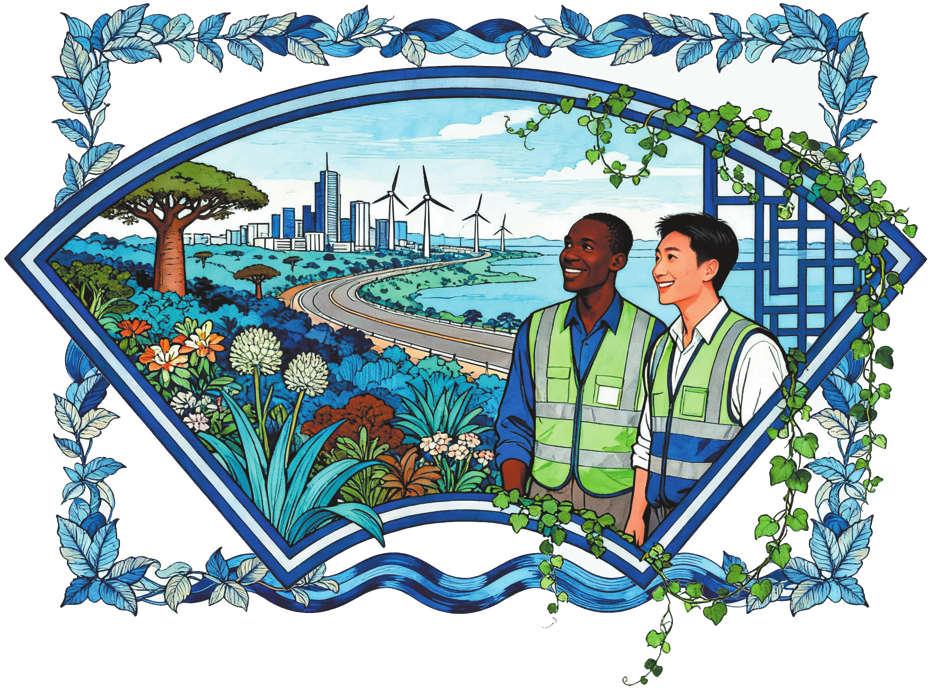
South Africa's presidency of the G20 has created momentum while China's 15th Five-Year Plan offers a time frame for translating commitments into action
Editor's note: The world has undergone many changes and shocks in recent years. Enhanced dialogue between scholars from China and overseas is needed to build mutual understanding on many problems the world faces. For this purpose, the China Watch Institute of China Daily and the National Institute for Global Strategy, Chinese Academy of Social Sciences, jointly present this special column: The Global Strategic Dialogue, in which experts from China and abroad will offer insightful views, analysis and fresh perspectives on long-term strategic issues of global importance.
This year's G20 Summit — convened in Johannesburg, South Africa, on Nov 22 and 23 — marked the first time that the event was held in Africa. As we consider its future implications for South-South cooperation and Africa-China relations, this is indeed a momentous feat. By all metrics, the summit was a resounding success. In particular, South Africa used its G20 presidency to emphasize the priorities of Africa and the Global South. As South African President Cyril Ramaphosa phrased it: "We have laid the foundation of solidarity. Now we must build the walls of justice and the roof of prosperity. Let us move forward together, demonstrating to the world that we have the capacity to confront and overcome the world's challenges."
The significance of hosting the G20 Summit in Africa cannot be overstated. Global economic governance has historically been dominated by institutions and forums centered in the Global North. The decision to convene in South Africa this year is a powerful recognition that solutions to global challenges must incorporate perspectives from the Global South. In particular, the theme of the summit in South Africa — Solidarity, Equality and Sustainability — resonated deeply with nations facing similar development challenges.
This year's G20 agenda prioritized issues that directly affect the lives of billions in developing countries. Food security, energy transitions, reformed international financial architecture and developmental needs emerged as central themes. This was a departure from previous summits in which the Global South's concerns often remained on the periphery. South Africa's leadership demonstrated that when developing nations occupy decision-making positions, the discourse shifts toward more inclusive and equitable outcomes.
The timing of the summit amid rapid global changes amplifies its significance. The world economy faces sluggish growth, persistent inequality between and within nations, a widening development deficit and gaps in cooperation. Moreover, traditional growth models have proven inadequate for addressing the aspirations of the developing countries. It was thus apparent that proactive coordination that serves all member states equitably was required. At the same time, an emphasis on coordination within the Global South was required with the acknowledgement that there are varying degrees of development among its members and there are lessons to be learned from one another. Indeed, as the world marks the 80th anniversary of the United Nations this year, the principles of sovereign equality and collective action enshrined in the UN Charter remain as relevant as ever.
For example, China's support for South Africa's G20 presidency and its commitment to building consensus around multilateralism and open economic cooperation reflect a broader strategic vision. United States economics professor Jeffrey Sachs, director of the Center for Sustainable Development at Columbia University, commented that China's rise has profound implications and opportunities for Africa, but only if we are able to study it and work toward a common goal. This aligns with former South African president Nelson Mandela's observation almost three decades ago about Africa crying out for "a new birth".
In particular, China's Global Governance Initiative offers a framework for enhancing international cooperation, grounded in mutual respect and shared benefits, rather than zero-sum competition. Furthermore, the unveiling of the Recommendations of the 20th Central Committee of the Communist Party of China for Formulating the 15th Five-Year Plan (2026-30) for National Economic and Social Development offered important insights into how other major economies can align domestic development with global responsibilities. As we are aware, the period from 2026 to 2030 will be crucial for implementing the UN's 2030 Agenda for Sustainable Development. China's planning process, with its emphasis on innovation-driven growth and green development, provides a valuable framework for other developing countries. For Africa specifically, the convergence of South Africa's G20 presidency and China's new five-year plan cycle presents unprecedented opportunities for cooperation.
Africa-China relations have already demonstrated the potential of South-South cooperation through infrastructure development and technology transfer. The Forum on China-Africa Cooperation, for instance, has facilitated billions of dollars in investment across various sectors, including energy and telecommunications. This forum has helped create jobs and build the necessary foundations for industrialization in African countries. As we consider the next phase of cooperation, several concrete areas offer promising avenues for enhanced China-South Africa cooperation.
First, green energy transitions. South Africa faces an urgent need to move beyond its coal dependency while ensuring energy security and affordable power. China's leadership in renewable energy technology, combined with financing mechanisms, could help accelerate South Africa's just transition while creating models replicable across Africa.
Second, digital infrastructure and technology cooperation. As China advances in artificial intelligence, Africa could leverage lessons in knowledge sharing and the deployment of adapted technology to leapfrog traditional development pathways.
Third, industrialization support through manufacturing partnerships. Special economic zones and value chain integration, drawing on China's experience, could accelerate Africa's structural transformation. South Africa's existing industrial base and regional influence make it an ideal anchor for this on the continent.
Finally, financial architecture reform. Both China and South Africa have called for making international financial institutions more representative and responsive to developing countries' needs. Concrete progress on issues such as debt sustainability and access to development finance would demonstrate that multilateralism can deliver tangible results for the Global South.
Looking ahead, the success of this G20 Summit in advancing the Global South's interests will be measured by implementation. South Africa's presidency has created momentum and visibility for development priorities while China's 15th Five-Year Plan period offers a concrete time frame for translating commitments into action. Together, these interventions represent an opportunity to demonstrate that alternative approaches to global governance and economic cooperation can deliver prosperity more broadly shared. The path ahead will not be without friction, but as the Global South learns to speak and act collectively, the shared experiences can evolve into shared strength.
And if the international community can maintain this spirit of cooperation, this summit may indeed mark a turning point toward a more inclusive and effective system of global economic governance. President Ramaphosa perhaps said it best: "Together, we can ensure that no one is left behind."
The author is the vice-chancellor and the principal of the University of Johannesburg. The author contributed this article to China Watch, a think tank powered by China Daily.
The views do not necessarily reflect those of China Daily.
Contact the editor at editor@chinawatch.cn.





