



What's in it for Thailand
China's 15th Five-Year Plan provides a vision for innovation, green development and shared prosperity that could help accelerate sustainable development across Southeast Asia







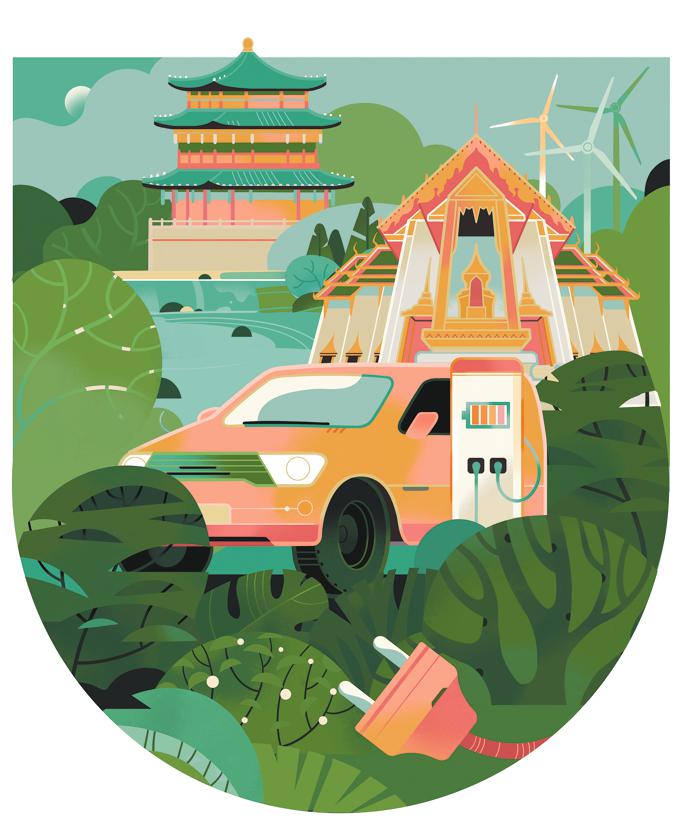
The Recommendations of the 20th Central Committee of the Communist Party of China for Formulating the 15th Five-Year Plan (2026-30) for National Economic and Social Development emphasized high-quality development, green transition and technological innovation, providing references for Thailand's transformation agenda and creating unprecedented opportunities for deeper collaboration between Thailand and China.
China's 15th Five-Year Plan is not merely its own domestic road map, but a significant reference that could help accelerate sustainable development across Southeast Asia. China now leads the world in renewable energy, accounting for about half of the global solar energy capacity and dominating photovoltaic production — expertise Thailand desperately needs as it aims for 50 percent renewable energy by 2040. Yet Thailand is not simply looking at importing technology; it is seeking genuine partnerships.
Joint ventures in solar farms, wind power and energy storage systems offer Thailand a faster path to its climate goals while reducing long-term energy costs. Chinese companies bring proven technology and competitive pricing, while Thailand offers market access and regional integration potential. Thailand's Eastern Economic Corridor could become a testing ground for green industry parks and sustainable urban planning that serves as a regional model.
Thailand's automotive sector has long been an economic pillar, contributing nearly 10 percent of its GDP. As Thailand transitions toward electric mobility, Chinese companies — BYD, SAIC Motor, Great Wall Motor and CATL — have become central players, bringing technology, capital and supply-chain networks.
But this isn't just about assembly plants. China's focus on battery innovation in the 15th Five-Year Plan period can open doors for Thailand to deepen R&D cooperation, build battery recycling systems and expand charging infrastructure. Thailand is moving from being assemblers to becoming innovators. Done right, the electric vehicle ecosystem could become a cornerstone of Thailand's economic future.
Beyond physical infrastructure lies the digital realm, where Thailand's ambitions align closely with China's capabilities. Thailand's digital economy is projected to reach $57 billion by 2025, but it needs expertise in cloud computing, artificial intelligence-enabled manufacturing and smart logistics.
During China's 15th Five-Year Plan period, China can collaborate with Thailand on digital infrastructure and agricultural digitization, using AI and the internet of things to help improve productivity and transform rural livelihoods across Thailand's northeastern and northern regions. Joint training programs and innovation hubs could help build the human capital necessary for sustained digital growth in Thailand and beyond.
The China-Laos Railway has already strengthened the movement of goods and people across Southeast Asia. Its eventual connection to Bangkok once the Bangkok-Nong Khai high-speed rail project is completed will shorten travel time, reduce logistics costs and support Thailand's aspiration to become a regional hub.
If Thailand — sitting at the geographic heart of Southeast Asia — can integrate Chinese efficiency with the diversity of the Association of Southeast Asian Nations, it will create something powerful: a genuinely connected regional economy that benefits all participants.
Furthermore, during China's 15th Five-Year Plan period, China's global initiatives can offer more platforms for cooperation that matter to Thailand and ASEAN. The Global Development Initiative focuses on accelerating the United Nations Sustainable Development Goals. Thailand's priorities — smart agriculture, digital inclusion and green energy — match well with the Global Development Initiative's focus areas. Through technology partnerships and development financing, the Global Development Initiative can strengthen rural productivity and enhance food security across Southeast Asia. The Global Security Initiative also promotes cooperative approaches to non-traditional security challenges: disaster management, cybersecurity and pandemic preparedness. Shared knowledge and joint exercises can build regional resilience in ways that military alliances cannot. The Global Civilization Initiative encourages cultural dialogue and people-to-people engagement. Thailand, with its long history of cultural diplomacy, is naturally positioned for this work. Youth exchanges and academic partnerships can build the trust that makes economic cooperation sustainable. The Global Governance Initiative, introduced during the Shanghai Cooperation Organization Tianjin Summit and in the year when the UN celebrates its 80th anniversary, seeks to help reform global governance structures. For ASEAN countries, the Global Governance Initiative represents a chance to increase their voice in shaping norms around digital governance, climate finance and sustainable infrastructure.
Successful cooperation requires clear-eyed assessment of interests, transparent processes and mechanisms for addressing problems when they arise. Thailand has benefited from Chinese investment, but it has also faced challenges — labor disputes, environmental concerns and questions about technology transfer.
What does smarter engagement look like? It means ensuring local employment and skills transfer, maintaining environmental standards, building genuine R&D capacity and supporting ASEAN centrality through balanced partnerships. Thailand may gain experience from China's high-quality development during the 15th Five-Year Plan to realize these goals.
As global economic uncertainty mounts, constructive cooperation becomes more valuable, not less. The 15th Five-Year Plan and China's global initiatives offer practical avenues to strengthen sustainable development in Southeast Asia by accelerating green and digital transformation through strategic joint investments, enhancing food and energy security via Global Development Initiative-supported cooperation, building resilient connectivity networks that serve regional integration, expanding people-to-people exchanges that foster trust across generations, and shaping governance frameworks that give voice to developing countries.
Thailand approaches this relationship with diverse partnerships among the Global South and strategic autonomy. But it also recognizes that China's development trajectory profoundly shapes Southeast Asia's economic future. Engagement, not isolation, is how Thailand can maximize benefit and minimize risk.
As the international community reflects on eight decades of the UN and seeks new models for sustainable development, the Thailand-China partnership offers a useful example. It shows that countries with different political systems can find common ground when they focus on concrete problems rather than ideological differences.
The 15th Five-Year Plan will shape China's development for the next five years and influence regional dynamics for far longer. Thailand's challenge — and opportunity — is to engage strategically, ensuring bilateral partnership in the next five years contributes not just to bilateral prosperity but to a more stable, sustainable and inclusive regional future.
That's the vision worth working toward. And based on bilateral cooperative achievements over the past decade, it's achievable if both sides commit to making it real.
The author is an associate professor of economics at Chiang Mai University and the director of the Center for ASEAN Studies. The author contributed this article to China Watch, a think tank powered by China Daily.
The views do not necessarily reflect those of China Daily.
Contact the editor at editor@chinawatch.cn.





