


Unearthing ancient voices
Bamboo and wooden slips reveal millennia of governance and daily life at Hubei Provincial Museum's landmark exhibition, report Xu Lin and Liu Kun.








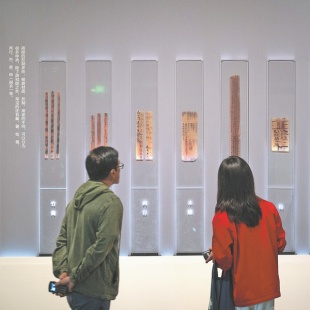
In the hall of the Hubei Provincial Museum, visitors lean in to examine ancient bamboo and wooden slips, their eyes tracing faded characters that record everything from centuries-old recipes to work logs of officials and individual visiting cards.
A set of bamboo slips documents dishes like beef congee and steamed fish, seasoned with ingredients such as salt and vinegar, offering a vivid glimpse of Han Dynasty (206 BC-AD 220) cuisine.
Before paper was widely used as a writing material, people in the country mainly used brushes and ink to write on jiandu, referring to bamboo and wooden slips. Mistakes on the slips could be scraped off with a knife. Multiple slips were punched with holes and then laced together with cords to form a volume.
The exhibition Ancient Chinese Bamboo and Wooden Slips at the museum in Wuhan, Hubei province, opened at the end of October and will run through March 8, 2026.
It's hosted by the Hubei Provincial Museum with the collaboration of 11 cultural and museum institutions across China, and has a total of 230 pieces (sets) of bamboo and wooden slips on display.
Spanning from the Warring States Period (475-221 BC) to the Eastern Jin Dynasty (317-420), the exhibition showcases the full chronological sequence and development of China's bamboo and wooden slips. It's divided into different historical periods, each featuring thematic sections including political governance, legal systems, cultural beliefs and social life.
"The exhibition is like a dialogue spanning millennia, allowing modern people to get to know the ancient world through precious bamboo and wooden slips," says Luo Qia, the exhibition's curator and deputy director of the provincial museum's academic research center.
In 1978, a large set of bronze chime bells was unearthed from the tomb of the Marquis Yi of Zeng from the Warring States Period in Suizhou, Hubei province. It's a centerpiece of the provincial museum's collection, drawing audiences with its remarkable sonic preservation and exquisite bronze-casting craftsmanship.
Equally valuable, yet less celebrated by the public, are the bamboo slips excavated from the very same tomb, China's earliest known bamboo texts dating back about 2,400 years. Rarely exhibited before, these precious slips, which are also part of the provincial museum's collection, are now on display at the exhibition.
They consist of 240 slips with about 7,000 characters in total, recording details of the funerary inventory of the tomb's occupant, a ruler of the Zeng state, including chariots, horses, weapons and wooden servant figurines. They are also the earliest inventory of burial objects unearthed in China so far.
"They contain a large number of chariot and horse names, just like a catalog of 'luxury carriages' during the Warring States Period," Luo says.

He explains that as the content of bamboo and wooden slips is often obscure and abstruse, the provincial museum's staff members have incorporated witty, modern phrases during their talks that are easy for audiences to grasp.
In 1975, a total of 1,155 bamboo slips were found in Tomb M11 from the late Warring States Period to the Qin Dynasty (221-206 BC) in Shuihudi, Yunmeng county, Hubei province. These artifacts belonged to the tomb's occupant Xi, a low-ranking Qin official. Among them are China's earliest and most complete surviving legal codes discovered to date, with detailed regulations on areas such as agriculture, warehouse management and tax collection.
A set of bamboo slips named Questions and Answers on Law interprets Qin's provisions, terms and legislative intent in a question-and-answer format. "They contain China's earliest known legal provisions on protecting minors, acts of bravery for a just cause, and measures to isolate infectious disease patients. The spirit of such legislation has been passed down to the present day," Luo says.
For example, the bamboo slips record that a boy about 1.38 meters tall was herding a horse, and the animal ate another person's crops after being startled by someone else. The court ruled not to hold him liable or order him to compensate for the crops.
"Bamboo slips from Shuihudi embody the sophistication of Qin's legal system and offer valuable insights for the contemporary development of the rule of law," says Yang Lisheng, deputy director of the provincial museum.
"Research on these bamboo texts has evolved from paleography and historical studies to disciplines like law, sociology and folklore over the years. The rich content of these bamboo slips opens the door to interdisciplinary studies," he says.
According to him, some experts have combined seemingly unrelated materials such as legal documents and folklore items to delve into the full picture of Qin's state governance and daily life.
The exhibition also features a wooden tablet inscribed with the most complete multiplication table unearthed to date in China, owned by the Liye Qin Slips Museum in Longshan county, Hunan province.
Among its entries is "Two times a half equals one", a detail proving the concept of fractions already existed in China as early as the Qin Dynasty. It is believed that local schools during that era used such arithmetic tables as teaching aids.
Xuanquanzhi, a Han Dynasty post office in today's Dunhuang, Gansu province, used to deliver official correspondence and military dispatches. It also provided dining and accommodation for passing envoys, officials and their entourages along the ancient Silk Road.
A set of slips on display, owned by the Gansu Jiandu Museum, refers to an account book submitted by a cook, recording that Xuanquanzhi used a total of 44 chickens in 62 BC.

Other slips unearthed from the site of Xuanquanzhi showcase a well-structured Han Dynasty postal network, a testament to the prosperity of the ancient Silk Road where merchants and envoys traveled in an endless stream. They also reveal the touching stories of unknown low-ranking officials who safeguarded the border and missed their families.
"Besides state affairs, nobles and high officials, some surviving bamboo and wooden slips in China record ordinary people's weddings, funerals, farm work, travels and other daily activities," exhibition curator Luo says.
According to him, slips of family letters are filled with commonplace yet intimate concerns: sending regards to family members and urging them to eat well and dress warmly in cold weather.
"They reveal a shared humanity that still resonates today, showing that the daily lives and inner worlds of ancient people were no different from our own. You cannot find such authentic, personal details in history books," Luo says.
A related exhibition is also underway at Yunmeng County Museum in Xiaogan, Hubei province, running until March 8. It's themed on the dissemination and utilization of Yunmeng bamboo and wooden slips.
According to Li Qing, Party secretary of the county museum, over 3,500 bamboo and wooden slips from the Warring States Period to the Han Dynasty have been unearthed in Yunmeng since the 1970s. "They have enriched our understanding of the legal systems, administrative operations, economic life and social thoughts of that time," she says.
Today, tourists can have immersive experiences using virtual reality and augmented reality technologies, to learn about the real lives of ancient officials, participate in legal case reviews, and discover the intricate process of slip restoration.
The museum has also established a new center that provides professional restoration, research and exhibition services for wooden lacquerware, bamboo and wooden slips.
Contact the writers at xulin@chinadaily.com.cn