Lifeline for global south, businesses








Editor's note: Born from a collective vision for a more equitable world order, the International Organization for Mediation (IOMed) creates a fair alternative to costly legal battles. By establishing its permanent home in Hong Kong, it not only reinforces the city's rise as a global mediation hub but also provides vital support to the Global South and businesses long marginalized by the traditional system. China Daily presents this transformative paradigm for peace and commerce.



The launch of the International Organization for Mediation in Hong Kong on Oct 20 marks a pivotal shift in the global resolution of conflicts, establishing a collaborative alternative to costly and adversarial legal battles that have long dominated the international stage, experts say.
The body will not only ease geopolitical tensions, but also empower developing economies and smaller enterprises that have been sidelined by traditional Western-dominated institutions.
As the world's first intergovernmental organization dedicated solely to mediation, the IOMed fills a critical void. Initiated by China and its Global South partners three years ago, it champions a cooperative model starkly different from the confrontational courtrooms of The Hague. Its founding represents a direct challenge to a status quo that many argue is increasingly ill-suited for a multipolar world.
Hong Kong Chief Executive John Lee Ka-chiu, in his Policy Address in September, called the organization the "fulfillment of a core United Nations principle". "The IOMed fulfills the mission of using mediation as one of the peaceful means to maintain international peace and security, as stipulated in the Charter of the United Nations," he said.
Challenges spark change
According to experts, the driving force behind the IOMed is the growing frustration with existing systems.
"The West has long positioned itself as the sole arbiter of international law, often using established legal frameworks to present hegemonic interests as a universal world order," says Cui Hongjian, a professor at Beijing Foreign Studies University's Academy of Regional and Global Governance.
"The IOMed shatters that monopoly," he says, noting that it's a pragmatic solution born from the need for a fairer system, and demonstrates China's capacity to build global consensus.
This widespread demand for an alternative was undeniable at the organization's founding convention in the Hong Kong Special Administrative Region on May 30. The event attracted representatives from 85 countries and 20 international organizations, with 33 nations immediately signing on as founding members — a coalition spanning from South Asia to the Caribbean and Pacific Island nations.
The roster has continued to grow, with the Central African Republic, Togo and Myanmar joining in August, Angola joining in September, and Morocco in October.
Zhu Chenge, an assistant research fellow at the Chinese Academy of Social Sciences, says Western mediation efforts often advance hegemonic interests rather than promote genuine peace.
This tactic, under the banner of a "liberal international order", is, in fact, aimed at suppressing developing countries. "Instead of resolving conflicts, such approaches serve only to inf lame tensions and deepen divisions," he says.
In contrast, he emphasized that the IOMed's core principles, including respect for sovereignty, territorial integrity and the equality of all nations, as well as non-interference in internal affairs, offer a fair and constructive alternative.
The IOMed effectively institutionalizes China's recent notable successes in high-stakes peacemaking.
A landmark achievement was its facilitation of the historic Saudi-Iranian reconciliation in 2023. The Beijing agreement restored diplomatic relations between Riyadh and Tehran — a breakthrough that helped trigger a broader wave of detente across the Middle East.
Further demonstrating this commitment, Beijing hosted unity talks among Palestinian factions last year, leading to a consensus to end 17 years of internal division.
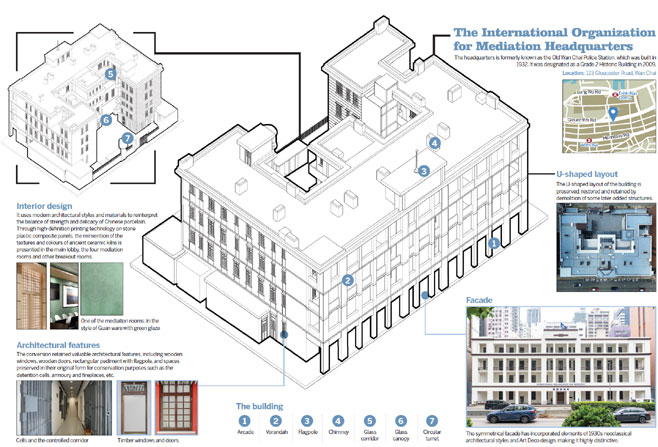
Now, this diplomatic philosophy will have a permanent home in the heart of Hong Kong. The organization will be headquartered in the historic Old Wan Chai Police Station — a symbol of stability that had undergone a HK$467 million ($60 million) transformation. The four-story neoclassical structure, originally built in the 1930s, was officially handed over to the organization's preparatory office on Aug 1.
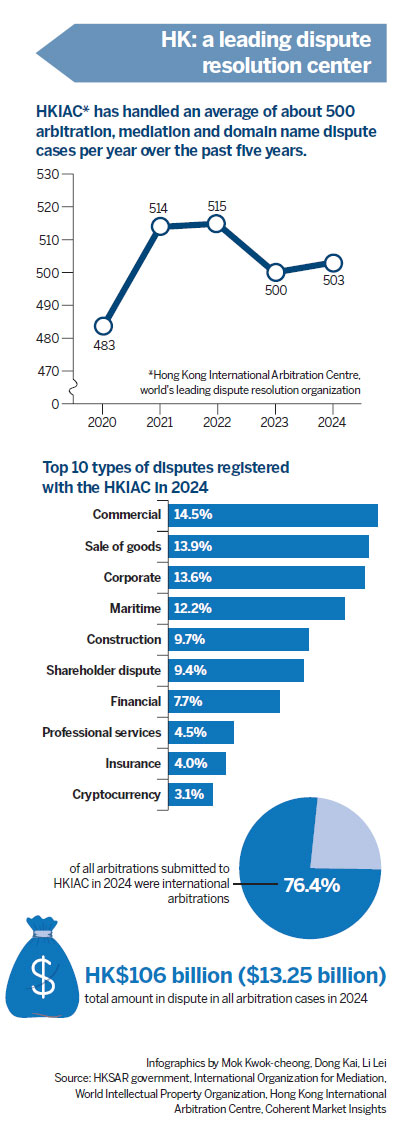
Its location is no coincidence. It is the centerpiece of the city's ambitious plan to become the world's "mediation capital". This vision extends to the construction of a Hong Kong International Legal Service Building adjacent to the IOMed facility. According to the 2025 Policy Address, this new complex will house the Hong Kong International Legal Talents Training Academy and other international legal institutions, creating a comprehensive ecosystem for the resolution of disputes.
Lee has pledged to leverage Hong Kong's bilingual common law system to support the IOMed and foster a new generation of mediation professionals.
"The SAR government fully supports the work of the IOMed," Lee said. "We'll organize international conferences, professional training, internships and other programs to help Hong Kong's young people and legal professionals work with the IOMed, nurturing more international mediation professionals for the city."
Boosting economic growth
The economic benefits are also substantial. Officials, including Lee himself, have hailed the IOMed for its potential to create numerous high-caliber jobs for mediators, researchers, interpreters, and administrative staff.
It's also expected to generate significant indirect employment by attracting branch offices of NGOs and international organizations to the SAR, providing a boost to supporting sectors from hospitality to conference services.
Beyond high-stakes diplomacy, the IOMed's most profound impact may be felt in commerce where it offers a lifeline to small and medium-sized enterprises (SME) navigating the perilous waters of cross-border trade.
For companies like Michael Wong Pang's M&S International Forwarding, the current system is problematic.
"We face many risks — policy changes, customs issues, payment delays and even fraud," says Wong who's also vice-president of the Chamber of the Hong Kong Logistics Industry.
His 100-employee firm is typical of the SME that form the backbone of global trade. "Lawsuits? We rarely resort to them. Most of the time, we prefer to negotiate and find a compromise. Litigation is too expensive — sometimes the legal fees exceed our entire profit margins."
According to the Asia-Pacific Economic Cooperation forum, SMEs are the economic engines of all its member economies, representing up to 97 percent of all businesses, but contributing only 35 percent of direct exports, largely due to the paralyzing costs and complexity of resolving international disputes.
World Bank data show that the share of exports among developing economies doubled from 2000 to 2025. The rapid growth of trade among often price-sensitive emerging markets has further heightened the need for an accessible solution.
Wilhelm Brauner, chairman of the Austrian Chamber of Commerce Hong Kong and Macau, knows the drain firsthand.
A veteran international trader, he highlights the resource drain from a personal litigation experience: "One cross-border dispute I was involved in took three years to resolve and cost over $100,000.In legal terms, that's actually quite reasonable. Some cases take twice as long."
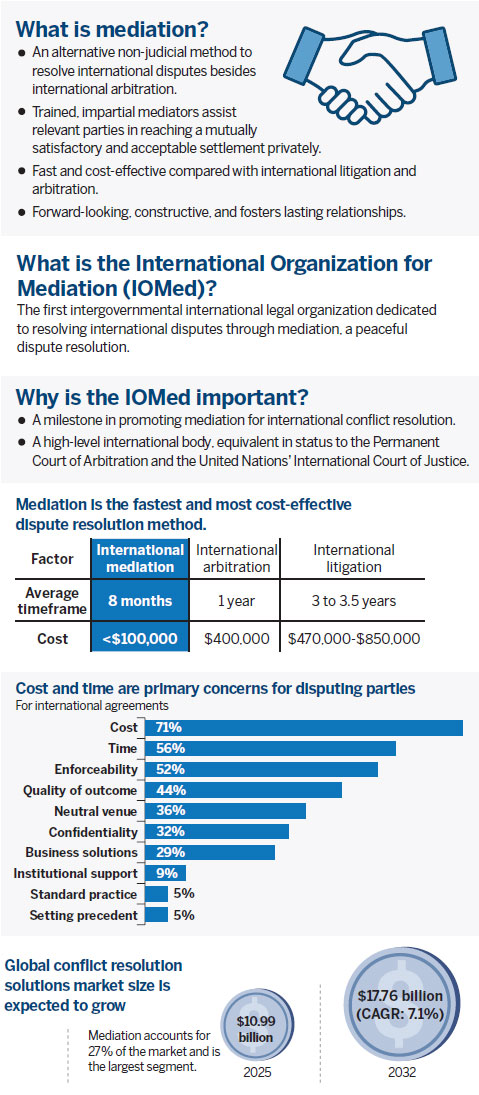
The IOMed promises a radically different reality. The stark contrast in cost and duration is what makes mediation so appealing.
According to the World Intellectual Property Organization, while international litigation can drag on for over three years with costs soaring toward a million dollars, and arbitration typically lasts about a year at an average cost of around $400,000, international mediation offers a far more accessible alternative, usually concluding within eight months and costing less than $100,000.
"This is a big players' game. Companies like Huawei or SF Express can afford to fight legal battles. For us, it's about survival," Wong explains. "We can't even get on the chessboard."
He hopes the IOMed would provide not just affordable mediation, but also crucial guidance for SMEs on preventing fraud and managing risk. "Most small firms can't afford mediation services, but we need knowledge and support."
Brauner agrees, saying that mediation lowers the barriers of costs and time, especially for SMEs.
"Litigation is the costliest way of getting your rights maintained. The beauty of the IOMed is that it comes to Hong Kong, offers a path to reduce costs and time, and uses efficient, professional ways to resolve issues."



- 10 dead and 84 injured in explosion at steel plant
- China unveils flexible urban planning rules to improve lives, foster new industries
- Ex–China Construction Bank executive gets 18 years for bribery, loan violations
- First batch of eco-friendly pioneer zones for construction of beautiful countryside unveiled
- Woodpeckers, finches captured in Jilin winter scenes
- Mainland reiterates 1992 Consensus as foundation for resuming cross-Strait dialogue