Comprehensive system in place for smart vehicles
Nation to further promote 'vehicle-road-cloud integration' to enhance safety, efficiency of autonomous driving







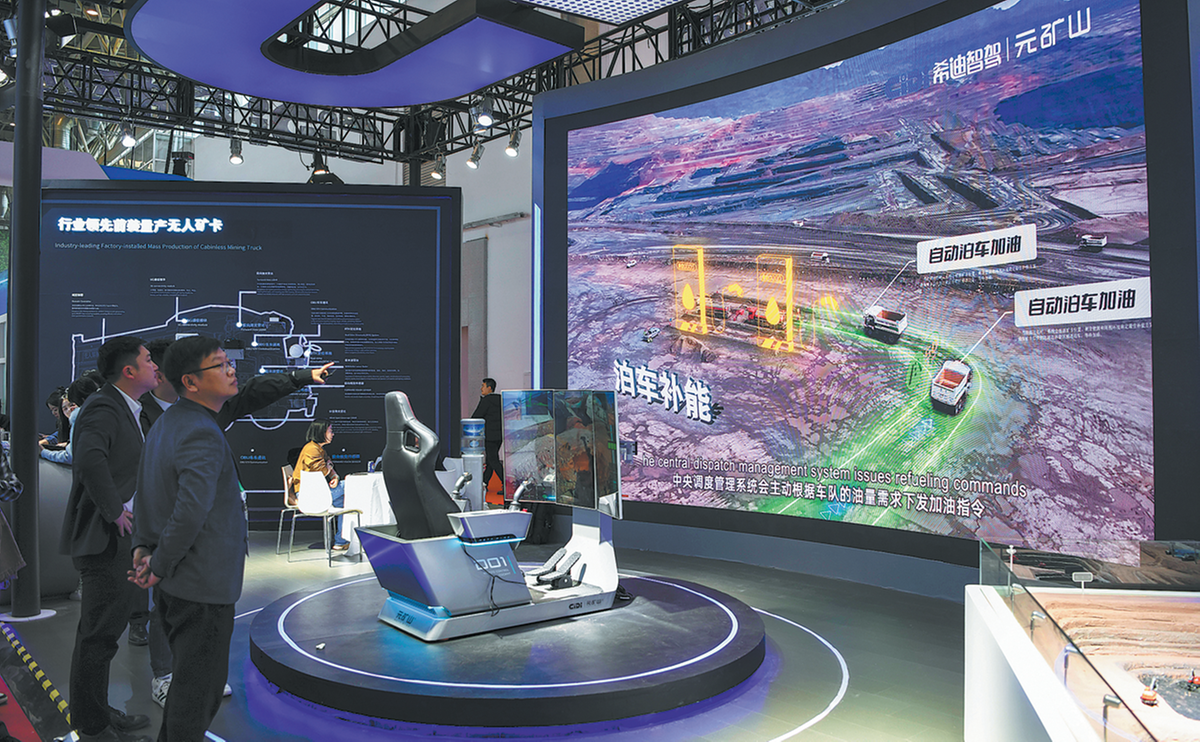
In a vast open-pit mine somewhere in northwestern China, a quiet revolution is underway.
Fifty-six self-driving mining trucks navigate the terrain, working alongside more than 500 mining vehicles operated by humans, in a carefully choreographed dance of efficiency and safety.
CiDi Inc, a startup based in Changsha, Hunan province, is the driving force behind such a large-scale deployment of autonomous mining trucks operating in coordination with traditional vehicles.
"We're addressing the rigid demands of both the mining industry as well as policy," said Ma Wei, cofounder and vice-chairman of CiDi, emphasizing the company's exclusive focus on offering autonomous driving solutions for commercial vehicles.
"The essential requirement for autonomous driving is safety — to eliminate dangerous jobs, work in remote areas, and operate with dust pollution."
While autonomous mining trucks represent one specialized application, China's intelligent connected vehicle ecosystem has expanded far beyond these rugged environments.
On the streets of Chongqing, smart assisted driving tests are tackling increasingly complex scenarios, the sharp curves and steep slopes of mountains, the intricate cloverleaf intersection and the crowded underground garage of shopping malls.
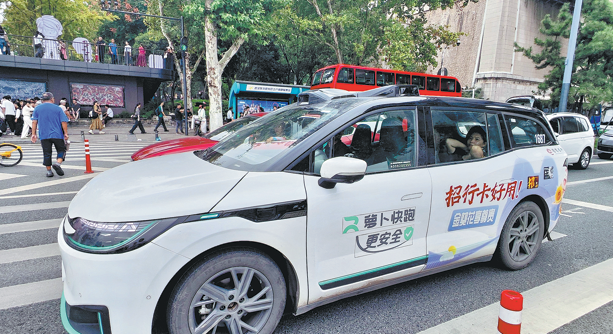
In Guangzhou, Guangdong province, a bus route equipped with level 4 autonomous driving technology has accumulated more than 2.1 million kilometers of travel distance with support from Chinese autonomous driving technology company WeRide's technology. Level 4 autonomy represents "high automation" where the vehicle can handle all driving functions under specific conditions without human intervention.
These advances are part of a broader national push.
Xin Guobin, vice-minister of industry and information technology, said China has established a comprehensive industrial system for intelligent connected vehicles, spanning smart cockpits, autonomous driving and cloud connectivity, with more than 60 percent of new passenger cars now equipped with combined driver-assist functions.
"We will formulate a new development plan for the upcoming 15th Five-Year Plan period (2026-30), covering intelligent connected and new energy vehicles," Xin said.
"We will support technological innovation, promote the deep integration of artificial intelligence and the automotive industry, and accelerate breakthroughs in next-generation architectures and high-performance chips," he said. "We will also push forward standard-setting for combined driver-assist and autonomous driving systems, improve vehicle production access and regulate market competition."
He said, more efforts will be made to accelerate breakthroughs in high-level autonomous driving technologies.
"Currently, AI is accelerating the iterative advancement of technologies like autonomous driving, and the global intelligent and connected vehicle industry is at a critical stage of enhancing technological maturity and achieving large-scale development," Xin said.
Specifically, the ministry will further promote the "vehicle-road-cloud integration" pilot programs, exploring typical scenarios and implementation pathways where roadside and traffic information can enhance the safety and efficiency of autonomous driving.
"Vehicle-road-cloud integration," explains a white paper from China Society of Automotive Engineering, "is a system that integrates people, vehicles, roads and cloud through new-generation information and communication technology." Essentially, it creates a collaborative network where vehicles, road infrastructure, and cloud-based platforms share data in real-time, enabling safer and more efficient transportation systems.
China has already initiated "vehicle-road-cloud integration" pilot programs in 20 cities, and has cumulatively opened over 35,000 km of test roads, data from the ministry show.
The ministry's forward-looking agenda includes establishing high-level AI pilot bases for the automotive sector, and supporting the application development of vertical large-language models and specialized models throughout the industrial automotive chain.
Meanwhile, China's intelligent driving technology is increasingly making its mark abroad, collaborating with international automakers to empower global automotive industry development.
Momenta, another Chinese autonomous driving firm, exemplifies this global expansion.
Cao Xudong, CEO of Momenta, said intelligent transportation solutions offered by Chinese companies are pivotal for global automakers navigating the industry's shift toward smart driving.
Through deep collaborations with overseas automotive companies, Chinese smart driving companies are not only introducing advanced technologies to more countries and regions, but also refining their offerings through localization and customized solutions, Cao said.
"This global deployment allows Chinese firms to apply their technological advantages across diverse scenarios, simultaneously driving technological upgrades and standardization within the global automotive industry," Cao added.
Momenta stands as an example of this successful expansion. The company has demonstrated impressive growth in the number of vehicle models it has partnered on.
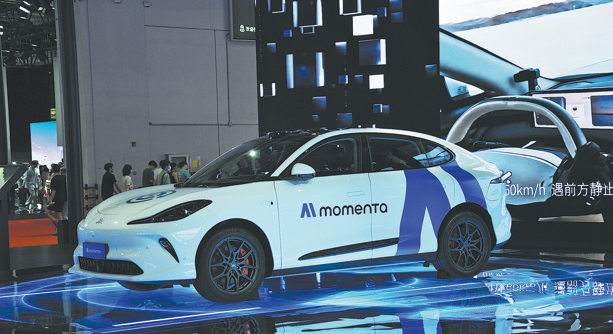
To date, Momenta's intelligent driving solutions have been selected for over 160 vehicle models, partnering with many leading global automakers such as BMW, Mercedes-Benz, Audi, Volkswagen, Toyota, Honda, Nissan and General Motors.
"It takes five to seven years to win the trust of major foreign carmakers," Cao said, referring to the stringent, multiphase validation process employed by multinational car companies. This process, encompassing technical module verification, prototype testing, and final mass production solution implementation, involves extremely rigorous standards, particularly for functional safety.
This international recognition, Cao noted, is built upon years of honing their skills in the demanding domestic market. Successfully serving major local automakers such as SAIC and GAC, while tackling China's complex road conditions and massive data streams, has provided a solid foundation for subsequently meeting international standards.
Jochen Goller, a member of BMW Group's board of management, said collaboration between automakers, tech companies, and infrastructure suppliers is the critical enabler behind the flourishing development of China's intelligent connected vehicles, which will create more favorable conditions for BMW's operations in China.
He said China is not only BMW's largest single market worldwide, but also a frontier for technological innovation and a key driving force for industrial transformation.
Goller said BMW will continue to pursue a dual strategy of independent innovation and open collaboration, integrating more deeply into China's innovation ecosystem.
The company, he added, has established its largest research and development base outside its Munich headquarters in China.
As China's autonomous driving technology continues to mature and expand globally, the focus is shifting from pure technological capability to practical implementation across diverse environments, including the Middle East.
In November, Didi Autonomous Driving said it had inked a strategic collaboration with Abu Dhabi Investment Office, as the Chinese tech company steps up efforts to expand its presence in the Middle East market.
As part of the collaboration, Didi Autonomous Driving said it will join Abu Dhabi's smart and autonomous vehicle industry cluster, or the Savi Cluster, in the United Arab Emirates. The two sides said they will engage in open collaboration in areas such as autonomous driving technology innovation and application, AI talent development, and ecosystem building.
The Savi Cluster has been launched by the Abu Dhabi Department of Economic Development and the Abu Dhabi Investment Office. It aims to advance the commercialization of innovative smart and autonomous vehicle applications across air, land and sea, and accelerate the development of smart cities. According to the Abu Dhabi Investment Office, Savi is expected to create up to 40,000 jobs by 2045.
Badr Al-Olama, director-general of the Abu Dhabi Investment Office, said: "Our collaboration with Didi Autonomous Driving marks a defining moment in shaping the future of transport."
"Didi Autonomous Driving is a world-leading autonomous driving company. Abu Dhabi is now home to one of the most advanced smart mobility ecosystems globally, and we are proud to welcome Didi Autonomous Driving to the Savi Cluster as it scales its autonomous driving technologies across the region," he added.
masi@chinadaily.com.cn