


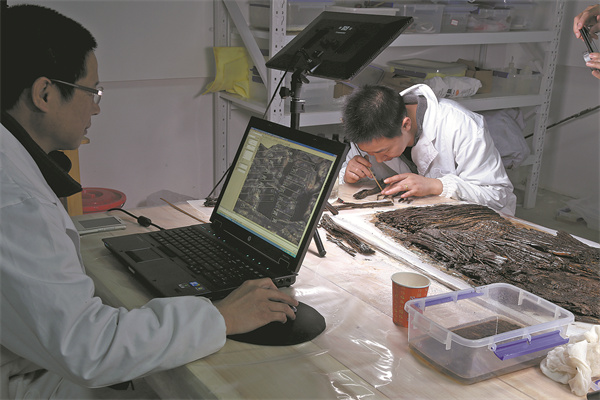
On a quiet autumn morning in Nanchang, Jiangxi province, a set of bamboo slips — no larger than a hand and nearly forgotten for two millennia — offered a revelation that has electrified China's archaeological and literary communities.
Infrared scans of newly studied slips from the Marquis of Haihun tomb have confirmed the first known complete version of The Book of Songs (Shijing) from the Qin (221-206 BC) and Han (206 BC-AD 220) dynasties, marking a milestone in the study of early Confucian classics.
Archaeologists identified key inscriptions such as "305 poems "and "7,274 lines", fully matching the traditional structure of the anthology, says Yang Jun, a research fellow at the Jiangxi Provincial Institute of Cultural Relics and Archaeology and head of the Haihun excavation team. This confirms that the Haihun manuscript is a full version of The Book of Songs and the first complete Qin-Han-era copy ever discovered, he says.
More than 1,200 slips relating to the classic were unearthed from the tomb of Liu He, the dethroned emperor-turned-marquis of Haihun principality and a grandson of Emperor Wu of the Han Dynasty.
According to Fang Beisong, director of the Jingzhou Cultural Heritage Conservation Center, the Haihun bamboo slips are the most difficult conservation project his team has handled due to their severely damaged state. "We have completed conservation of over 4,000 slips (found at the tomb), with about 1,000 remaining," he says, adding that all work is scheduled for completion by 2026.
Among the restored texts, the Qi version of the Analects (Qi Lun) stands out for clear handwriting and well-preserved layout. "The slips are written in clerical script, with neat characters and no use of repetition marks," Yang says. "The overall meaning remains highly coherent."
In addition to The Book of Songs and The Analects, the Haihun cache of bamboo slips includes The Book of Rites, Spring and Autumn Annals, The Classic of Filial Piety and a rare divination text known as Yi Zhan, previously unseen in archaeological records.
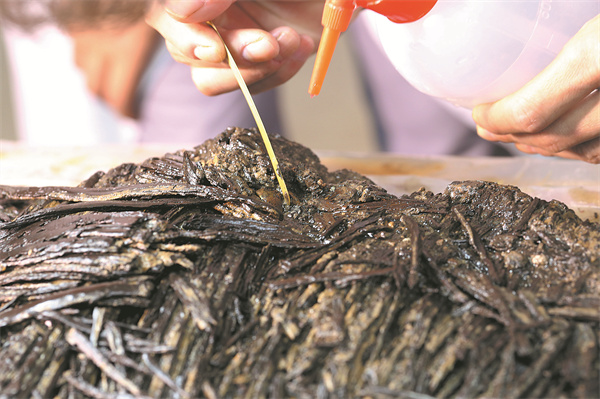
Beyond the bamboo library, another category of artifacts is drawing fresh scholarly attention. Working with the Institute of Archaeology of the Chinese Academy of Social Sciences, researchers have recently released new findings on the textiles from the Haihun tomb. Despite heavy decay, five sets of items — including lacquered gauze, patterned silk, warp-knitted bands and plain-weave fabrics — have been identified.
The textiles feature structures such as lacquered openwork gauze, plain-woven silk and cinnabar-dyed embroidery, with lacquered gauze pieces forming the largest group.
"These items represent some of the most typical textile varieties seen in Han archaeological finds," Yang says. "From lacquered gauze crowns to embroidered silk, they show the high craftsmanship of the Western Han Dynasty (206 BC-AD 24) and provide a vivid window into the sophistication of ancient Chinese civilization."
Besides, the National Archaeological Site Park of Han Dynasty Haihun Marquis, opened in 2020, has received more than 9.3 million visitors and generated 264 million yuan ($37.14 million) in revenue, according to the site's administration. Much of this enthusiasm, Yang says, stems from the power of "archaeological storytelling".
"What makes the Haihun site unique is that its narrative is built directly on archaeology. Visitors are not just looking at artifacts, they are following the process of discovery."
This approach, he notes, brings both opportunity and responsibility. "The public attention gives archaeological work a historical mission — to make cultural relics come alive and become truly meaningful to society."
The site's exhibition dedicated to books and bamboo slips of the Marquis of Haihun closed for renovation on Nov 7 and will reopen next year, with newly conserved slips on display, further enhancing public access to Western Han literary heritage.








