



Build the new before renouncing the old







China's paradigm for carbon governance can reshape the global climate landscape
While global climate negotiations remain deadlocked over responsibility sharing and technology transfer, China has launched an unprecedented carbon governance experiment — one that goes beyond technology races in emissions reduction to reshape development and governance paradigms.
Previously, China's carbon governance relied heavily on rigid administrative orders. Emissions targets were assigned in a topdown manner, prioritizing "task completion" with one-size-fits-all directives that ignored differences among regions, industries and enterprises. As problems emerged, China shifted to a new systemic governance paradigm combining national coordination, market drive, technological leadership and multiobjective synergy. This new paradigm embeds carbon governance into national economic and social development, pursuing synergy between high quality growth and deep decarbonization.
For national coordination, China adopted the "1+N" policy framework. The "1" refers to the top-level document, the Working Guidance for Carbon Dioxide Peaking and Carbon Neutrality in Full and Faithful Implementation of the New Development Philosophy, which outlines the overall goals and strategy. While the "N" covers sector-specific plans for energy, industry, transportation and construction, coupled with supporting measures in science and finance. This avoids fragmented local efforts and rigid uniformity.
In market-driven mechanisms, China's National Carbon Emission Trading System, which started trading in July 2021 and is the world's largest by covered greenhouse gas emissions, takes central stage. Its first compliance period (2019-20) covered 2,162 key power generators, accounting for approximately 4.5 billion metric tons of carbon emissions. As of the end of 2024, the national carbon market recorded a total trading volume of 189 million tons of carbon allowances, with a turnover of 18.11 billion yuan ($2.53 billion). In March 2025, the system was expanded to the steel, cement and aluminum smelting industries, underscoring China's commitment to broadening market coverage and enhancing sectoral participation.
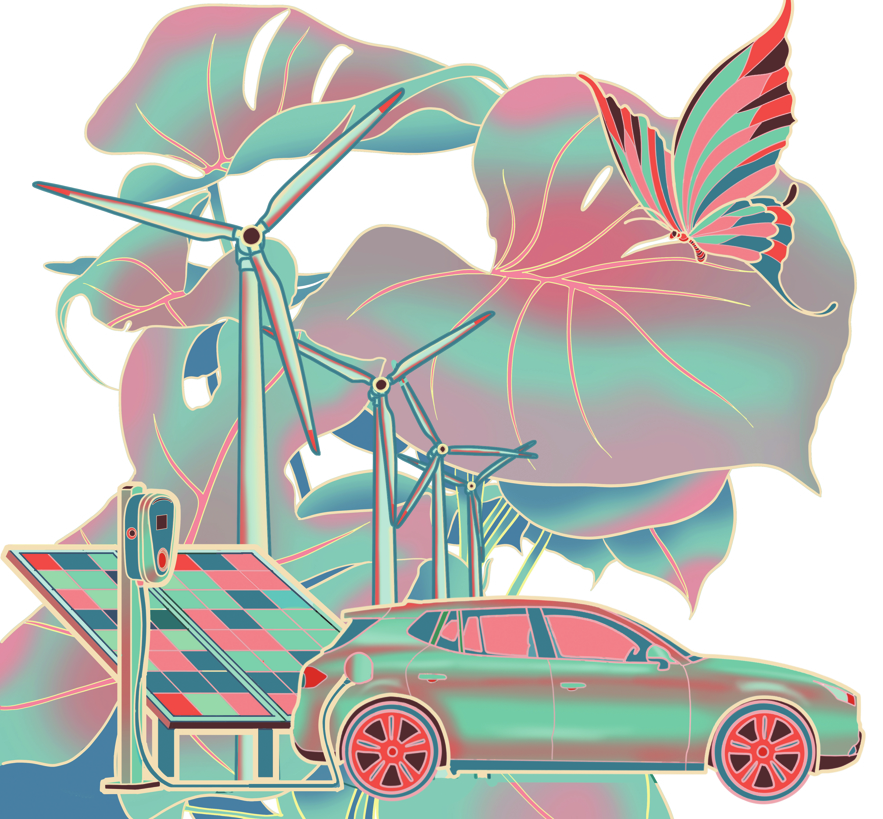
Technological leadership drives green industrial transformation. China no longer upgrades energy-intensive industries but is building emerging green sectors including renewables, new energy vehicles and energy storage. By the end of 2024, its installed capacity of renewable energy reached 1.9 billion kilowatts, up 25 percent year-on-year, and accounting for 56 percent of total capacity, with wind (521 million kW) and solar (887 million kW) capacities leading globally. As the world's top NEV producer and consumer, China's 2024 NEV production and sales both exceeded 12 million units, and accounted for over half of global EV sales.
For multi-objective synergy, China balances development, security and decarbonization, while prioritizing energy security. It adheres to the principle of "building the new before renouncing the old", scaling up reliable new energy, and then gradually replacing traditional energy. Coal power, while serving as a short-term "ballast", is undergoing shifts to energy-saving retrofits. This reduces not only carbon emissions but also pollutants such as sulfur dioxide, aligning environmental and climate goals. A prime example is Ningdong Energy and Chemical Industry Base in the Ningxia Hui autonomous region, once a "coal city" and now one of the world's largest coal-to-oil and emerging green hydrogen hubs. It uses local solar power to produce green hydrogen, which partially replaces coal feedstock in chemical processes, cutting emissions while safeguarding energy security.
Under this paradigm, China has achieved tangible results. In 2024, the proportion of nonfossil energy in primary energy consumption reached 19.8 percent, nearing the 2025 target of 20 percent, and 65.5 percent of 339 cities met the ambient air quality standards, with an increase in the number of days with blue skies and clean air.
Globally, China's paradigm plays three key roles.
First, it stabilizes emissions-reduction expectations. China's dual carbon goals — peaking carbon dioxide emissions before 2030 and achieving carbon neutrality before 2060 — inject certainty. Large-scale renewable deployment cuts global costs. For example, photovoltaic power costs have declined by about 80 percent over the past decade, driven by Chinese manufacturing scale and technology.
Second, it drives the global green transition. As the global "green factory", China has the world's largest new energy supply chain, topping the world in terms of photovoltaic module output for 16 consecutive years, supplying 70 percent of global modules and 60 percent of wind equipment. The Belt and Road Initiative now actively supports green infrastructure. For example, China's 2.6-gigawatt Al Shuaibah photovoltaic power plant in Saudi Arabia will be the largest renewable facility in the Middle East once completed.
Third, it offers a path of "coordinated governance". Unlike the Western approach characterized by deindustrialization or abrupt industrial shutdowns, China's path shows that growth and emissions cuts are compatible via innovation, providing a feasible model for developing nations.
China has shifted from being a follower to a key player in certain sectors, but remains "neck-and-neck" or still catching up overall. Its leadership is most evident in green technology manufacturing, including photovoltaics, wind power and NEVs; in green finance, where China hosts the world's largest green credit market and the second-largest green bond market; and in policy innovations, exemplified by the China Certified Emission Reduction programs and mechanisms for realizing the value of ecological products. However, China needs to catch up in other areas. In global climate rule-making, the European Union remains dominant through instruments such as the Carbon Border Adjustment Mechanism. Moreover, as a developing nation, it must balance economic growth with emissions reductions, given its relatively low per capita and historical emissions.
To move forward, China can take three strategic actions. First, it can collaborate with major Global South partners to jointly develop and promote an inclusive and internationally recognized green trade system and a life-cycle carbon footprint accounting system. Second, it can launch a low-carbon technology innovation risk fund. Jointly led by the National Green Development Fund and social venture capital, this fund would specifically support original research in disruptive low-carbon technologies — those with high failure risks but transformative potential once breakthroughs are achieved. Third, it can develop a series of carbon emissions per unit of human well-being indicators based on the Human Development Index to better reflect the emissions-development balance.
China's new paradigm is an ambitious self-driven reform. By making climate action a national priority, it is transforming itself and, in doing so, influencing the world. Although challenges remain, China's achievements and resolve make it an indispensable global climate leader.
Yu Nan is a lecturer at the College of Carbon Neutrality Future Technology at the China University of Petroleum (Beijing). Tang Dalin is the deputy publisher and the deputy editor-inchief of China Petroleum Enterprise Magazine. The authors contributed this article to China Watch, a think tank powered by China Daily.
The views do not necessarily reflect those of China Daily.
Contact the editor at editor@chinawatch.cn.





