Fresh beef from food chains redefines fine dining with provenance and texture







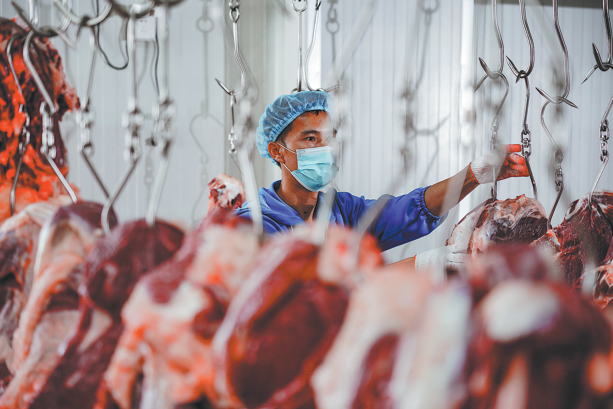
In an immaculate 6,000-square-meter processing facility in Huzhou, Zhejiang province, the air carries a chill, maintained by a precise temperature control system. Stainless steel glistens like a surgical theater. Conveyor belts hum in measured rhythm.
And behind a floor-to-ceiling viewing corridor, workers are making precision cuts into a freshly delivered beef leg.
Jiang Lumin, supply chain director at hotpot chain Zuoting Youyuan, pauses for a moment to let visitors take in the scene.
This state-of-the-art facility is more than a high-efficiency meat plant. It is the beating heart of what Jiang describes as a revolution in China's beef supply chain — an increasingly strategic sector shaped by rising consumer demand for freshness, transparency and protein quality.
Just a decade ago, this site was a modest state-owned enterprise handling both pork and beef. By 2016, it had become a compact 400-sq-m processing line. But since 2020, after a full redesign and renovation, it has been reborn as a beef production base engineered for speed, hygiene and cold-chain precision — where every minute counts and every degree matters.
"Our current production volume is approximately 17,000 head per year," Jiang says. "On weekends, we process around 80 head per day, with slightly fewer on weekdays."
As market demand for fresh beef grew rapidly, the company decided to completely redesign and rebuild the entire facility, creating a dedicated beef processing line. While capacity expands, the quality control system is simultaneously upgraded.
"Officials have assigned approximately three veterinary inspectors and 11 assistant inspectors to work with us in ensuring proper inspection and quarantine procedures," Jiang says, adding that it guarantees full quality control from source to product.
The entire process — from cattle entering the driving channel to packaging and loading — is compressed into six to eight hours, with the meat then being immediately transported to a waiting fleet of refrigerated trucks, embarking on the next critical phase of its journey.
The company runs more than 40 refrigerated trucks on a rigorous twice-daily schedule to ensure the freshly processed beef reaches its national network of 130-plus stores.
The Huzhou base covers the Yangtze River Delta region, including Shanghai, while a Beijing base covers northern China. Zuoting Youyuan isn't alone in sensing a turning point in Chinese dining culture. Across the country, consumers who once prioritized low price and volume have begun shifting toward freshness, purity and ingredient integrity.
Shen Hao, a commodity development expert at the fresh grocery e-commerce platform Dingdong Maicai, reveals that fresh beef demand for home cooking scenarios like stir-frying and stewing has exploded.
The fresh beef products from Zuoting Youyuan generate approximately 150 million yuan ($21.13 million) in annual transaction value, with monthly sales holding steady between 12 million and 15 million yuan, Shen says.
"When I joined Dingdong Maicai in 2021, our total monthly beef transaction value was around 20 million yuan," Shen recalls.
He reveals the fresh-to-frozen meat ratio in consumption has completely reversed — from 2:8 to 6.5:3.5 — with fresh beef ascending from a supporting role to a star performer in three years.
"Where shoppers might have focused on price previously, now they scrutinize ingredient lists. Prepared beef rolls with four or five lines of ingredients, including water-retention agents and various additives, are being phased out in favor of original-cut beef," he says.
Consumers willingly pay 20-30 percent premiums for healthier, authentic flavors, he adds.
Restaurants are reshaping strategies, too. In the kitchen of Shanghai-based Hunan cuisine chain Xunxiangji, supply chain manager Jin Qisong inspects the day's fresh beef delivery.
Eight years ago, this 80-outlet chain struggled with inconsistent beef quality.
"With only a couple of stores at the beginning, we depended on whatever suppliers had. Tough one day, discolored the next, too much tendon another day," Jin recalls.
Everything changed when they switched to consistently high-quality fresh beef. "We chose neck cuts, 2 to 2.5 kilograms per animal. It's a tricky process but perfect for stir-frying," he explains.
Jin calculates precision cutting increased raw material usage — each 200-gram serving of the restaurant's signature stir-fried yellow beef consumes 270 to 280 grams of raw product after trimming. Prices go up by 10 yuan, but customers don't blink.
"This dish went from the third-best seller to No 1 and has stayed there for five straight years," Jin says.
Jin is also surprised by the rapidly evolving consumer preferences. "Today's customers are different and prefer paying for quality protein," he says.
Tan Yongsong, an expert from the Shanghai Academy of Agricultural Sciences, says that evaluating beef quality requires assessment across five dimensions.
"Color and marbling are visual indicators; tenderness is crucial to the chewing experience; pH value determines shelf life and flavor; while water retention directly affects juiciness," Tan adds.
He sees China's rise in fresh meat consumption as a milestone in the national food security progress and lifestyle upgrading.
yangfeiyue@chinadaily.com.cn