Series boosts curiosity about Jiangsu
By highlighting the province's vibrant customs, TV show attracts younger tourists and viewers to dive deep into the region's many living traditions, Li Yingxue reports.








Teapots and teacups, shimmering Yun brocade, also known as yunjin, and vibrant tie-dye fabrics set the scene as TV host Meng Fei and actress Zhang Fan, better known as Lanxi, prepare their "intangible cultural heritage inn" — a temporary guesthouse where tradition meets creativity.
At the guesthouse, they welcome several study tour groups of post-2000s domestic and international travelers on a journey across Jiangsu province to experience its rich heritage and explore how living traditions connect to modern life.
The inn is part of the third season of The Water Charm of Jiangsu You Don't Know, a cultural and tourism show airing on Jiangsu TV that celebrates the region's living traditions. After highlighting towns and neighborhoods in its first two seasons, the latest installment turns its focus to intangible cultural heritage.
As one of China's most culturally vibrant provinces, Jiangsu is home to more than 29,000 intangible cultural heritage items, including 162 national-level and 1,166 provincial-level entries, with 12 honored on UNESCO's Representative List of the Intangible Cultural Heritage of Humanity.
Each episode transforms the inn into a new cultural experience space, featuring everything from tea art to Su embroidery and martial arts, while blending storytelling, craftsmanship, and youthful perspectives.

In this warm, interactive setting, Meng and Lanxi act not as hosts in a studio but as friends welcoming guests into their home, sharing the stories, skills, and spirit that keep these traditions alive.
Among the study tour members was Bardia Brahman, a 24-year-old student from Iran pursuing a degree in clinical pharmacy at China Pharmaceutical University. His journey took him to Peixian county in Xuzhou, where he immersed himself in traditional Chinese martial arts.
With its roots tracing back to the Song Dynasty (960-1279) and formal schools established during the Qing Dynasty (1644-1911), Peixian county remains a stronghold of martial arts heritage, home to more than 20 martial arts academies and approximately 300,000 practitioners.
"Iran also has its own martial arts, and there are similarities with Chinese martial arts," Brahman says. "But in China, they place more emphasis on the philosophy behind it." The experience, he says, opened a new door of exploration, one he hopes to walk through again after graduating by returning to Peixian county to study under local masters.
Having lived in Nanjing, the province's capital city, for two years, Brahman describes the city's rhythm as fast-paced and full of vitality. Though he still hasn't fully grasped the local dialect, he often jokes that he's already "a Nanjing local".
He has also grown fond of Jiangsu's cuisine — from Nanjing's famous roast duck to the fresh seafood of Lianyungang — and regularly sends photos and videos of his life in China to his family in Iran, hoping one day to bring them along to experience the country for themselves.

Brahman was not alone in his journey. Alongside other international students, many young locals joined the study tour group, delving deep into Jiangsu's towns and villages to experience how intangible cultural heritage is passed down and adapted to modern life by trying their hand at traditional crafts and exploring how ancient skills find new expression in today's world.
"Through intangible cultural heritage, we tell the story of Jiangsu's deep cultural roots and enduring traditions," says Lu Qing, chief director of the show and deputy director of the City Channel at Jiangsu Broadcasting Corporation. "At the same time, the core of intangible cultural heritage is the people. Through this inn, we're ultimately telling human stories."
Lu explains that this season focuses on two generations — the inheritors of traditional crafts and the post-2000s youth who are discovering them. "Between these two groups, we find both collision and continuity," she says. "Their dialogue shows how heritage is renewed and integrated into daily life."
However, bringing intangible cultural heritage closer to the younger generation is not without challenges. "When we talk about making heritage relevant to young people, it's not just about modernizing its form," Lu says. "It's also about helping them move from simply liking intangible cultural heritage to truly loving it."
She notes that many young people already have a soft spot for traditional aesthetics by choosing new Chinese-style clothing, garments with frog buttons, or dresses embroidered with Jiangsu-style patterns. "But their affection is often fragmented," Lu says. "They may appreciate the look, but they don't really understand the heritage behind it."
That's why the program places young participants, especially the post-2000 generation, at its center. "They are both the experiencers and the storytellers," Lu says.
To connect these audiences, the show incorporates intangible cultural heritage elements into fashion, design, milk tea, and even nail art, while using social media language via livestreams or short videos to make it relatable. "Only when they experience it themselves can they form emotional connections and co-create with it," Lu says. "That's how heritage stays alive and young."
She recalls an episode where participants learned the Song Dynasty art of whisked tea, or diancha. "When I saw their focus and sincerity, I realized that if young people experience heritage, an emotional resonance will naturally follow."
After that episode aired, Lu received a message from a viewer saying her child, a member of the post-2010 generation, had become fascinated with the art of whisked tea and began learning it at home.
"That was deeply rewarding," Lu says. "It means our program not only inspired those born after the 2000s to experience heritage firsthand but also, through online sharing and social media, sparked curiosity among even younger audiences. That's how Jiangsu's intangible heritage continues to live, breathe, and connect across generations."
Lu describes the creation of the intangible cultural heritage inn as a bold experiment in cultural tourism, one that has since become a signature of the series.
"The inn adds a recognizable symbol to the program and leaves behind a lasting cultural and tourism landmark for each filming location — a space where the public can experience ICH in person, helping transform culture into sustainable tourism," she says.
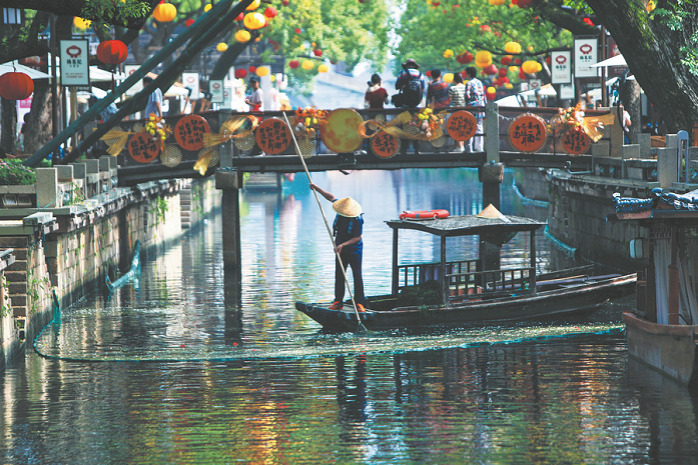
From the small towns of the first season to the neighborhoods of the second, each theme has been rooted in a sense of place, Lu explains. "Our goal is to create a tangible and engaging platform where Jiangsu's history, culture, nature, and cuisine can reach a wider audience," she says.
That approach has brought tangible benefits. After the first season aired, Zhenze ancient town saw its cultural tourism revenue exceed 8 million yuan ($1.12 million), attracting over 35,000 participants in autumn sericulture study tours and more than 500 training and visiting groups.
Following the release of the second season's Yangzhou episodes, a humble noodle shop featured in the show quickly became a local sensation, with its signature "dry noodles and pork kidney soup" combo selling more than 500 bowls a day, several times the number sold before the show aired.
In the current season, each episode focuses on a distinct form of intangible cultural heritage, reflecting the province's diversity and depth. "To a certain extent, every intangible cultural heritage tradition also represents the character and cultural evolution of its region," Lu says.
Lu and her team are already planning the fourth season. "We'll once again travel across the province, uncovering new perspectives and stories," she says.
"They might come from ancient villages, the Red revolutionary heritage sites, Jiangsu's rich biodiversity, or museums and libraries. At the same time, building on its abundant ecological resources, we aim to promote the deep integration of 'ecology plus tourism', creating a series of distinctive and culturally rich tourism projects while safeguarding ecological integrity," Lu says.
"Whatever the theme, our focus will remain unchanged: to delve deep into Jiangsu's cultural essence and tourism potential, and to tell the stories of the people who live here."
Contact the writer at liyingxue@chinadaily.com.cn