Cleaning up tallest rubbish tip
Nepal readies five-year strategy to tackle litter problem on Qomolangma







Editor's note: In this weekly feature China Daily gives voice to Asia and its people. The stories presented come mainly from the Asia News Network (ANN), of which China Daily is among its 20 leading titles.
Nepal's plan calls for waste rangers, higher fees and stricter rules to tackle the mountain's longstanding litter problem.
Nepal is preparing to unveil a five-year cleaning strategy for the world's highest mountain, Qomolangma, or Mount Everest in the West, as it struggles under decades of waste.
Experts say the alarming amount of refuse collected each season underscores the urgent need for sustainable mountaineering practices. Melting snow and ice caused by climate change further expose previously buried garbage and even human remains, worsening contamination of the watershed and posing health risks to downstream communities.
A draft of the Clean Mountain Strategy (2025-2029) proposes a fund of 308 million Nepalese rupees ($2.68 million) to clean up the mountain.
However, insiders say the eventual cost will exceed 1 billion rupees.
The plan envisions forming a team of "mountain rangers" composed of climbers to monitor and manage waste at the mountain's base camp and higher camps. The draft also calls for exploring the use of drones to collect waste above the base camp.
For decades the burden of litter has scarred the Qomolangma region. Hundreds of climbers, Sherpas, guides and porters leave behind tons of waste — ranging from oxygen canisters, plastic bottles, ropes, kitchen scraps and human waste — polluting both the slopes and settlements downstream.
Plastic remains a particular menace. It can take up to 500 years for a single plastic bag to biodegrade. If burned, it poisons the air; if buried, it pollutes the soil. As climbing traffic has increased, plastic has steadily crept higher up the mountain, turning Qomolangma into a glaring symbol of environmental neglect.
The strategy follows a Supreme Court ruling last year that called for the cleanup, said Himal Gautam, director at the Department of Tourism. "It is still in draft form but will be implemented soon."
Shorter climbing seasons caused by worsening weather demand stricter regulation, the draft says. It proposes limiting climbing permits by assessing the mountain's carrying capacity and available services.
The court ordered the government to issue permits only after specifying the number of climbers. The directive came amid traffic jams on the summit ridge and growing trash piles.
According to the Himalayan Database, an authoritative climbing archive set up by the late US journalist and author Elizabeth Hawley, more than 200 people died on the Nepal side of Everest between 1953, when Edmund Hillary and Tenzing Norgay Sherpa became the first to reach the summit, and 2022.
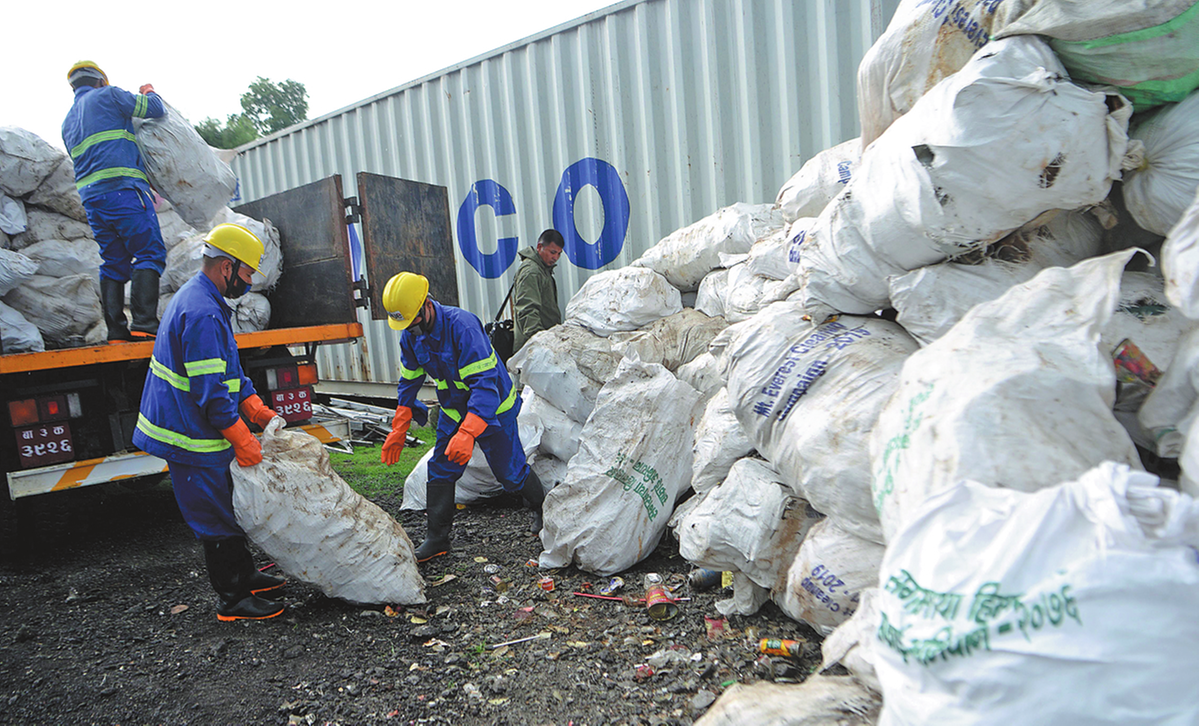
Waste collection figures also reveal the magnitude of the problem. A pollution control committee reported clearing 85 metric tons of garbage during last year's spring season alone, including nearly 28 tons of human waste. The Nepali Army cleared another 11 tons.
To reduce pressure, Nepal has sharply raised climbing fees. Under revised regulations, the per person royalty for foreigners climbing via the south route in spring has been raised from $11,000 to $15,000.
Polluter-pays principle
Under the proposed strategy, climbers will also be required to pay a refundable garbage deposit, returned only if waste is brought back, as well as a nonrefundable environmental fee.
A portion of climbing revenues will be earmarked for cleanup campaigns, with provisions for local community involvement.
The strategy says expedition operators should also be charged waste management fees under the polluter-pays principle.
A mountain cleanup campaign fund will be created, and climbers will be required to carry human waste bottles.
Industry leaders say Nepal is already late.
"We proposed a $100 nonrefundable per climber fee in 2010," said Dambar Parajuli, president of the Expedition Operators Association Nepal. "Had it been implemented, the fund would have exceeded 1 billion rupees by now." China introduced a similar measure in 2014.
Qomolangma's Camp IV is the most polluted site, and cleaning it requires enormous resources, Parajuli said. "We estimate a minimum of 1 billion rupees for five years, but frequent policy changes due to unstable governments have prevented consistent action."
The draft strategy proposes stricter rules on equipment and materials.
Rope-fixing teams above base camp must report their annual use of ladders and nylon ropes, about 400 kilograms of which are left behind each year, the Nepal Mountain Academy said. These ropes, often buried in snow, can stay there for decades.
Banners and prayer flags above base camp must be biodegradable and standardized.
Nonbiodegradable materials must be returned for verification. Every climber must bring back at least 3 kg of waste, which will be monitored at Camp II by both mountain rangers and waste management associations.
Bags for excrement will be compulsory above base camp, and authorities will check that climbers bring them back. Equipment lists for each expedition will also be logged to ensure accountability.
The strategy also emphasizes transparency and global engagement. Progress reports will be distributed internationally, and a third-party independent monitoring team will conduct annual assessments. A GPS-based tracking system will be piloted to monitor climbers' movements.
In addition, the government plans to integrate environmental awareness into local curricula and introduce educational materials nationwide.
Some measures have already been put into effect. Since last year climbers above base camp have been required to use excrement bags.
With Qomolangma's reputation at stake, officials hope the new strategy will balance mountaineering ambitions with environmental responsibility. However, experts caution that unless funds match the scale of the challenge, the image of the world's highest peak as the planet's most visible garbage dump could endure.
The Kathmandu Post, Nepal