



In dedicated pursuit of low-carbon development







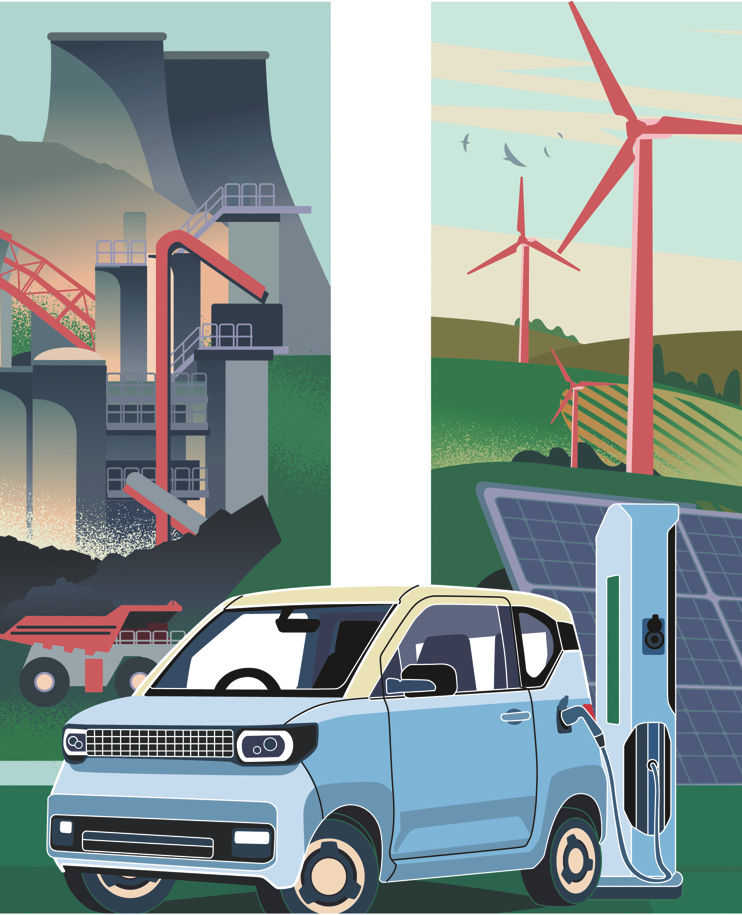
By deepening domestic reforms and expanding South-South cooperation, China is finding solutions to the global climate challenge
Climate change poses a common challenge to all humanity, necessitating joint solutions across borders. In 2016, China ratified the Paris Agreement, joining global efforts to limit the rise in average global temperature and reduce greenhouse gas emissions. In September 2020, President Xi Jinping announced China's dual carbon targets — peak carbon dioxide emissions before 2030 and achieve carbon neutrality before 2060 — a historic step in global climate governance.
Building on this pledge, China officially submitted its updated Nationally Determined Contributions in 2021, setting concrete goals: cutting carbon intensity by more than 65 percent from the 2005 level; raising the share of non-fossil fuels in primary energy consumption to around 25 percent; expanding total installed capacity of wind and solar power to over 1.2 billion kilowatts by 2030; and increasing forest stock volume by 6 billion cubic meters from the 2005 level. During the 14th Five-Year Plan period (2021-25), China recorded significant achievements in advancing its low-carbon transition in four key areas.
First, China has improved its carbon governance system and steadily built a comprehensive framework for climate governance. China introduced the "1+N" policy framework for carbon peaking and neutrality, which consists of an overarching action plan, and a series of sector-specific and region-specific road maps. In 2024, the State Council, China's cabinet, issued the Work Plan for Accelerating the Building of a Dual Control System for Carbon Emissions, introducing the concept of a carbon budget into official policy for the first time. Provincial and city governments were also required to integrate carbon targets into their economic and social planning.
Second, China accelerated its renewable energy development, with its installed capacity of wind and solar power surpassing 1,400 gigawatts by the end of 2024. In 2024 alone, about 278 GW of solar and 79.8 GW of wind power were added, cementing China's position as the global leader in renewable energy deployment. Wind and solar power together generated 1.83 trillion kilowatt-hours of electricity in 2024, a year-on-year increase of nearly 27 percent, accounting for about 18 percent of national power output.
Third, China launched a national carbon market and expanded into a dual-track system: the mandatory National Carbon Emissions Trading System and the National Voluntary Greenhouse Gas Emission Reduction Trading Market. The ETS, launched nationwide in 2021, saw record activity in 2024 with 189 million metric tons traded and turnover of 18.11 billion yuan ($2.53 billion); prices exceeded 100 yuan per ton for the first time, peaking at 105.65 yuan. By the end of 2024, allocation and compliance were tightened, with a 99.98 percent compliance rate for 2023 allowances. The voluntary market started operation in 2024. By August, it had generated the first batch of Voluntary Emission Reductions. Cumulative voluntary trading reached 2.71 million tons with turnover of 229 million yuan, providing additional revenue streams for low-carbon projects and enriching China's market-based decarbonization approach.
Fourth, China enhanced its carbon sinks by implementing large-scale afforestation, ecological restoration and grassland protection projects. China's forest stock volume has reached 20.99 billion cubic meters, contributing about one-fourth of the world's newly added greenery since 2020 and positioning China as the largest contributor to global greening. Initiatives such as the Natural Forest Protection Program further integrated ecological preservation with rural development, enhancing both biodiversity and carbon sequestration capacity.
Despite recent progress, China faces several major challenges in advancing its energy transition. First, energy-intensive industries such as steel, cement and chemicals hold a key position in national development, which makes economic restructuring and industrial upgrading both complicated and costly. A more fundamental challenge is the continued dominance of coal in the energy mix. As the world's largest energy consumer, China still meets over 50 percent of its primary energy demand with coal. This transition is difficult because, unlike many other countries, China is attempting to move directly from coal to large-scale deployment of renewables without going through an "oil and gas era", which greatly increases the difficulty of this transition. Furthermore, although facing rapidly rising energy demand and growing low-carbon requirements, renewable energy expansion is limited by land availability, insufficient grid capacity and high storage costs. Finally, market incentives for low-carbon energy remain weak. For a long time, high-carbon energy in China has been relatively cheap, while low-carbon energy alternatives have been more expensive, with significant price differences across regions. This disparity makes it particularly difficult to rely on market forces to drive the transition.
Looking ahead, the upcoming 15th Five-Year Plan (2026-30) will mark a critical period for aligning economic modernization with climate ambitions. At the United Nations Climate Summit 2025 on Sept 24, President Xi announced China's new NDCs as follows: "China will, by 2035, reduce economy-wide net greenhouse gas emissions by 7 percent to 10 percent from peak levels, striving to do better; increase the share of non-fossil fuels in total energy consumption to over 30 percent; expand the installed capacity of wind and solar power to over six times the 2020 levels, striving to bring the total to 3,600 gigawatts; scale up the total forest stock volume to over 24 billion cubic meters; make new energy vehicles the mainstream in the sales of new vehicles; expand the National Carbon Emissions Trading Market to cover major high-emission sectors; and basically establish a climate adaptive society." These commitments provide the strategic framework for the next stage of transition.
To deliver on them, China will need to accelerate electrification, invest in energy storage and smart grids, and advance low-carbon technologies such as carbon capture and utilization, while balancing energy security with decarbonization and nurturing green industries as new growth drivers. By deepening domestic reforms and expanding South-South cooperation to share technology and finance, China is not only preparing for its own low-carbon future but also contributing solutions to the global climate challenge. Low-carbon development is therefore both a national imperative and China's contribution to building a shared future for humanity.
Tang Dalin is the deputy publisher and the deputy editor-in-chief of China Petroleum Enterprise Magazine. Gong Qi is a researcher at the China Institute of Global Carbon-Neutral Economy at the University of International Business and Economics. The authors contributed this article to China Watch, a think tank powered by China Daily.
The views do not necessarily reflect those of China Daily.
Contact the editor at editor@chinawatch.cn.





