Pharma sector transforms for growth
Drugmakers report rising R&D spending, revenue share from innovative products







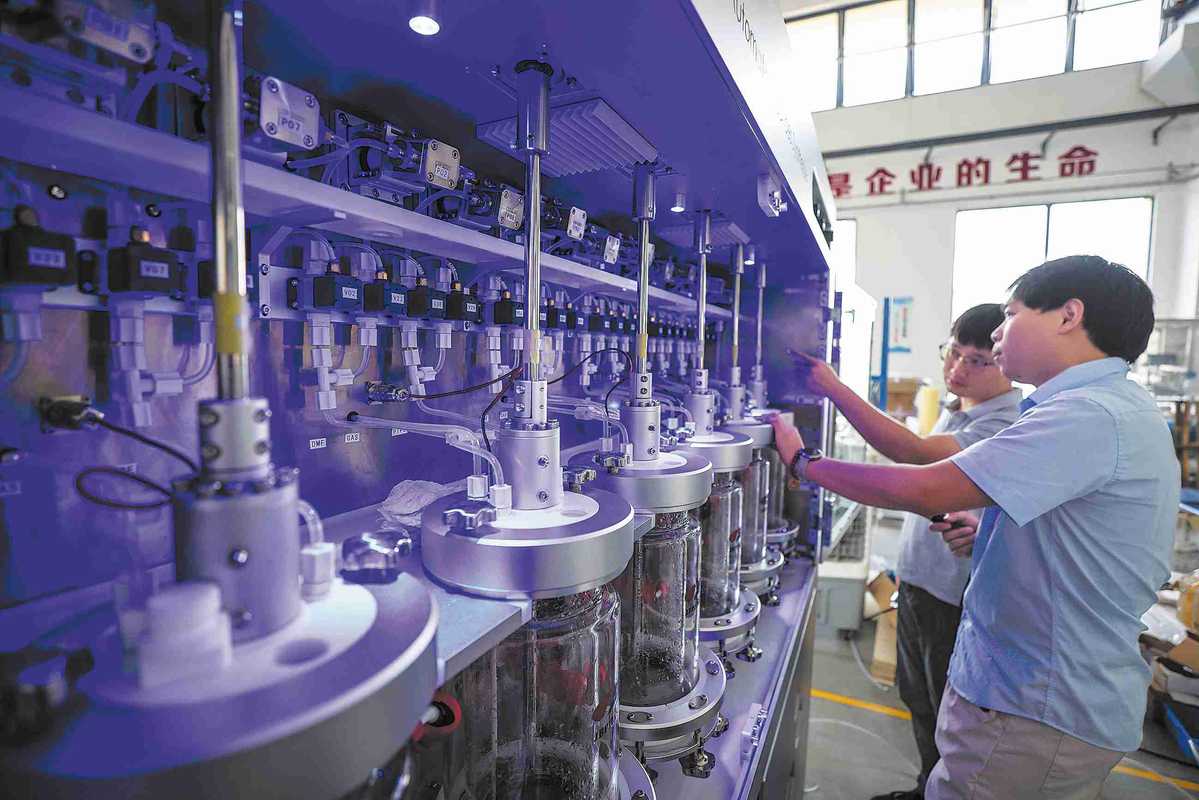
China's pharmaceutical sector, once driven largely by generic drug production, is now witnessing a steady rise in innovative drug development, cross-border partnerships, and record research and development spending, signaling a structural transformation toward high-quality growth, experts and industry insiders said.
In the first half, Jiangsu Hengrui Pharmaceuticals Co Ltd reported total revenue of 15.76 billion yuan ($2.21 billion), up nearly 16 percent year-on-year, with net profit rising around 30 percent to 4.45 billion yuan, according to its interim report.
For the first time, income from innovative drugs and licensing accounted for more than 60 percent of its total revenue. In 2018, the majority of the company's revenue was generated from generics, while only a small fraction came from innovative products.
The shift reflects more than just product mix. "Innovation and globalization have become the twin engines driving our growth," the company said in a statement to China Daily. "As one of the country's leading R&D-driven pharmaceutical enterprises, we have made continuous innovation our first development strategy."
Over the years, Hengrui has invested more than 48 billion yuan in research and development, with its R&D-to-revenue ratio climbing to 29.4 percent in 2024 — among the highest in the industry. The company operates 14 research centers worldwide, supported by a 5,600-strong global research team.
To date, Hengrui has secured domestic approvals for 24 Category 1 innovative drugs and four Category 2 new drugs.
Hengrui's transformation reflects not just the company's evolution, but the transformation of China's broader pharmaceutical industry.
Across China, a growing number of once traditional drugmakers, such as Jiangsu Hansoh Pharmaceutical Group Co Ltd, Jiangsu province-based Simcere Pharmaceutical Group Ltd and Hebei province-based CSPC Pharmaceutical Group Ltd, now are achieving similar transitions, reporting double-digit R&D growth and rising revenue shares from innovative products, according to their interim reports.
The shift is reconfirmed by hard figures.
China's pharmaceutical industry, now the world's second largest, accounts for around 30 percent of the global pipeline of innovative drugs in research, according to the National Medical Products Administration.
Jin Chunlin, director of the Shanghai institute of medical science and technology information, said China's pharmaceutical industry is entering a new developmental phase, underpinned by policy reform and accumulated industry expertise.
Jin explained that the generic-drug era was an essential foundation. It allowed firms to accumulate funds, master manufacturing techniques and establish a robust drug quality evaluation system. However, he said: "Companies cannot remain forever in the comfort zone of generics. Innovation is the only way forward."
The industry's transformation has been propelled by a decade of deep structural reforms. Beginning in 2015, the government overhauled drug review and approval mechanisms, accelerating the path to market for innovative therapies.
A landmark shift came in 2018 with the introduction of the national drug centralized procurement program, designed to pool public hospital demand and negotiate lower prices directly with drugmakers. By reducing inflated generic prices, the reform freed up funds for medical insurance coverage and redirected corporate focus toward innovation.
By 2020, a consensus had formed across the industry: the era of high-margin generics was over. China's pharmaceutical sector needed to evolve from imitation to innovation.
"The national drug centralized procurement reform has effectively reshaped China's pharmaceutical landscape," said Jiang Bin, deputy director of the Research Center of Public Policy at Peking University. "It has driven the industry away from a 'high-marketing, high-margin' model toward one defined by 'low cost and high innovation', improving efficiency and encouraging higher-quality growth."