



Ed-tech firm bets big on AI learning solutions
Artificial intelligence is creating opportunities for education tech plays







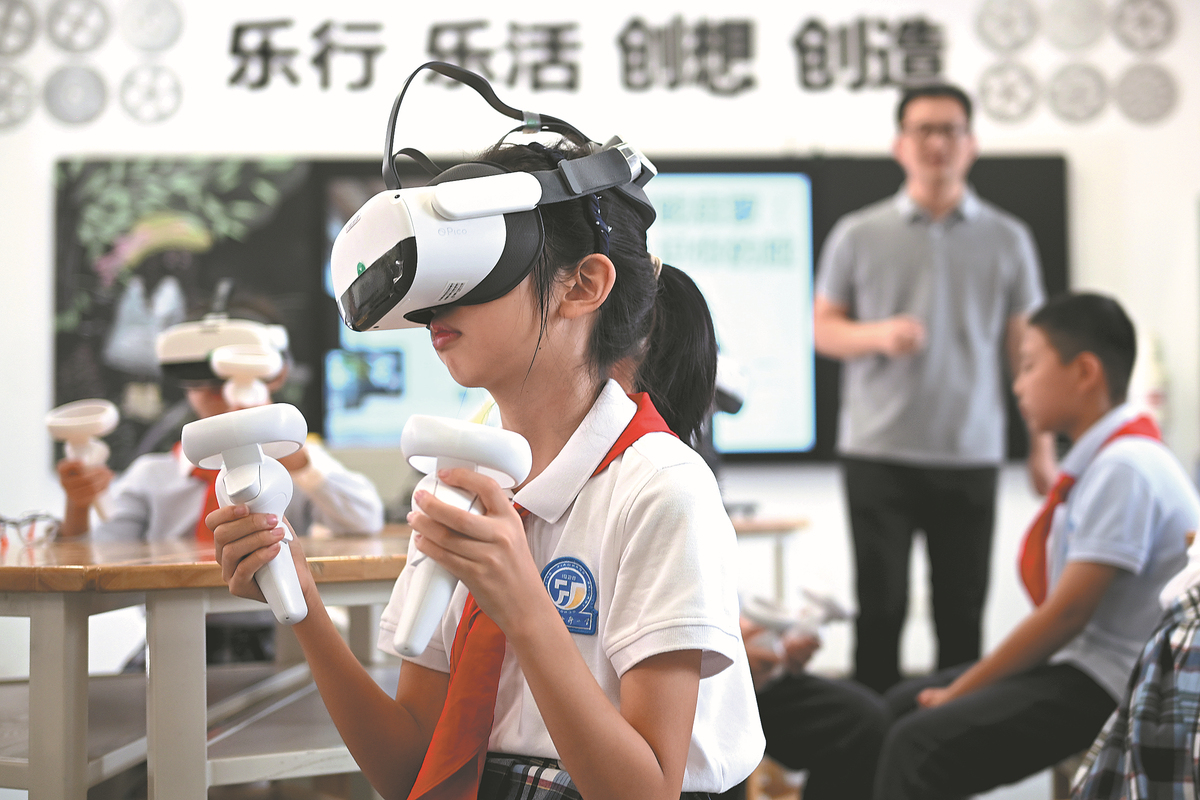
The growing influence of artificial intelligence in China's educational system is creating significant opportunities for domestic education technology firms, including ed-tech giant Gaotu Group, to capitalize on demand for AI-powered learning solutions, a company executive said.
The rapid integration of AI in Chinese higher education isn't just a technological evolution, it's creating a massive and clear business opportunities for domestic education technology firms, said Luo Bin, cofounder of Gaotu.
"We see this burgeoning trend as a pivotal moment," he said.
"As AI increasingly shapes China's education landscape, there's an urgent demand for companies like ours to provide innovative, AI-enhanced learning experiences and tools that meet the evolving needs of both institutions and students."
Gaotu Group announced the establishment of the "Gaotu-Renmin University of China AI Smart Education Joint Laboratory" in collaboration with the Gaoling Artificial Intelligence Institute of Renmin University of China in September.
The collaboration, eyeing to further integrate industrial practice and academic research advantages, will jointly explore a new paradigm of AI education focusing on deep reasoning and enhanced retrieval of large models and intelligent agents, it said.
"The shift toward AI-integrated curriculum across Chinese universities is a strong signal for the ed-tech market. It tells us that our investment in AI capabilities and educational systems is not just future-proofing, but directly addressing a present and growing need that generates significant opportunities for growth," said Luo.
The deep integration of AI in education is rapidly advancing the deployment and widespread adoption of various innovative educational scenarios, said Wang Xiaohu, deputy head of Renmin University.
Industry experts believe AI models are being integrated into educational and tutoring services at an accelerated pace, driven by China's national ambition for technological leadership and the intense desire of parents to enhance their children's achievements.
A recent survey conducted by the MyCos Institute, a Chinese higher-education research body, indicates that generative AI has achieved near-universal adoption on university campuses.
Nearly 60 percent said they engaged with these tools frequently — either daily or several times a week, it said.
Leading Chinese universities such as Renmin University have already introduced AI courses that are open to all students, which signifies an evolving national dedication to enhancing AI literacy across the educational spectrum, said Luo.
A report by Stanford University's Institute for Human-Centered Artificial Intelligence on global AI attitudes revealed that China leads the world in its eagerness for AI, with around 80 percent of Chinese respondents expressing excitement about new AI services, significantly higher than the 35 percent in the United States and 38 percent in the United Kingdom.
Most top Chinese universities have added interdisciplinary AI general education classes, AI-related degree programs and AI literacy modules in the past year.
Tsinghua University is establishing a new undergraduate college focused on training students in AI alongside a traditional discipline, such as biology, healthcare, science or the humanities.
These follow new national guidelines issued by the Ministry of Education in April, advocating extensive "AI+ education "reforms across all educational stages, with the goal of fostering critical thinking, digital literacy and practical skills.
Further demonstrating this commitment, the Beijing municipal government mandated AI education in all its schools, from primary to university level, earlier this year.
According to Luo, while some regions abroad lean more toward open-ended, project-based teaching, requiring students to conduct extensive research, China mostly follows a relatively structured educational model, which naturally impacts AI tool usage.
This divergence, however, is rapidly diminishing, as project-based learning is gaining traction. Domestic basic education has also begun to explicitly integrate AI, computer and internet-related content, he said.
Major Chinese tech players such as ByteDance, Alibaba, and Tencent are actively engaging with the education sector, mirroring global counterparts like OpenAI and Anthropic.
Luo underscored their strategic interest in university students, a crucial future demographic for their products and services.
"University students will soon graduate and enter society, becoming potential customers," Luo explained, noting tech companies aim to capture this group at the university stage to cultivate usage habits early for business and brand benefits, alongside a "public welfare" aspect.
While AI tool usage among Chinese university students is high and diverse, Luo highlighted that the real challenge lies in cultivating varying levels of AI literacy in a systematic manner.
"Currently, how to systematically cultivate students' abilities at these different levels within universities is not yet fully standardized," he said.
"While universities would likely offer more courses on fundamental AI cognition, practical AI skills acquisition might be more market-driven due to the rapid iteration of tools. Conversely, universities, with their inherent strengths in research and innovation, are ideally positioned to lead the integration of AI into scientific inquiry and advanced problem-solving."
zhengxin@chinadaily.com.cn




















