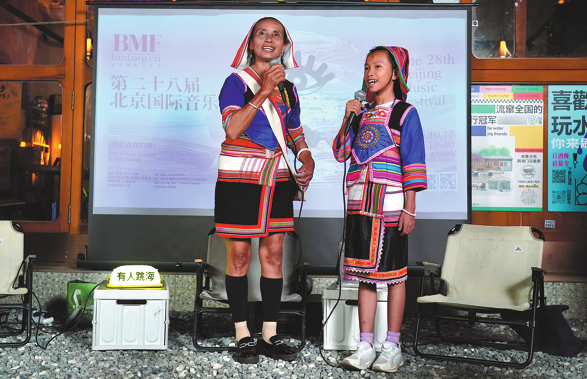
"Whatever your nationality, age, beliefs, or ethnicity, come watch our performance and dance with us."
This invitation comes from He Guiying, the first woman ever to beat the sacred Jino drum in the deep rainforests of Southwest China. On Sunday, He, together with eight children from Jino Mountain, will present the music and dance of their culture on the stage of the Beijing International Music Festival.
Born in 1967, during her teenage years, He Guiying broke the taboo forbidding women to touch the Jino drum. Today, she is the sole national-level inheritor of the Jino drum dance and has dedicated more than 40 years to this art. Filled with pride, she says: "We are a small ethnic group, and these are such small children standing on a grand stage — how could I not be proud?"
The Jino people are China's last-recognized ethnic group, officially designated in 1979 as the country's 56th such group. With a population of fewer than 30,000, they have long lived in the Jino township of Jinghong city, Xishuangbanna Dai autonomous prefecture, Yunnan province.
For the Jino, the drum is both a totem and a sacred ritual object. According to legend, a great flood once submerged Jino Mountain. The creator goddess Amo Yaobei placed twin siblings inside a giant drum. After drifting for seven days and nights, the waters receded and the sound of the drum thudding against the ground signaled their survival. The siblings then became the ancestors of the Jino people. To honor the goddess' blessing, the Jino strike the drum each year during their most important celebration, the Temaoke Festival, held from Feb 6-8 to welcome the New Year and pray for favorable weather and abundant harvests.
Every ritual involving the drum is solemn and cautious. Since He's childhood, it has been said that the drum "cannot be struck casually". Each of the Jino's 40-plus villages keeps one drum, housed in the home of the zhuoba, the most respected village elder. Any improper contact with the drum, damage to it, or even a mouse entering its chamber, was seen as an ominous sign.
Only during the Temaoke Festival would the drum be revealed. On the first day, the zhuoba would strike the drum three times to signal the arrival of the festival. After sacrifices, he would lead the villagers in the drum dance. Traditionally, the drum was placed on a high stand, beaten by two men — one on each side — while women danced beside it. On the following two days of the festival, the drumsticks could be passed to other male villagers to pray for their families' well-being. For women, however, touching the drum meant being cursed.
Elders constantly warned the girls: beating the drum would bring disaster to their families. As a child, He shared this fear. But when she finally picked up the sticks and struck the drum, nothing happened.
For her, drumming came naturally. She loved singing and dancing since childhood. After dropping out of junior high in 1983, He worked in the fields by day and studied traditional songs and dances with her village's elderly artists by night. With her bright, powerful voice and sharp memory, she quickly stood out: "My mouth is my best speaker. I can sing, dance, choreograph, and even teach students," she says.
Her talent soon made her the star of the village troupe. Around that time, scholars studying ethnic culture visited and asked her: "Are there forms in the drum dance where men and women duel on the drum?" She answered, "No." This exchange sparked her reflection: Why couldn't women play the drum? Her curiosity grew.
Around 1985, she began secretly teaching herself by observing others. "Nothing happened the first time I played, nor the second. I knew then — the drum belonged to me."
But the drum was not made for her. About 1 meter in diameter and half a meter in width, standing nearly 2 meters high on its frame, it dwarfed the petite He. Her hands blistered from practice. With no electricity in the village, she trained by candlelight and firelight under the moon. By 1986, after relentless practice, she could play and dance at the same time, performing the drum dance in full.
For her, the courage to drum came from her culture itself: "It's not just the drum, but also the dance and the songs." Yet preserving this culture did little to ease her hardships. In the lean 1980s and 1990s, she performed even when penniless — sometimes borrowing 10 yuan ($1.4) from her father, a factory worker earning 30 yuan a month, just for her bus fares. She often skipped meals, returning home hungry after shows.
Meanwhile, she held many other roles: a village doctor for 28 years, running house-to-house for visits; the founder of a rural cooperative that helps women produce traditional "machete cloth"; manager of 3,000 rubber trees; and later, a rainforest tour guide. No matter how busy life became, she never gave up drumming.
Her stamina is unmatched — able to drum nonstop for half an hour or more. Filmmaker Song Yi, who followed her for a documentary, noted: "Counting every man and woman in Jino villages who can play, she is still the one who drums the longest."
In recent years, she has focused on teaching and choreographing the drum dance, especially encouraging women: "The drum isn't what you fear. It can bring you good fortune." In the third edition of the dance, she introduced a new segment — each member taking turns striking the drum, "to bring its blessings home".
By the fifth edition, she integrated everyday life into the ancient dance. One controversial move — playing the drum with her back turned — was inspired by her experience as a mother: "Sometimes a child, while nursing, mischievously turns his back. I see the drum as my mother. I love her, so I can also face away while drumming."
Her goal is not rebellion, but cultural preservation and awareness. As more people learn about the drum dance, her village troupe has gained opportunities to perform nationwide. Last year, composer Du Yun collaborated with her on a musical based on Jino mythology, performed by Jino children. Though unfamiliar with modern art, He embraced the project: "Times are changing. So must our culture. What matters is that it can express our life."
Today, more Jino women than men are learning the drum dance.
"As long as I am here," He says, "my drum will keep beating."
Bai Shuhao contributed to this story.
China Daily