


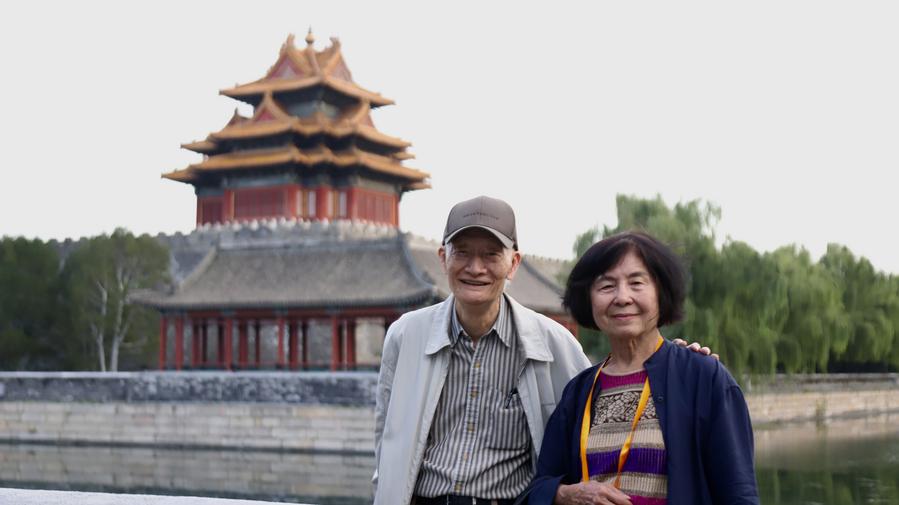
The 100-year-old Palace Museum, situated on the site of the Forbidden City in Beijing, has welcomed a special visitor from Taipei -- a city some 2,000 kilometers away that is home to another Palace Museum.
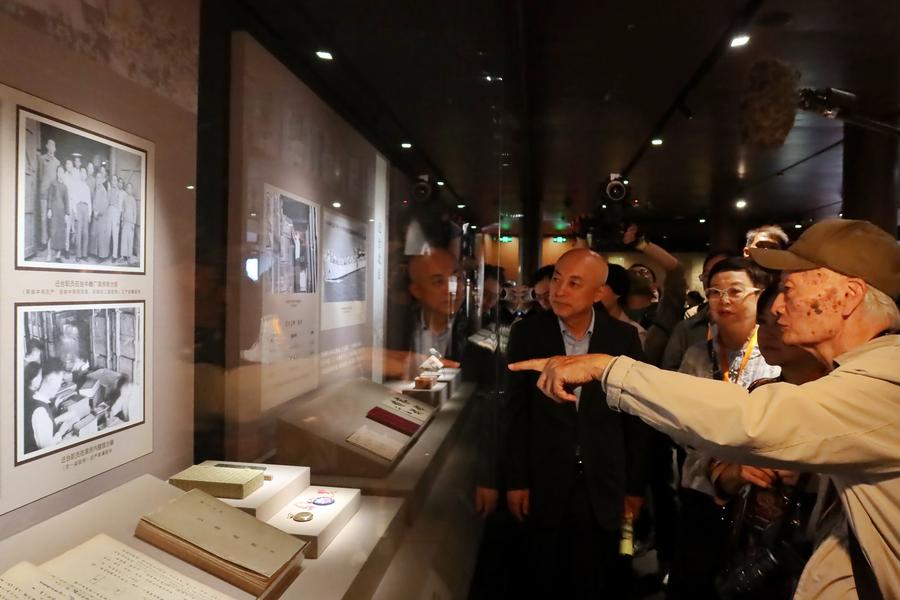
Chuang Ling, an 87-year-old photographer from Taiwan and the son of a former staff member who worked for both Palace Museums, visited Beijing to attend an exhibition commemorating the miraculous evacuation of the museum's collection during Chinese People's War of Resistance against Japanese Aggression more than 80 years ago.
On Oct. 10, 1925, the Forbidden City -- the vast walled complex that once served as China's imperial palace -- was opened to the public for the first time, along with its priceless imperial art collections.
Chuang Ling's father, Chuang Yan, was among the museum's earliest staff members. Joining the preparation team in 1924, he witnessed and participated in the Palace Museum's turbulent early years and the establishment of another Palace Museum in Taipei.
"My father passed away in 1980 in Taipei," Chuang recalled. "In his final moments, he kept murmuring a faint and indistinct word. I listened carefully and finally made it out -- it was 'Beiping' (a former name of Beijing)."
In 1933, as Japan's invasion loomed, more than 13,000 crates of the Palace Museum's collection, priceless treasures of Chinese art, were evacuated from Beijing. Over the following years, they journeyed across half of China, navigating the chaos of war, and found temporary refuge in the country's southwest.
The museum collections first arrived in Shanghai and then moved to Nanjing in eastern China. When they were forced to leave Nanjing in 1937, Chuang Yan was tasked with escorting the first batch of 80 crates containing bronze, porcelain, calligraphy, paintings, embroideries, jade, and other items.
As the Japanese advanced, the collection's destinations shifted repeatedly -- from Hubei and Hunan in central China, and further south and west to Guangxi, Guizhou and Sichuan.
There were many close calls. Soon after the escort team left Changsha in Hunan Province, the library that had stored the treasures was reduced to ashes by heavy bombing. Similarly, about ten days after the team departed from Guiyang in Guizhou Province, the city was largely destroyed by air raids.
In Anshun, Guizhou, the museum's treasures were hidden in a natural cave, where Chuang Yan and his family guarded them for years. Their diet mainly consisted of cabbage, tofu, and rice mixed with sand and even worms. "Life was hard," Chuang Ling said, "but we felt rich in spirit."
"These museum staff, most of them intellectuals, had no idea where the collections would go or how long the evacuation would last. They simply chose to guard them. What they did is deeply moving," said Zheng Xinmiao, former curator of the Palace Museum in Beijing.
Although the country had suffered devastating losses during the resistance war, the Forbidden City's treasures remained largely intact thanks to the dedication and sacrifice of the escort teams.
"The Palace Museum's collections are not only valuable artworks, but also the living history of the Chinese nation," Zheng said. "Protecting them meant preserving the essence of Chinese culture. The evacuation embodied the Chinese people's indomitable spirit in the face of invasion."
Between 1945 and 1949, the Palace Museum's collection was divided. Part of it was transported to Taiwan by the Kuomintang -- along with some of its guardians. The Chuang family accompanied the treasures to the island and has been settled there ever since.
Chuang Yan later became vice curator of the Palace Museum in Taipei, where he continued his lifelong mission of protecting and promoting Chinese culture.
For decades, the artworks from the Palace Museum have silently served as cultural messengers, nurturing generations in Taiwan and fostering a profound understanding of Chinese culture there.
In 2009, curators from the two museums across the Taiwan Strait exchanged visits for the first time. In 2011, "Dwelling in the Fuchun Mountains," a classic Chinese landscape painting that had been divided into two halves and housed on opposite sides of the Strait, was reunited at the Taipei Palace Museum for a special exhibition.
The two museums are like brothers, and through exchanges and academic cooperation, scholars on both sides will deepen mutual understanding and help promote greater cross-Strait understanding, said Wang Xudong, curator of the Palace Museum in Beijing.
The ongoing exhibition that brought Chuang Ling to Beijing features a bronze vessel from the Spring and Autumn Period (770-221 B.C.). The Taipei Palace Museum holds another vessel of the same kind. During the Qing dynasty, one vessel was kept in the Summer Palace in Beijing, and the other in the Forbidden City; however, they eventually ended up on opposite sides of the Strait.
"These two vessels symbolize the deep connection between the Palace Museum collections in Beijing and Taipei, as well as the unity of China's 5,000-year-old civilization," said Xu Wanling, a research fellow at the Beijing Palace Museum and a senior expert on Palace Museum history.
The exhibition also features statues of key members of the evacuation mission and personal items loaned by their families in Taiwan, including Chuang Yan's journal.
With great joy, Chuang Ling posed for a photo beside the statue of his father -- a reunion that transcended time and space.
"My father's greatest regret was that he couldn't bring the treasures back to their home in the Forbidden City," Chuang said softly. "I only hope that his regret will not be passed on to future generations."








