Preserving family letters protects legacy of martyrs







"Mother, if I die fighting for the people, do not weep for me. Look at the bodies lying on the battlefield — each one is the beloved son of a mother."
These heart-wrenching words were written by 23-year-old revolutionary martyr Feng Tingkai in a letter to his mother just before he sacrificed his life in battle during the Chinese People's War of Resistance Against Japanese Aggression (1931-45). He left behind no photograph — only the final letter.
The letter is now housed at the Museum of Family Letters at the Renmin University of China, where such emotions still echo through time. Thousands of letters, their pages yellowed and ink faded, tell intimate stories of love, sacrifice and devotion — preserving memories that refuse to fade.
Among them are three precious letters from Pei Chao, a soldier who joined the Red Army in 1936. His nephew, Pei Jiucheng, donated the letters to the museum in July, still hoping to learn what became of his uncle.
"It took three years to receive the first letter — just two pages," Pei Jiucheng recalled. The second arrived a year later, and the third — five pages long — came in 1941, marking the fifth year of Pei Chao's absence.
In that third letter, Pei Chao expressed deep longing for his family: "Although I am far away, my heart remains at home." He urged his siblings to care for their aging parents and reassured his wife: "I miss you very much, and although I can not come home right away — I will never marry another."
To protect his family, Pei Chao never revealed his location or missions, only hinting: "I need not say, and you will know what I do." Postmarks from Feixian in Shandong province and Yancheng in Jiangsu province suggest that he served with the Eighth Route Army and the New Fourth Army.
"There were only these three letters. We never heard from him again," Pei Jiucheng said.
Pei Chao was one of countless unsung heroes of the war. Yet his words, like those of many others, continue to speak across time.
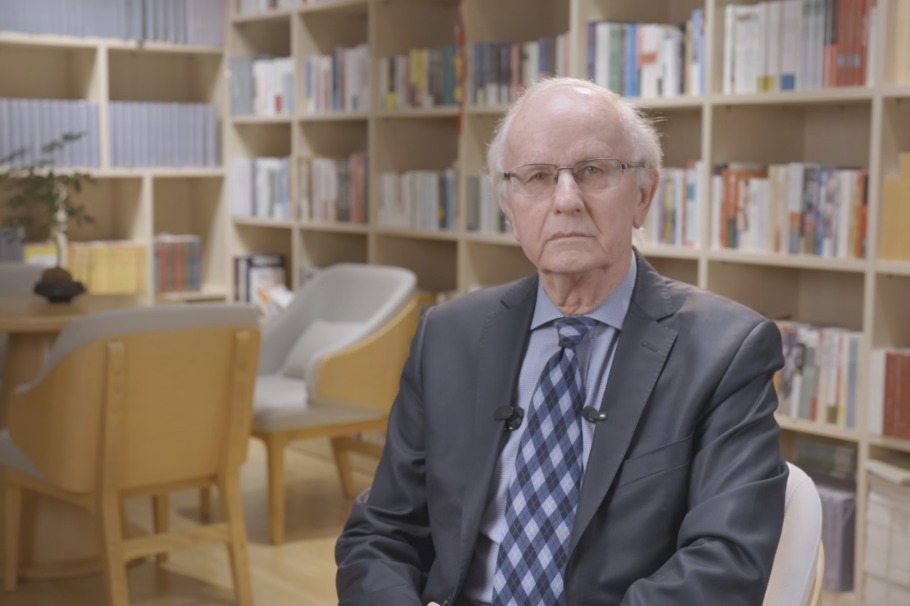
Zhang Ding, deputy director of the museum, highlighted the historical and emotional significance of these letters.
"Family letters are vital carriers of memory and Chinese cultural heritage. They reveal the personal sacrifices of revolutionary soldiers and their families, and reflect traditional virtues and patriotism," Zhang said.
"These letters reflect the lives of ordinary people," he said. "They have stories and emotions, and they are easy to read and resonate deeply with visitors."
He added, "A letter may be as thin as a cicada's wing, but the emotions it carries weigh as much as 1,000 kilograms — the trembling pen of a traveler, the tear stains on a mother's cheek, the unspoken longing of a lover."
The museum holds more than 80,000 letters, with about 3,000 on permanent display. They include correspondence from well-known figures such as Chen Duxiu and Liang Qichao, as well as from ordinary citizens.
For many students at Renmin, the museum has become a regular spot to visit between classes.
Shen Minghui, a doctoral candidate at the university's School of Public Administration and Policy, first visited between lectures and was deeply moved. She later became a volunteer at the museum.
"When I share these stories, it feels like a spiritual dialogue across time," Shen said. "This experience has profoundly shaped my values and life choices."
She added that many visitors often discuss ways to bring these stories to life through documentaries, exhibitions, or short videos.
"Promoting family letter culture isn't about clinging to the past," she said. "It's about creative adaptation. In the future, our digital chats could also be considered a form of family correspondence."
Another volunteer, Hou Dingjian, an undergraduate at the university's School of Liberal Arts, introduced a unique exhibit — a "letter" made of drawings from a father to his then kindergarten-aged daughter, using images instead of words.
"As times change, so does the form of letters," Hou said. "They may appear fragmented on social media today, but the essence remains — sincere expression and emotional connection."
zoushuo@chinadaily.com.cn




- Xi, Macron hold informal meeting in China's Sichuan
- The 'Gyrfalcon' mounted police team safeguards grasslands in northern borderland of China
- Liaoning launches first province-level online book lending platform
- Annual Fairy's Day marked in Xizang
- Chinese, Cuban communist parties hold seventh theory seminar
- Full moon seen across China