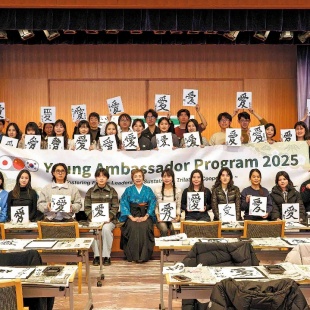



Youth envoys connect as neighbors
A program helps young people from China, Japan and South Korea break stereotypes and form friendships








Discovering similarities
Shen from China said what struck him most in his interactions with Japanese and Korean youth was not the cultural differences but rather the underlying commonalities that connect the three East Asian nations.
"We share similar educational experiences, navigate comparable daily routines, and as young people, we grapple with analogous uncertainties about the future. These shared experiences fostered an immediate sense of connection," he said.
Itsuki Shimoosako, a postgraduate student at the University of Tokyo's Graduate School of Public Policy and a double-degree student at Peking University, said that his deepest impression about the three countries is the shared cultural elements, including their communication styles, traditions, and cuisine.
The lectures in the program also highlighted shared societal challenges, such as aging populations, public health, climate change, which deepened his understanding of the common ground.
Born and raised in Germany, Shimoosako grew up surrounded by Chinese and Korean friends, which gave him familiarity with their cultures.
However, he also witnessed tensions rooted in historical and political differences, even among East Asian communities in Germany. This inspired him to join the program, aiming to cultivate a "stronger shared identity as East Asians".
Shimoosako emphasized the value of collaborative creation. He worked with Chinese and Korean peers to develop the CJK Cultural Pass Initiative, a proposal offering discounts at cultural sites across the three countries.
Their team won the Best Team Award, which he viewed as a testament to what can be achieved when young minds focus on common goals rather than differences.
"In our late-night discussions," Shimoosako recalled, "we learned to navigate our different communication styles — Chinese peers prioritizing harmony, Koreans ensuring everyone had a voice, and Japanese teammates focusing on methodical detail. What struck me was how these differences, instead of dividing us, actually enriched our proposal."
The friendship forged through the program has broadened Shimoosako's perspective on current issues in East Asia and reinforced his belief that commonalities outweigh differences.
"It's also heartwarming to know that I now have a network of like-minded peers in China and South Korea who share a vision for stronger regional cooperation," he added.
Similarly, Kim from Yonsei University, discovered the transformative power of informal dialogue. "One of my most memorable experiences was a casual chat over tea in a small Kyoto tea house," she said.
"We shared stories about our journeys, talked about the challenges we face as young people and the issues in our countries, and exchanged our hopes for a future with more cooperation and sustainability."
The relaxed setting helped Kim and other participants connect personally, form friendships, and inspire them to work together on new solutions for their communities, she said.
Kim said she recognized the importance of sustained trilateral cooperation between China, Japan, and South Korea, which have deep historical, economic, and geopolitical ties. "Despite occasional tensions, our shared challenges such as climate change, regional security, and economic integration, necessitate ongoing dialogue and mutual understanding," she said.
Youth role
Since its launch in 2013, the China-Japan-ROK Young Ambassador Program has been held 11 times and has grown into one of the brands under the Trilateral Cooperation Secretariat.
As major countries in the Asia-Pacific and important economies globally, China, Japan, and South Korea together account for about 24 percent of the world's GDP and around 20 percent of global trade.
The years 2025-2026 have also been designated as the "China-Japan-ROK Years of Cultural Exchange".
At the ninth China-Japan-ROK Leaders' Meeting last year, the three leaders reaffirmed the importance of strengthening exchanges. By fostering friendly interaction among the younger generation, the foundation for trilateral cooperation can be further consolidated.
As negative perceptions of one another are gradually deepening among the three countries, the young ambassador program expects that young people will play an active role in overcoming prejudice and confrontation.
For the participants, the program acts as a platform to break down barriers, foster trust and mutual understanding, as well as build personal connections that go beyond national boundaries.
Youth cultural exchanges are vital in building bridges between nations. They create platforms for mutual understanding, dismantling stereotypes, and developing collaborative solutions to regional challenges, Kim from Yonsei University said.
Kim, who also serves as a senior assistant at the United Nations Development Programme, said, "In my future endeavors both at the United Nations and within academic and policy circles, I plan to promote initiatives that encourage dialogue and cooperation among young leaders from China, Japan, and South Korea."
Whether through mentoring future delegates or organizing cross-cultural workshops and forums, Kim said she is committed to contributing to a more inclusive and sustainable regional future.
Shimoosako believed that ideally there should be more CJK youth exchanges involving a broader range of participants, not just students with relevant academic background or international experiences.
To foster real change, it is crucial to engage more diverse youth in these programs, helping to break down long-standing misconceptions and promote genuine understanding, he said.
Young people are the backbone of a nation's future and their perceptions will shape the dominant narratives of their societies, Shen from China said.
After the program, he remains in active contact with Japanese and Korean friends through social media.
These friendships have influenced his academic trajectory as he plans to pursue research visits in Japan and South Korea to deepen his understanding of regional dynamics.
He noted that historical disputes persist because of the lack of direct, interpersonal engagement. "When people fail to meet face-to-face, stereotypes and misconceptions thrive," he said.
"Only through direct dialogue can we truly foster heart-to-heart understanding, and youth cultural exchanges have always been at the core of meaningful people-to-people connections."
Kim Hyein said, "Regardless of nationality, language, or culture, the blood that flows under our skin is all red."
Unresolved historical and political differences between South Korea, China, and Japan should not be used as excuses for hatred or animosity, and in order to eliminate them, opportunities for young people from the three countries to gradually and sincerely get to know each other must be expanded, she said.
"I believe the beginning and core of this opportunity lies with the youth who will lead the three countries in the future. Therefore, I strongly support cultural and youth exchanges and I think I found my vision," she said.