



China-Egypt collaboration promotes civilization dialogue







The Nile River, eternal and majestic, carves its path through endless desert landscapes before surrendering to the Mediterranean in North Egypt. Along its fertile black banks, ancient Egyptian civilization blossomed, a land of awe and mystery where the world's first scripts were etched, some of the earliest cities rose, and belief in eternity gave shape to temples and tombs.
Today, this river of history flows into a new chapter, as China and Egypt join hands to guard the legacies of their ancient civilizations. Together they are breathing new life into weathered stones and faded murals, through joint archaeological digs, relic restorations and cultural exhibitions.
In this dialogue across time, two cradles of human wisdom affirm a shared belief that the diversity of civilizations is a treasure to be cherished, and that protecting the past is a way of inspiring the future, experts said.
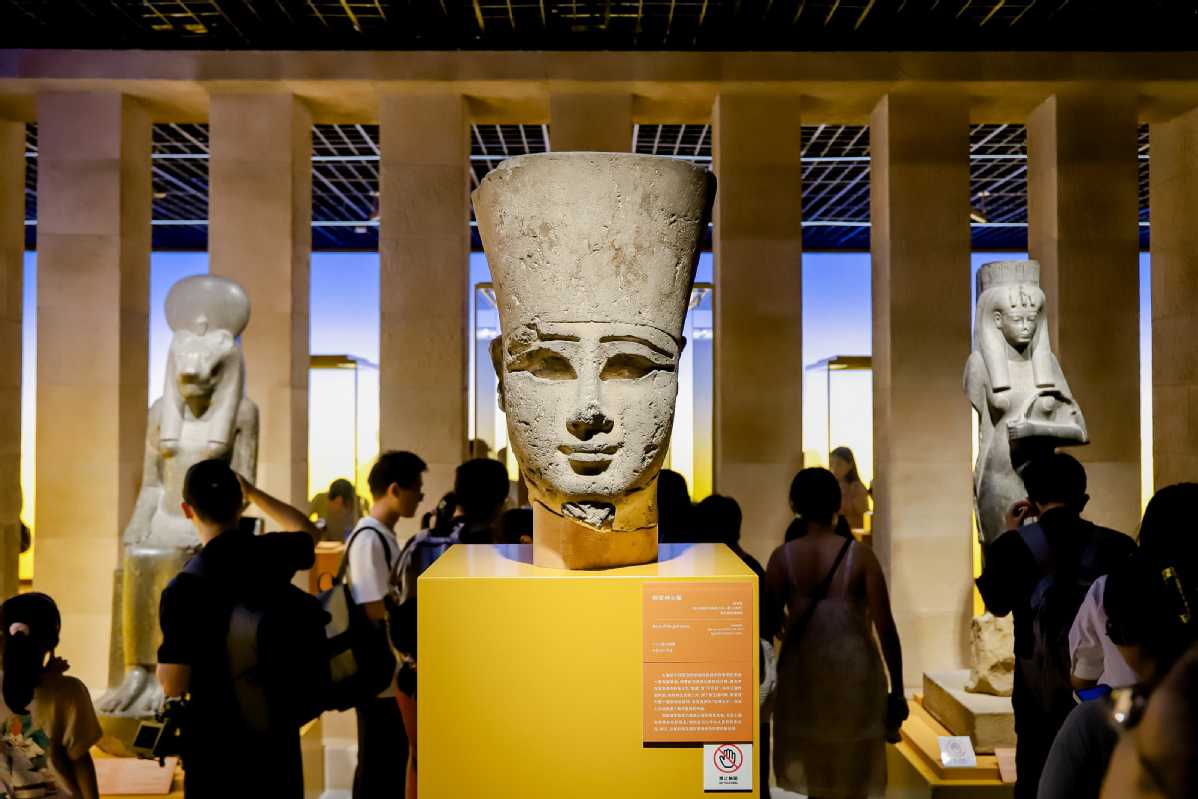
From the summer of 2024 to the summer of 2025, Shanghai Museum staged the landmark exhibition "On Top of the Pyramid: The Civilization of Ancient Egypt". Showcasing 788 rare artifacts, the 13-month event drew an impressive 2.78 million visitors. The exhibition presented over 400 newly unearthed artifacts, underscoring the rich fruits of recent China-Egypt joint archaeological projects.
In recent years, China and Egypt have steadily deepened archaeological cooperation. In 2018, following a protocol between Egypt's Ministry of Tourism and Antiquities and the Chinese Academy of Social Sciences, China's first full archaeological mission in Egypt began excavations at the Montu Temple ruins in Luxor's Karnak Temple Complex.
In parallel, joint efforts are underway to nominate China's Baiheliang Ancient Hydrological Inscription and Egypt's Rawda Island Nilometer as World Cultural Heritage sites of the United Nations Educational, Scientific and Cultural Organization (UNESCO).
Meanwhile, teams have begun digitally documenting thousands of ancient coffins in Saqqara — a sprawling necropolis of ancient Egyptian royalty — contributing to both preservation and scholarship.
Yan Haiying, professor of history at Peking University, said that China and Egypt, both heirs to ancient civilizations, stand as mirrors to one another. Comparative research between these two cultural giants not only deepens mutual understanding, but also enriches each side's sense of identity and historical self-awareness.
"The exhibition of ancient Egyptian civilization has sparked a cultural wave in China. In the past, Egypt-themed shows here were often canned exhibitions curated in the West and staged mainly for profit. This time, however, Shanghai Museum achieved a major breakthrough, taking the lead in curating independently and working hand in hand with Egyptian counterparts. Without the joint archaeology of China and Egypt, these newly unearthed relics could never have come to China," Yan said.
She said ancient China and Egypt, both nourished by great rivers, shared striking commonalities as agrarian civilizations. Each cultivated cosmologies and philosophies rooted in the idea of harmony between heaven and humanity, and in prayers for blessings in the afterlife. Both sought a unified national order and revered the ideal of living in balance with nature.
"Therefore, before the relics of ancient Egypt, Chinese hearts stir with a quiet resonance: two great civilizations, though distant, recognizing one another across the span of time," Yan said.
Xue Jiang, a researcher at the World Art History Institute of Shanghai International Studies University, said that ancient Egyptian and Chinese civilizations share similar characteristics, and these cultural parallels have laid a strong foundation for the two nations to deepen cooperation in preserving their rich heritage.
Xue and his colleagues carried out field research in Egypt on the digitization of newly unearthed artifacts, which led to an agreement with Egyptian partners to launch a series of long-term collaborative projects. The first initiative, which focused on the investigation, cataloging, database creation and joint publication of artifacts discovered in Saqqara, was designated as a pilot, testing new methods and technologies for heritage preservation.
"Following our research, we will publish findings in Arabic, Chinese and English, and establish a trilingual database. Looking ahead, we plan to set up joint laboratories and apply China's most advanced archaeological technologies to help Egypt build a modern archaeological system," he said.
Both experts said strengthened cooperation between China and Egypt in heritage protection will not only deepen cultural exchanges, but also contribute to safeguarding the diversity of world civilizations.
"Every civilization shines with its own brilliance, and all stand equal, and this forms the very foundation of dialogue and exchange. As heirs to these legacies, we bear the responsibility of safeguarding world heritage and preserving the shared treasures of human civilization," Xue said.
Yan said that with each newly unearthed artifact, Egyptian national pride swelled and confidence soared, inspiring renewed efforts to safeguard their cultural treasures and celebrate their rich history.
"Understanding one's past is key to fostering one's cultural confidence. China and Egypt should work together to safeguard their shared historical and cultural heritage, enhance the protection and transmission of cultural relics, and jointly preserve the collective memory of history," she said.
Xue added: "Civilizations are neither superior nor inferior; they are united by the shared aspiration to learn from one another, collaborate and achieve mutual benefit. In reflecting on civilization, we must not only examine its authenticity, but also seek a collective human memory and empathy that transcend time and space."
Jiao Jie, Fan Zihao and Xinhua contributed to this story.










