



Beijing teacher's assignment in Hotan high school a class apart







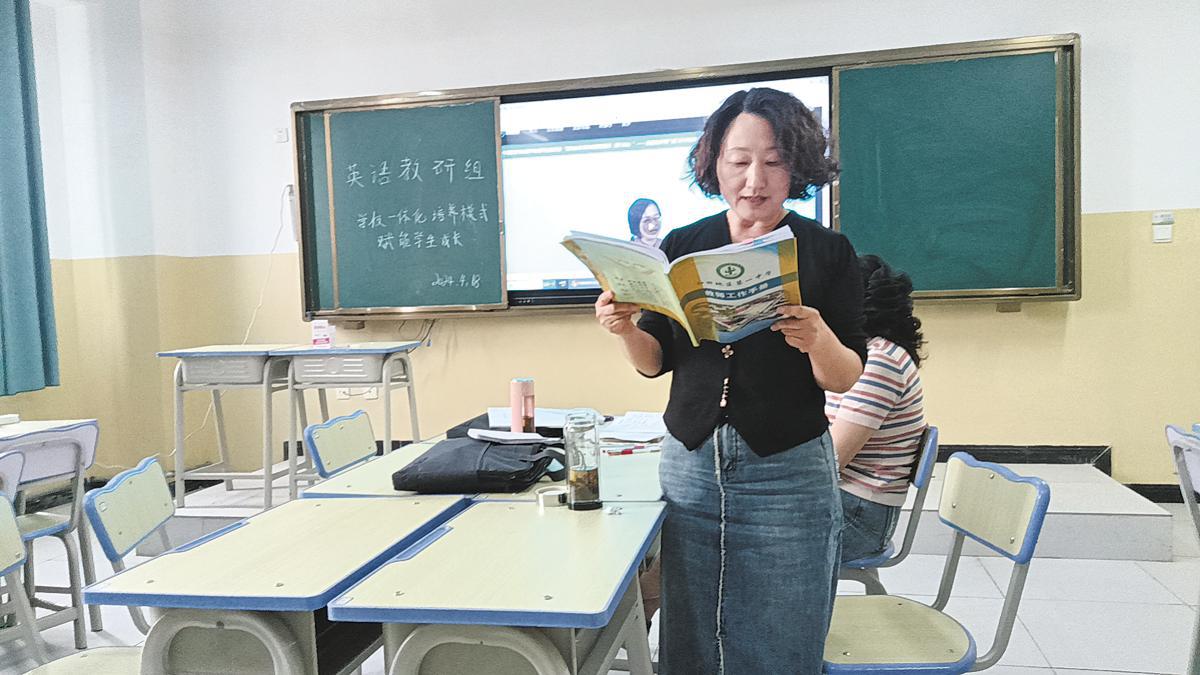
More than a year has passed since English teacher Liu Chunhua returned to her original position at the Beijing Huiwen Middle School after completing a 17-month service in the Xinjiang Uygur autonomous region, and she's still proud of that experience and continues to contribute remotely.
From February 2023 to July 2024, Liu taught English and served as the assistant to the principal at No 1 Middle School in Hotan prefecture of southern Xinjiang, along with several peer teachers from the capital.
Like their predecessors, they endeavored to introduce updated educational philosophies and teaching methods to the school, while facilitating exchanges between students and teachers from Beijing and Hotan.
Having taught in both urban and rural schools in Beijing, Liu has long recognized the importance of experienced teachers, as well as effective concepts and methods, in bridging educational gaps. She has also cultivated a curiosity for education in China's frontier regions and has been reflecting on the possible contributions she can make with her nearly 30 years of experience teaching English at junior and senior high schools. Her stint in Hotan was the realization of such a vision.
There, Liu encountered a teaching environment quite different from her school in Beijing. Her students in Xinjiang are eager to learn but face challenges due to their limited foundation in English. This is largely because they have few opportunities to use the foreign language in daily life and have had limited access to quality English education in the past.
Liu's work in Xinjiang started with a semester teaching a class of twelfth graders who were busy preparing for the national college entrance examination, or gaokao, and urgently needed to improve exam scores.
After identifying their weak points and the causes, she improved classroom efficiency by focusing on key knowledge areas and engaging students in frequent interactions to better address their learning difficulties. She also established study groups to foster cooperation.
During evening self-study sessions, she supervised students as they memorized vocabulary and texts and helped them improve their pronunciation, grammar and reading skills.
In the following two semesters teaching grade 11 students, Liu paid more attention to designing transitional courses to fill gaps in knowledge, besides strengthening the students' overall foundation in English.
She was quick to encourage students who showed progress, sometimes rewarding them with notebooks, stationery and snacks. As a result, her students' average English scores improved significantly, once rising from last place to sixth place among 14 classes in the grade. "I needed to build steps in each lesson for students to learn and progress little by little, ensuring they didn't fear difficulty while also helping them catch up. My approach was a time-consuming process that demanded patience," Liu said.
She added that this experience has enhanced her ability to discern and understand her students' confusion, weak points and needs. This has facilitated her current work back in Beijing that puts more emphasis on stimulating students' interest in learning English, so that they actively engage in studying even without the supervision of teachers and parents.
In Hotan, Liu also helped local teachers improve their teaching skills by offering tips to boost students' engagement in class, clarifying each unit's teaching objectives and step-by-step procedures, apart from providing reference materials that outlined exam priorities, major topics, essential vocabulary and sentence structures — altogether aiming to demonstrate a systematic concept and method for designing their daily classes.
As assistant to the principal, Liu contributed to organizing exchange activities between high schools in Hotan and Beijing, during which teachers from both regions observed each other's lessons, either online or offline, reviewed cases and inspired one another.
Meanwhile, she engaged students of her Hotan and Beijing schools, as well as those from the School Attached to the Central Academy of Art and Design in the capital, in joint online class meetings, where young people introduced their hometowns, local lives and learning environments and discussed topics centered on the country's history and modern development, technological advancement and environmental protection.
Sometimes the Xinjiang students showcased traditional dances in ethnic costumes, while art students from Beijing sketched their peers from the other side of China and invited them to guess the subjects of the portraits.
According to Duo Zhifeng, Party secretary of the No 1 middle school, the joint efforts of local staff and exchange teachers from Beijing in all aspects regarding teaching and school management have yielded significant progress, as evidenced by the students' improved performance in the gaokao.
In 2023, around 62 percent of students were admitted to undergraduate programs. The number rose to nearly 93 percent in 2024 and reached 96 percent this year, with 48.4 percent being enrolled in first-tier universities, Duo said.
He added that a total of 75 teachers from various districts in Beijing have participated in exchange programs at the Hotan school since 2018, bringing new concepts and methods from the capital. They have trained local teachers, aiming to optimize and leave behind practical experience, and supported by the various resources Beijing has invested, contributed to improving the school's facilities and campus culture.
Back home, Liu and three acquaintances started a private initiative in December to support seven underprivileged students at the Hotan school, most of whom have lost their parents. They plan to donate 500 yuan ($70) per month to each student for 10 months a year until they graduate from high school.
Four of these students have graduated, with three now attending first-tier universities. Working with Duo, Liu's team is assessing the need for support among new students.
One particular thing Liu's more than willing to share is a piece of traditional Chinese-style painting featuring the fingerprints of 142 teachers from the same batch from Beijing who supported Hotan's education. She was the major contributor to this idea.
Using traditional ink-wash techniques, Liu created the trunk and branches of a plum blossom. She then traveled across Hotan to collect her colleagues' fingerprints to form the petals and buds, before making final adjustments to complete the image.
The painting was later sent as a gift to the Beijing municipal leading group headquarters in Hotan to support cooperation with Xinjiang.
In Chinese culture, the plum blossom symbolizes strength and resilience, blooming despite the bitter cold. Liu said that only by dedicating themselves to teaching with patience and wholeheartedness can they contribute to places where the motherland needs them most, leaving behind a legacy and promoting long-term educational development in Hotan prefecture.


- Labubu lights up Shanghai lantern show
- Cherry blossom festival in Yongfu town celebrates agricultural innovation and cultural exchange
- China's first domestically built cruise ship welcomes its 1 millionth guest
- The Devil Still Dances: High Vigilance against Japanese Militarism's Infiltration in Sports and Culture Fields
- 189 historical artifacts of Japanese invasion donated to museum in NE China
- Death toll rises to 8 in North China factory explosion












